

60
1 Preliminaries
⎡
⎣
a 1
a 2
a 3
⎤
⎦ =
⎡
⎣
α 11 α 21 α 31
α 12 α 22 α 32
α 13 α 23 α 33
⎤
⎦
⎡
⎣
a
1
a
2
a
3
⎤
⎦
(1.7.10)
1.7.2 The Cartesian Second Order Tensors
The definition of a vector based on the coordinate transformation is extended, the
definition of a tensor can be obtained.
Suppose that a quantity T is a ordered population composed of three components
T j , if they from a rectangular coordinate system Ox 1 x 2 x 3 according to the following
transformation rule
T
i = α i j T j
(1.7.11)
are transformed to three components T
i in another rectangular coordinate system
Ox
1 x
2 x
3 , then the T is called the Cartesian first order tensor, it is called the first
order tensor for short. This shows that a vector is the Cartesian first order tensor. A
first order tensor needs a freedom index to express.
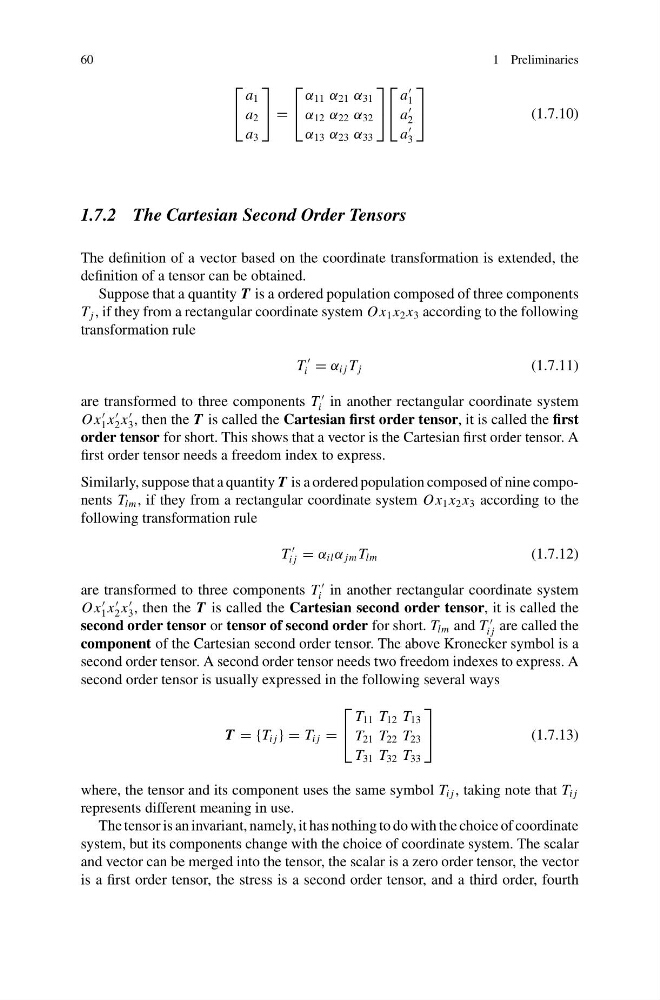
Similarly, suppose that a quantity T is a ordered population composed of nine components T lm , if they from a rectangular coordinate system Ox 1 x 2 x 3 according to the
following transformation rule
T
i j = α il α jm T lm
(1.7.12)
are transformed to three components T
i in another rectangular coordinate system
Ox
1 x
2 x
3 , then the T is called the Cartesian second order tensor, it is called the
second order tensor or tensor of second order for short. T lm and T
i j are called the
component of the Cartesian second order tensor. The above Kronecker symbol is a
second order tensor. A second order tensor needs two freedom indexes to express. A
second order tensor is usually expressed in the following several ways
T = {T i j } = T i j =
⎡
⎣
T 11 T 12 T 13
T 21 T 22 T 23
T 31 T 32 T 33
⎤
⎦
(1.7.13)
where, the tensor and its component uses the same symbol T i j , taking note that T i j
represents different meaning in use.
The tensor is an invariant, namely, it has nothing to do with the choice of coordinate
system, but its components change with the choice of coordinate system. The scalar
and vector can be merged into the tensor, the scalar is a zero order tensor, the vector
is a first order tensor, the stress is a second order tensor, and a third order, fourth
1 Preliminaries
⎡
⎣
a 1
a 2
a 3
⎤
⎦ =
⎡
⎣
α 11 α 21 α 31
α 12 α 22 α 32
α 13 α 23 α 33
⎤
⎦
⎡
⎣
a
1
a
2
a
3
⎤
⎦
(1.7.10)
1.7.2 The Cartesian Second Order Tensors
The definition of a vector based on the coordinate transformation is extended, the
definition of a tensor can be obtained.
Suppose that a quantity T is a ordered population composed of three components
T j , if they from a rectangular coordinate system Ox 1 x 2 x 3 according to the following
transformation rule
T
i = α i j T j
(1.7.11)
are transformed to three components T
i in another rectangular coordinate system
Ox
1 x
2 x
3 , then the T is called the Cartesian first order tensor, it is called the first
order tensor for short. This shows that a vector is the Cartesian first order tensor. A
first order tensor needs a freedom index to express.
Similarly, suppose that a quantity T is a ordered population composed of nine components T lm , if they from a rectangular coordinate system Ox 1 x 2 x 3 according to the
following transformation rule
T
i j = α il α jm T lm
(1.7.12)
are transformed to three components T
i in another rectangular coordinate system
Ox
1 x
2 x
3 , then the T is called the Cartesian second order tensor, it is called the
second order tensor or tensor of second order for short. T lm and T
i j are called the
component of the Cartesian second order tensor. The above Kronecker symbol is a
second order tensor. A second order tensor needs two freedom indexes to express. A
second order tensor is usually expressed in the following several ways
T = {T i j } = T i j =
⎡
⎣
T 11 T 12 T 13
T 21 T 22 T 23
T 31 T 32 T 33
⎤
⎦
(1.7.13)
where, the tensor and its component uses the same symbol T i j , taking note that T i j
represents different meaning in use.
The tensor is an invariant, namely, it has nothing to do with the choice of coordinate
system, but its components change with the choice of coordinate system. The scalar
and vector can be merged into the tensor, the scalar is a zero order tensor, the vector
is a first order tensor, the stress is a second order tensor, and a third order, fourth