

1.7 Basic Conceptions of Tensors
61
order or higher order tensor. For a three-dimensional space, the nth order tensor has
the 3
n components. In general, for a m-dimensional space, the nth order tensor has
the m
n components. It is thus clear that the tensor is the more general description of
invariant.
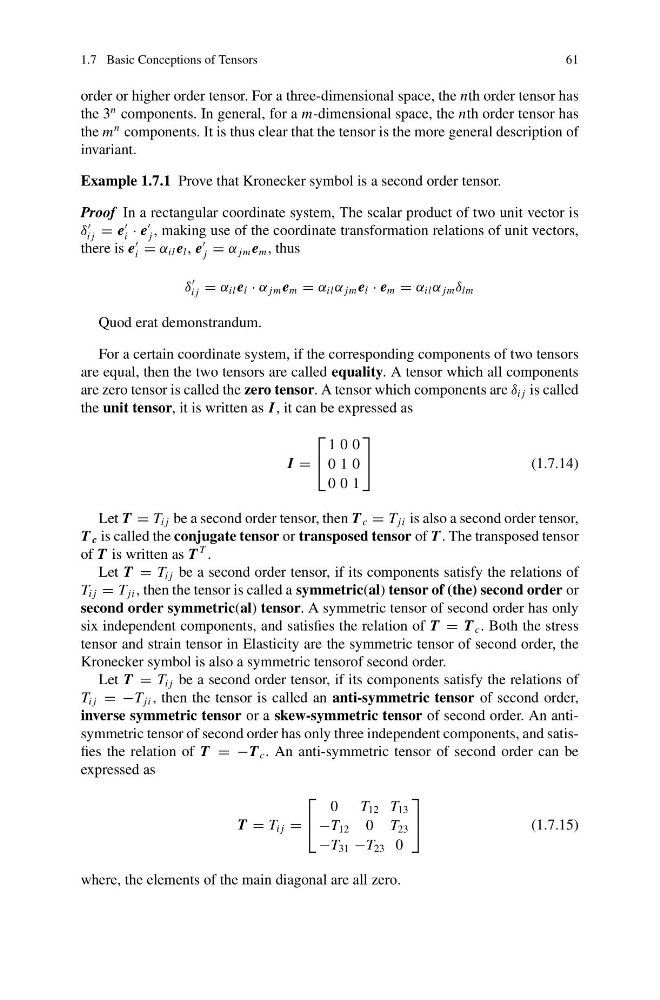
Example 1.7.1 Prove that Kronecker symbol is a second order tensor.
Proof In a rectangular coordinate system, The scalar product of two unit vector is
δ
i j = e
i · e
j , making use of the coordinate transformation relations of unit vectors,
there is e
i = α il e l , e
j = α jm e m , thus
δ
i j = α il e l · α jm e m = α il α jm e l · e m = α il α jm δ lm
Quod erat demonstrandum.
For a certain coordinate system, if the corresponding components of two tensors
are equal, then the two tensors are called equality. A tensor which all components
are zero tensor is called the zero tensor. A tensor which components are δ i j is called
the unit tensor, it is written as I, it can be expressed as
I =
⎡
⎣
1 0 0
0 1 0
0 0 1
⎤
⎦
(1.7.14)
Let T = T i j be a second order tensor, then T c = T ji is also a second order tensor,
T c is called the conjugate tensor or transposed tensor of T . The transposed tensor
of T is written as T
T .
Let T = T i j be a second order tensor, if its components satisfy the relations of
T i j = T ji , then the tensor is called a symmetric(al) tensor of (the) second order or
second order symmetric(al) tensor. A symmetric tensor of second order has only
six independent components, and satisfies the relation of T = T c . Both the stress
tensor and strain tensor in Elasticity are the symmetric tensor of second order, the
Kronecker symbol is also a symmetric tensorof second order.
Let T = T i j be a second order tensor, if its components satisfy the relations of
T i j = −T ji , then the tensor is called an anti-symmetric tensor of second order,
inverse symmetric tensor or a skew-symmetric tensor of second order. An antisymmetric tensor of second order has only three independent components, and satisfies the relation of T = −T c . An anti-symmetric tensor of second order can be
expressed as
T = T i j =
⎡
⎣
0
T 12 T 13
−T 12 0 T 23
−T 31 −T 23 0
⎤
⎦
(1.7.15)
where, the elements of the main diagonal are all zero.
61
order or higher order tensor. For a three-dimensional space, the nth order tensor has
the 3
n components. In general, for a m-dimensional space, the nth order tensor has
the m
n components. It is thus clear that the tensor is the more general description of
invariant.
Example 1.7.1 Prove that Kronecker symbol is a second order tensor.
Proof In a rectangular coordinate system, The scalar product of two unit vector is
δ
i j = e
i · e
j , making use of the coordinate transformation relations of unit vectors,
there is e
i = α il e l , e
j = α jm e m , thus
δ
i j = α il e l · α jm e m = α il α jm e l · e m = α il α jm δ lm
Quod erat demonstrandum.
For a certain coordinate system, if the corresponding components of two tensors
are equal, then the two tensors are called equality. A tensor which all components
are zero tensor is called the zero tensor. A tensor which components are δ i j is called
the unit tensor, it is written as I, it can be expressed as
I =
⎡
⎣
1 0 0
0 1 0
0 0 1
⎤
⎦
(1.7.14)
Let T = T i j be a second order tensor, then T c = T ji is also a second order tensor,
T c is called the conjugate tensor or transposed tensor of T . The transposed tensor
of T is written as T
T .
Let T = T i j be a second order tensor, if its components satisfy the relations of
T i j = T ji , then the tensor is called a symmetric(al) tensor of (the) second order or
second order symmetric(al) tensor. A symmetric tensor of second order has only
six independent components, and satisfies the relation of T = T c . Both the stress
tensor and strain tensor in Elasticity are the symmetric tensor of second order, the
Kronecker symbol is also a symmetric tensorof second order.
Let T = T i j be a second order tensor, if its components satisfy the relations of
T i j = −T ji , then the tensor is called an anti-symmetric tensor of second order,
inverse symmetric tensor or a skew-symmetric tensor of second order. An antisymmetric tensor of second order has only three independent components, and satisfies the relation of T = −T c . An anti-symmetric tensor of second order can be
expressed as
T = T i j =
⎡
⎣
0
T 12 T 13
−T 12 0 T 23
−T 31 −T 23 0
⎤
⎦
(1.7.15)
where, the elements of the main diagonal are all zero.