

10.6 Variational Problems of Functionals with Parallel-Type Inner …
689
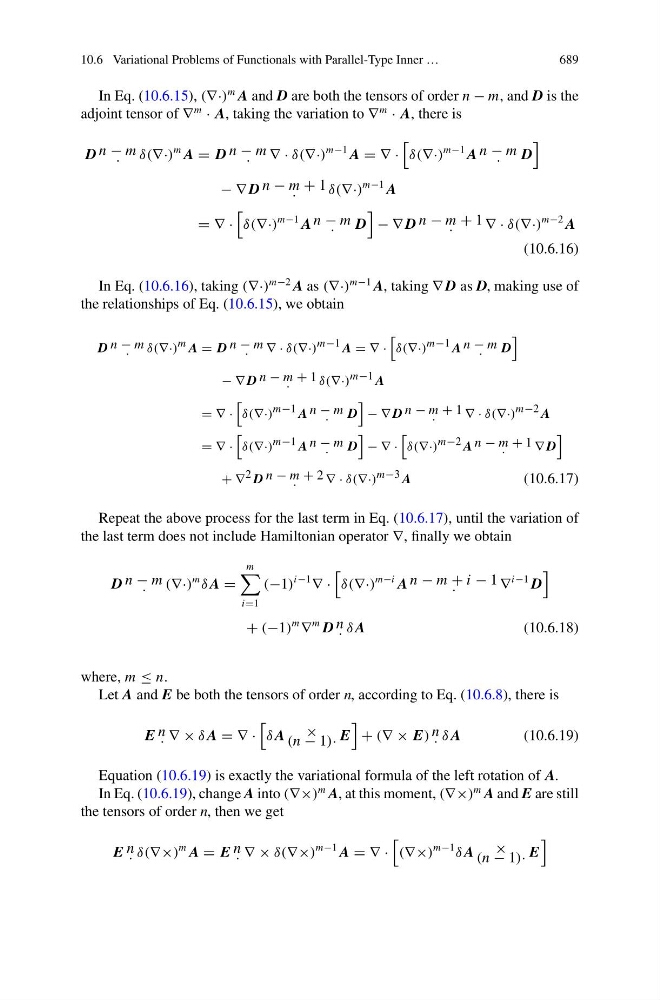
In Eq. (10.6.15), (∇·)
m A and D are both the tensors of order n − m, and D is the
adjoint tensor of ∇
m
· A, taking the variation to ∇
m
· A, there is
D n − m
· δ(∇·)
m A = D n − m
· ∇ · δ(∇·)
m−1 A = ∇ ·
δ(∇·)
m−1 A n − m
· D
− ∇ D n − m + 1
·
δ(∇·)
m−1 A
= ∇ ·
δ(∇·)
m−1 A n − m
· D
− ∇ D n − m + 1
·
∇ · δ(∇·)
m−2 A
(10.6.16)
In Eq. (10.6.16), taking (∇·)
m−2 A as (∇·)
m−1 A, taking ∇ D as D, making use of
the relationships of Eq. (10.6.15), we obtain
D n − m
· δ(∇·) m A = D n − m
· ∇ · δ(∇·) m−1 A = ∇ ·
δ(∇·) m−1 A n − m
· D
− ∇ D n − m + 1
·
δ(∇·) m−1 A
= ∇ ·
δ(∇·) m−1 A n − m
· D
− ∇ D n − m + 1
·
∇ · δ(∇·) m−2 A
= ∇ ·
δ(∇·) m−1 A n − m
· D
− ∇ ·
δ(∇·) m−2 A n − m + 1
·
∇ D
+ ∇ 2 D n − m + 2
·
∇ · δ(∇·) m−3 A
(10.6.17)
Repeat the above process for the last term in Eq. (10.6.17), until the variation of
the last term does not include Hamiltonian operator ∇, finally we obtain
D n − m
· (∇·)
m
δ A =
m
i=1
(−1)
i−1
∇ ·
δ(∇·)
m−i A n − m + i − 1
·
∇
i−1 D
+ (−1)
m
∇
m D n
· δ A
(10.6.18)
where, m ≤ n.
Let A and E be both the tensors of order n, according to Eq. (10.6.8), there is
E n
· ∇ × δ A = ∇ ·
δ A ×
(n − 1)· E
+ (∇ × E) n
· δ A
(10.6.19)
Equation (10.6.19) is exactly the variational formula of the left rotation of A.
In Eq. (10.6.19), change A into (∇×)
m A, at this moment, (∇×)
m A and E are still
the tensors of order n, then we get
E n
· δ(∇×)
m A = E n
· ∇ × δ(∇×)
m−1 A = ∇ ·
(∇×)
m−1
δ A ×
(n − 1)· E