

690
10 Variational Problems of Functionals with Vector, Tensor …
+ (∇ × E) n
· ∇ × δ(∇×)
m−1 A
(10.6.20)
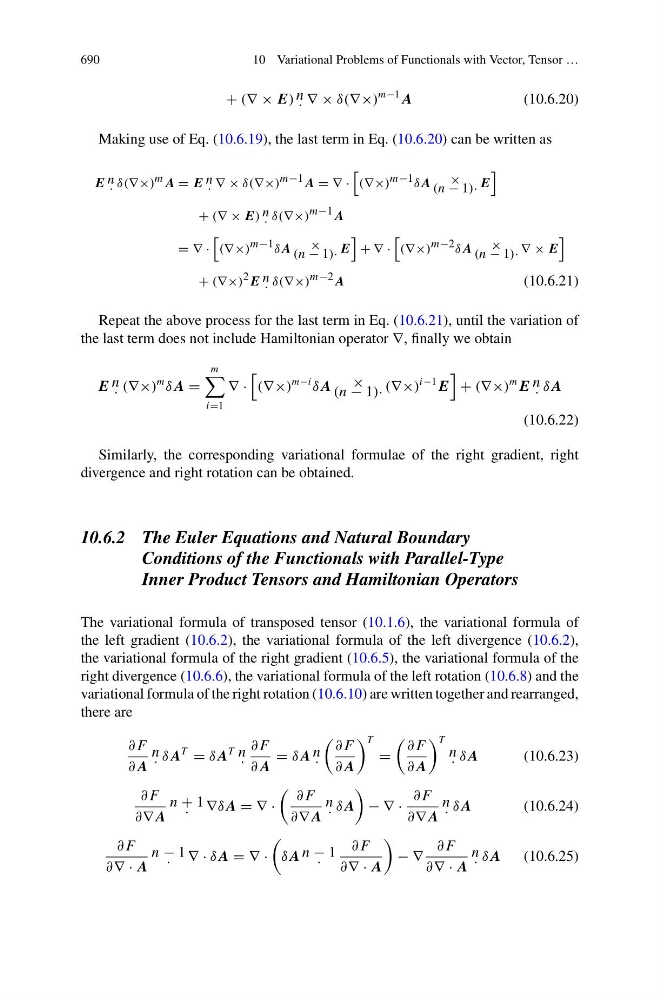
Making use of Eq. (10.6.19), the last term in Eq. (10.6.20) can be written as
E n
· δ(∇×) m A = E n
· ∇ × δ(∇×) m−1 A = ∇ ·
(∇×) m−1 δ A ×
(n − 1)· E
+ (∇ × E) n
· δ(∇×) m−1 A
= ∇ ·
(∇×) m−1 δ A ×
(n − 1)· E
+ ∇ ·
(∇×) m−2 δ A ×
(n − 1)· ∇ × E
+ (∇×) 2 E n
· δ(∇×) m−2 A
(10.6.21)
Repeat the above process for the last term in Eq. (10.6.21), until the variation of
the last term does not include Hamiltonian operator ∇, finally we obtain
E n
· (∇×)
m
δ A =
m
i=1
∇ ·
(∇×)
m−i
δ A ×
(n − 1)· (∇×)
i−1 E
+ (∇×)
m E n
· δ A
(10.6.22)
Similarly, the corresponding variational formulae of the right gradient, right
divergence and right rotation can be obtained.
10.6.2 The Euler Equations and Natural Boundary
Conditions of the Functionals with Parallel-Type
Inner Product Tensors and Hamiltonian Operators
The variational formula of transposed tensor (10.1.6), the variational formula of
the left gradient (10.6.2), the variational formula of the left divergence (10.6.2),
the variational formula of the right gradient (10.6.5), the variational formula of the
right divergence (10.6.6), the variational formula of the left rotation (10.6.8) and the
variational formula of the right rotation (10.6.10) are written together and rearranged,
there are
∂ F
∂ A
n
· δ A
T
= δ A
T n
·
∂ F
∂ A
= δ A n
·
∂ F
∂ A
T
=
∂ F
∂ A
T
n
· δ A
(10.6.23)
∂ F
∂∇ A
n + 1
· ∇δ A = ∇ ·
∂ F
∂∇ A
n
· δ A
− ∇ ·
∂ F
∂∇ A
n
· δ A
(10.6.24)
∂ F
∂∇ · A
n − 1
· ∇ · δ A = ∇ ·
δ A n − 1
·
∂ F
∂∇ · A
− ∇
∂ F
∂∇ · A
n
· δ A
(10.6.25)