

616
10 Variational Problems of Functionals with Vector, Tensor …
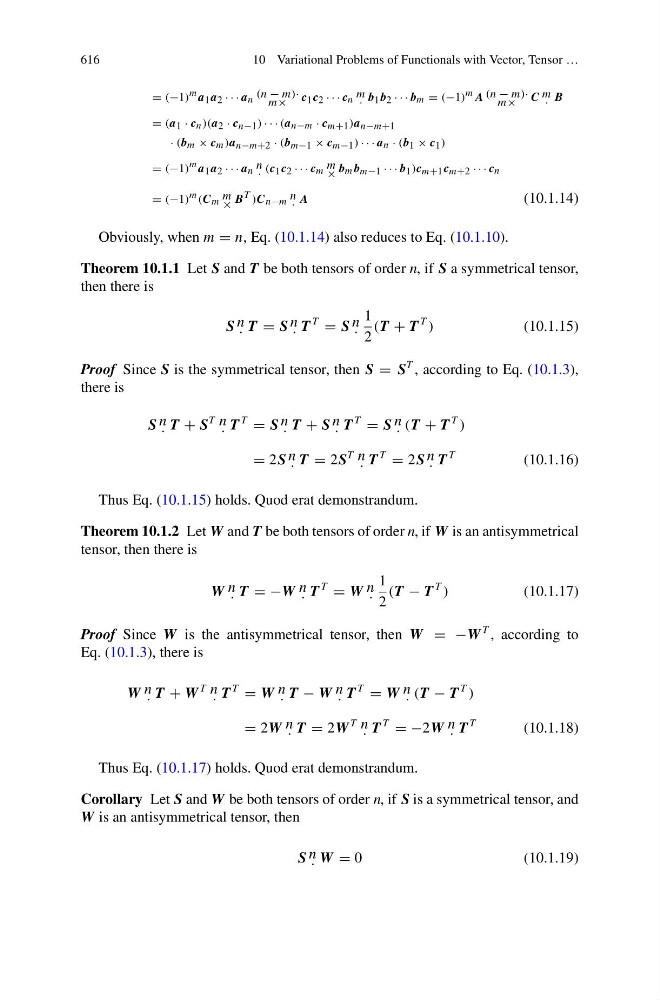
= (−1) m a 1 a 2 · · · a n (n − m)·
m× c 1 c 2 · · · c n m
· b 1 b 2 · · · b m = (−1) m A (n − m)·
m× C m
· B
= (a 1 · c n )(a 2 · c n−1 ) · · · (a n−m · c m+1 )a n−m+1
· (b m × c m )a n−m+2 · (b m−1 × c m−1 ) · · · a n · (b 1 × c 1 )
= (−1) m a 1 a 2 · · · a n n
· (c 1 c 2 · · · c m m
× b m b m−1 · · · b 1 )c m+1 c m+2 · · · c n
= (−1) m (C m m
× B T )C n−m n
· A
(10.1.14)
Obviously, when m = n, Eq. (10.1.14) also reduces to Eq. (10.1.10).
Theorem 10.1.1 Let S and T be both tensors of order n, if S a symmetrical tensor,
then there is
S n
· T = S n
· T
T
= S n
·
1
2
(T + T
T
)
(10.1.15)
Proof Since S is the symmetrical tensor, then S = S
T , according to Eq. (10.1.3),
there is
S n
· T + S
T n
· T
T
= S n
· T + S n
· T
T
= S n
· (T + T
T
)
= 2S n
· T = 2S
T n
· T
T
= 2S n
· T
T
(10.1.16)
Thus Eq. (10.1.15) holds. Quod erat demonstrandum.
Theorem 10.1.2 Let W and T be both tensors of order n, if W is an antisymmetrical
tensor, then there is
W n
· T = −W n
· T
T
= W n
·
1
2
(T − T
T
)
(10.1.17)
Proof Since W is the antisymmetrical tensor, then W = −W
T , according to
Eq. (10.1.3), there is
W n
· T + W
T n
· T
T
= W n
· T − W n
· T
T
= W n
· (T − T
T
)
= 2W n
· T = 2W
T n
· T
T
= −2W n
· T
T
(10.1.18)
Thus Eq. (10.1.17) holds. Quod erat demonstrandum.
Corollary Let S and W be both tensors of order n, if S is a symmetrical tensor, and
W is an antisymmetrical tensor, then
S n
· W = 0
(10.1.19)