

1.5 Fundamental Lemmas of the Calculus of Variations
45
Lemma 1.5.1 Let a function f (x) be continuous in the interval [a, b], an arbitrary
function η(x) has nth order continuous derivative in the interval [a, b], and for a
positive number m(m = 0, 1, . . . , n), when it satisfies the following conditions
η
(k)
(a) = η
(k)
(b) = 0 (k = 0, 1, . . . , m)
if the integral
b
a
f (x)η(x)dx = 0
(1.5.1)
can always hold, there must be in the interval [a, b]
f (x) ≡ 0
(1.5.2)
Proof With the reduction to absurdity. If f (x) does not identically vanish in the
interval [a, b], then it can be seen from the continuity of f (x) that there is at least
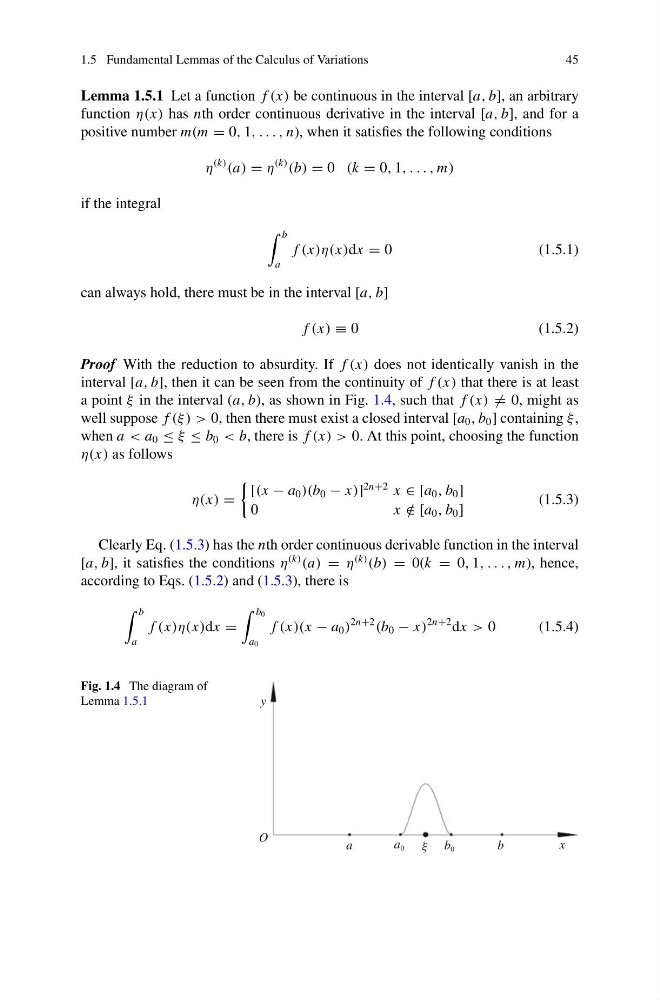
a point ξ in the interval (a, b), as shown in Fig. 1.4, such that f (x) = 0, might as
well suppose f (ξ ) > 0, then there must exist a closed interval [a 0 , b 0 ] containing ξ ,
when a < a 0 ≤ ξ ≤ b 0 < b, there is f (x) > 0. At this point, choosing the function
η(x) as follows
η(x) =
[(x − a 0 )(b 0 − x)]
2n+2 x ∈ [a 0 , b 0 ]
0
x /
∈ [a 0 , b 0 ]
(1.5.3)
Clearly Eq. (1.5.3) has the nth order continuous derivable function in the interval
[a, b], it satisfies the conditions η
(k)
(a) = η
(k)
(b) = 0(k = 0, 1, . . . , m), hence,
according to Eqs. (1.5.2) and (1.5.3), there is
b
a
f (x)η(x)dx =
b 0
a 0
f (x)(x − a 0 )
2n+2
(b 0 − x)
2n+2 dx > 0
(1.5.4)
Fig. 1.4 The diagram of
Lemma 1.5.1
O
x
y
a
a 0
b
b 0
ξ
45
Lemma 1.5.1 Let a function f (x) be continuous in the interval [a, b], an arbitrary
function η(x) has nth order continuous derivative in the interval [a, b], and for a
positive number m(m = 0, 1, . . . , n), when it satisfies the following conditions
η
(k)
(a) = η
(k)
(b) = 0 (k = 0, 1, . . . , m)
if the integral
b
a
f (x)η(x)dx = 0
(1.5.1)
can always hold, there must be in the interval [a, b]
f (x) ≡ 0
(1.5.2)
Proof With the reduction to absurdity. If f (x) does not identically vanish in the
interval [a, b], then it can be seen from the continuity of f (x) that there is at least
a point ξ in the interval (a, b), as shown in Fig. 1.4, such that f (x) = 0, might as
well suppose f (ξ ) > 0, then there must exist a closed interval [a 0 , b 0 ] containing ξ ,
when a < a 0 ≤ ξ ≤ b 0 < b, there is f (x) > 0. At this point, choosing the function
η(x) as follows
η(x) =
[(x − a 0 )(b 0 − x)]
2n+2 x ∈ [a 0 , b 0 ]
0
x /
∈ [a 0 , b 0 ]
(1.5.3)
Clearly Eq. (1.5.3) has the nth order continuous derivable function in the interval
[a, b], it satisfies the conditions η
(k)
(a) = η
(k)
(b) = 0(k = 0, 1, . . . , m), hence,
according to Eqs. (1.5.2) and (1.5.3), there is
b
a
f (x)η(x)dx =
b 0
a 0
f (x)(x − a 0 )
2n+2
(b 0 − x)
2n+2 dx > 0
(1.5.4)
Fig. 1.4 The diagram of
Lemma 1.5.1
O
x
y
a
a 0
b
b 0
ξ