

44
1 Preliminaries
U = At + Bte
2t
+ Ce
2t
+ D
(1.4.26)
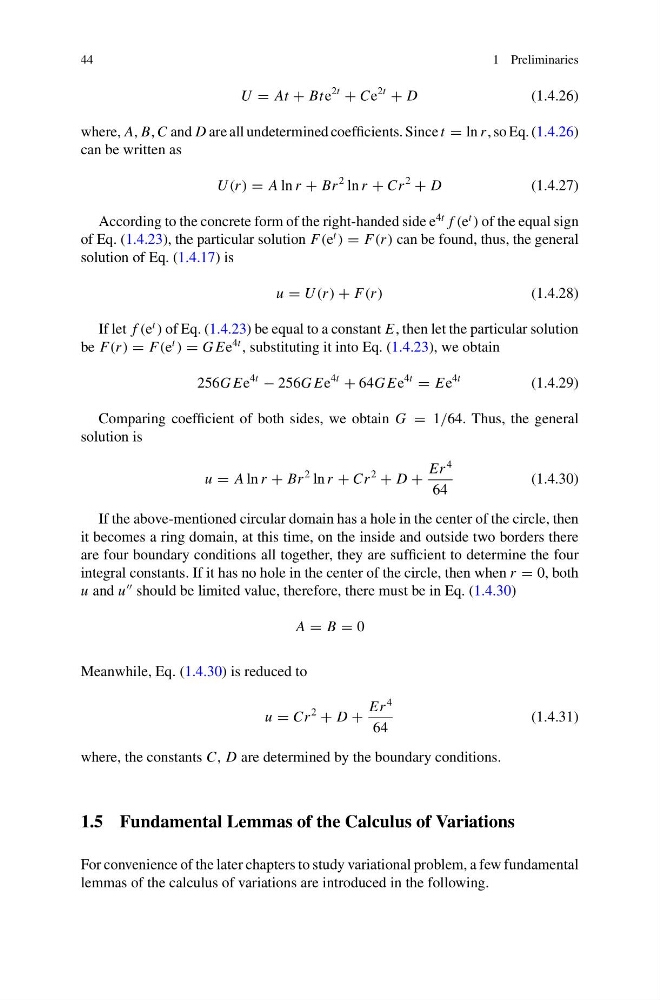
where, A, B, C and D are all undetermined coefficients. Since t = ln r , so Eq. (1.4.26)
can be written as
U (r ) = A ln r + Br
2 ln r + Cr
2
+ D
(1.4.27)
According to the concrete form of the right-handed side e
4t f (e
t
) of the equal sign
of Eq. (1.4.23), the particular solution F(e
t
) = F(r ) can be found, thus, the general
solution of Eq. (1.4.17) is
u = U (r ) + F(r )
(1.4.28)
If let f (e
t
) of Eq. (1.4.23) be equal to a constant E, then let the particular solution
be F(r ) = F(e
t
) = G Ee
4t , substituting it into Eq. (1.4.23), we obtain
256G Ee
4t
− 256G Ee
4t
+ 64G Ee
4t
= Ee
4t
(1.4.29)
Comparing coefficient of both sides, we obtain G = 1/64. Thus, the general
solution is
u = A ln r + Br
2 ln r + Cr
2
+ D +
Er
4
64
(1.4.30)
If the above-mentioned circular domain has a hole in the center of the circle, then
it becomes a ring domain, at this time, on the inside and outside two borders there
are four boundary conditions all together, they are sufficient to determine the four
integral constants. If it has no hole in the center of the circle, then when r = 0, both
u and u
should be limited value, therefore, there must be in Eq. (1.4.30)
A = B = 0
Meanwhile, Eq. (1.4.30) is reduced to
u = Cr
2
+ D +
Er
4
64
(1.4.31)
where, the constants C, D are determined by the boundary conditions.
1.5 Fundamental Lemmas of the Calculus of Variations
For convenience of the later chapters to study variational problem, a few fundamental
lemmas of the calculus of variations are introduced in the following.
1 Preliminaries
U = At + Bte
2t
+ Ce
2t
+ D
(1.4.26)
where, A, B, C and D are all undetermined coefficients. Since t = ln r , so Eq. (1.4.26)
can be written as
U (r ) = A ln r + Br
2 ln r + Cr
2
+ D
(1.4.27)
According to the concrete form of the right-handed side e
4t f (e
t
) of the equal sign
of Eq. (1.4.23), the particular solution F(e
t
) = F(r ) can be found, thus, the general
solution of Eq. (1.4.17) is
u = U (r ) + F(r )
(1.4.28)
If let f (e
t
) of Eq. (1.4.23) be equal to a constant E, then let the particular solution
be F(r ) = F(e
t
) = G Ee
4t , substituting it into Eq. (1.4.23), we obtain
256G Ee
4t
− 256G Ee
4t
+ 64G Ee
4t
= Ee
4t
(1.4.29)
Comparing coefficient of both sides, we obtain G = 1/64. Thus, the general
solution is
u = A ln r + Br
2 ln r + Cr
2
+ D +
Er
4
64
(1.4.30)
If the above-mentioned circular domain has a hole in the center of the circle, then
it becomes a ring domain, at this time, on the inside and outside two borders there
are four boundary conditions all together, they are sufficient to determine the four
integral constants. If it has no hole in the center of the circle, then when r = 0, both
u and u
should be limited value, therefore, there must be in Eq. (1.4.30)
A = B = 0
Meanwhile, Eq. (1.4.30) is reduced to
u = Cr
2
+ D +
Er
4
64
(1.4.31)
where, the constants C, D are determined by the boundary conditions.
1.5 Fundamental Lemmas of the Calculus of Variations
For convenience of the later chapters to study variational problem, a few fundamental
lemmas of the calculus of variations are introduced in the following.