

46
1 Preliminaries
This contradicts Eq. (1.5.1), so f (x) > 0 is impossible. Similarly, it can be proved
that f (x) < 0 is also impossible. Moreover since f (x) is continuous in the interval
[a, b], so there is f (a) = f (b) = 0. To sum up, there must be
f (x) ≡ 0 x ∈ [a, b]
Quod erat demonstrandum.
In the above proof, the function η(x) takes the form of Eq. (1.5.3), but the choice
method of the function η(x) is not unique, for instance, it can take η(x) = Aϕ(x),
there A is a selected appropriate constant, moreover the expression of the function
ϕ(x) is as follows
ϕ(x) =
e
1
(x−x 0 ) 2 −δ 2 x ∈ (x 0 − δ, x 0 + δ)
0
x /
∈ (x 0 − δ, x 0 + δ)
(1.5.5)
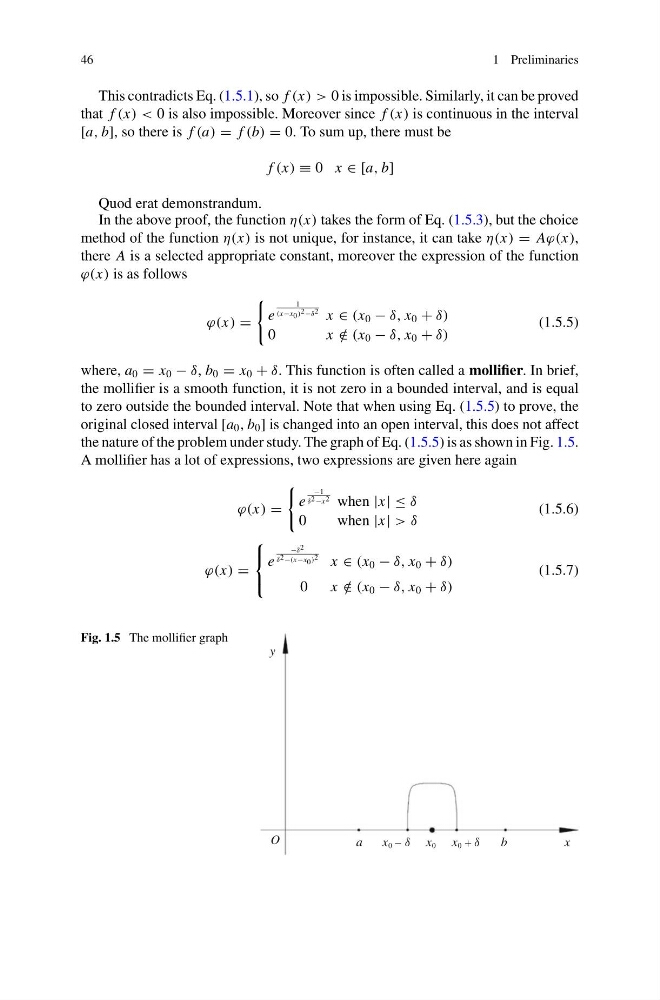
where, a 0 = x 0 − δ, b 0 = x 0 + δ. This function is often called a mollifier. In brief,
the mollifier is a smooth function, it is not zero in a bounded interval, and is equal
to zero outside the bounded interval. Note that when using Eq. (1.5.5) to prove, the
original closed interval [a 0 , b 0 ] is changed into an open interval, this does not affect
the nature of the problem under study. The graph of Eq. (1.5.5) is as shown in Fig. 1.5.
A mollifier has a lot of expressions, two expressions are given here again
ϕ(x) =
e
−1
δ 2 −x 2 when |x| ≤ δ
0
when |x| > δ
(1.5.6)
ϕ(x) =
⎧
⎨
⎩
e
−δ 2
δ 2 −(x−x 0 ) 2
x ∈ (x 0 − δ, x 0 + δ)
0
x /
∈ (x 0 − δ, x 0 + δ)
(1.5.7)
Fig. 1.5 The mollifier graph
O
x
y
a
b
x 0
x 0 − δ
x 0 + δ
1 Preliminaries
This contradicts Eq. (1.5.1), so f (x) > 0 is impossible. Similarly, it can be proved
that f (x) < 0 is also impossible. Moreover since f (x) is continuous in the interval
[a, b], so there is f (a) = f (b) = 0. To sum up, there must be
f (x) ≡ 0 x ∈ [a, b]
Quod erat demonstrandum.
In the above proof, the function η(x) takes the form of Eq. (1.5.3), but the choice
method of the function η(x) is not unique, for instance, it can take η(x) = Aϕ(x),
there A is a selected appropriate constant, moreover the expression of the function
ϕ(x) is as follows
ϕ(x) =
e
1
(x−x 0 ) 2 −δ 2 x ∈ (x 0 − δ, x 0 + δ)
0
x /
∈ (x 0 − δ, x 0 + δ)
(1.5.5)
where, a 0 = x 0 − δ, b 0 = x 0 + δ. This function is often called a mollifier. In brief,
the mollifier is a smooth function, it is not zero in a bounded interval, and is equal
to zero outside the bounded interval. Note that when using Eq. (1.5.5) to prove, the
original closed interval [a 0 , b 0 ] is changed into an open interval, this does not affect
the nature of the problem under study. The graph of Eq. (1.5.5) is as shown in Fig. 1.5.
A mollifier has a lot of expressions, two expressions are given here again
ϕ(x) =
e
−1
δ 2 −x 2 when |x| ≤ δ
0
when |x| > δ
(1.5.6)
ϕ(x) =
⎧
⎨
⎩
e
−δ 2
δ 2 −(x−x 0 ) 2
x ∈ (x 0 − δ, x 0 + δ)
0
x /
∈ (x 0 − δ, x 0 + δ)
(1.5.7)
Fig. 1.5 The mollifier graph
O
x
y
a
b
x 0
x 0 − δ
x 0 + δ