

596
9 Variational Principles in Mechanics and Their Applications
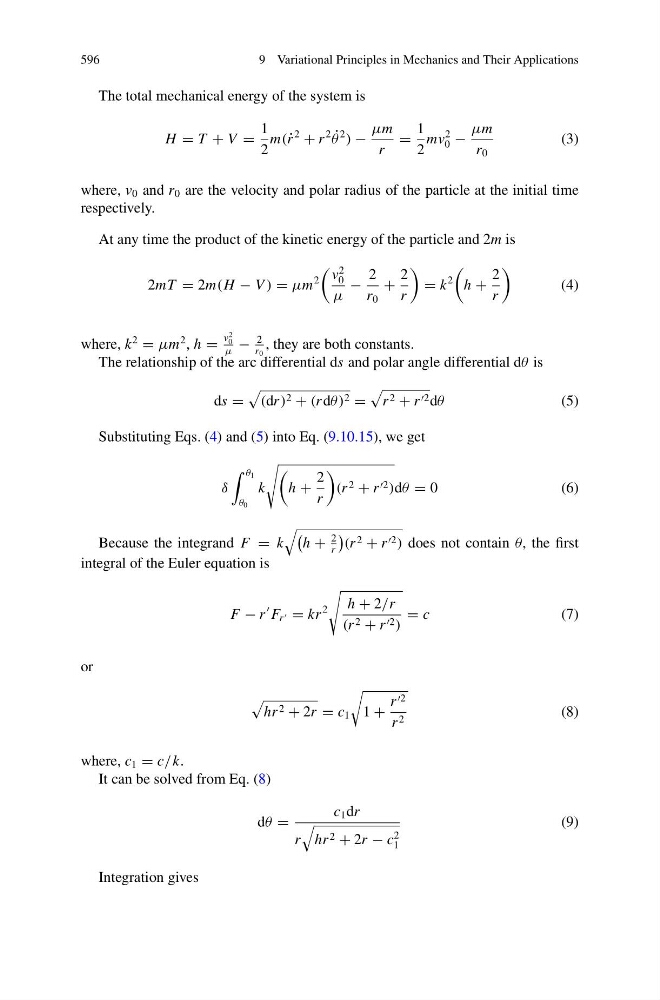
The total mechanical energy of the system is
H = T + V =
1
2
m(˙ r
2
+ r
2 ˙
θ
2
) −
μm
r
=
1
2
mv
2
0 −
μm
r 0
(3)
where, v 0 and r 0 are the velocity and polar radius of the particle at the initial time
respectively.
At any time the product of the kinetic energy of the particle and 2m is
2mT = 2m(H − V ) = μm
2
v
2
0
μ
−
2
r 0
+
2
r
= k
2
h +
2
r
(4)
where, k
2
= μm
2 , h =
v
2
0
μ
−
2
r 0
, they are both constants.
The relationship of the arc differential ds and polar angle differential dθ is
ds =
(dr ) 2 + (r dθ) 2 =
r 2 + r 2 dθ
(5)
Substituting Eqs. (4) and (5) into Eq. (9.10.15), we get
δ
θ 1
θ 0
k
h +
2
r
(r 2 + r 2 )dθ = 0
( 6 )
Because the integrand F = k
h +
2
r
(r 2 + r 2 ) does not contain θ, the first
integral of the Euler equation is
F − r
F r = kr
2
h + 2/r
(r 2 + r 2 )
= c
(7)
or
hr 2 + 2r = c 1
1 +
r 2
r 2
(8)
where, c 1 = c/k.
It can be solved from Eq. (8)
dθ =
c 1 dr
r
hr 2 + 2r − c
2
1
(9)
Integration gives
9 Variational Principles in Mechanics and Their Applications
The total mechanical energy of the system is
H = T + V =
1
2
m(˙ r
2
+ r
2 ˙
θ
2
) −
μm
r
=
1
2
mv
2
0 −
μm
r 0
(3)
where, v 0 and r 0 are the velocity and polar radius of the particle at the initial time
respectively.
At any time the product of the kinetic energy of the particle and 2m is
2mT = 2m(H − V ) = μm
2
v
2
0
μ
−
2
r 0
+
2
r
= k
2
h +
2
r
(4)
where, k
2
= μm
2 , h =
v
2
0
μ
−
2
r 0
, they are both constants.
The relationship of the arc differential ds and polar angle differential dθ is
ds =
(dr ) 2 + (r dθ) 2 =
r 2 + r 2 dθ
(5)
Substituting Eqs. (4) and (5) into Eq. (9.10.15), we get
δ
θ 1
θ 0
k
h +
2
r
(r 2 + r 2 )dθ = 0
( 6 )
Because the integrand F = k
h +
2
r
(r 2 + r 2 ) does not contain θ, the first
integral of the Euler equation is
F − r
F r = kr
2
h + 2/r
(r 2 + r 2 )
= c
(7)
or
hr 2 + 2r = c 1
1 +
r 2
r 2
(8)
where, c 1 = c/k.
It can be solved from Eq. (8)
dθ =
c 1 dr
r
hr 2 + 2r − c
2
1
(9)
Integration gives