

9.10 The Maupertuis-Lagrange Principle of Least Action
595
in 1744, but he did not give proof at that time. While Eq. (9.10.10) is usually called
the Lagrange principle of least action, it is called the Lagrange principle for short,
in 1760 Lagrange gave the strict mathematical proof of the theorem.
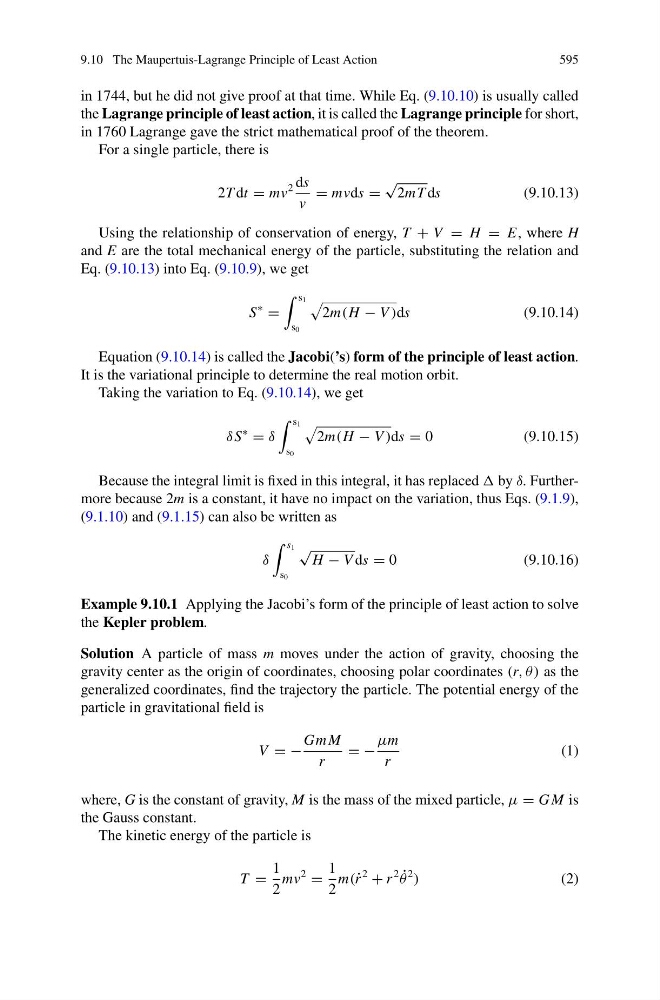
For a single particle, there is
2T dt = mv
2 ds
v
= mvds =
√
2mT ds
(9.10.13)
Using the relationship of conservation of energy, T + V = H = E, where H
and E are the total mechanical energy of the particle, substituting the relation and
Eq. (9.10.13) into Eq. (9.10.9), we get
S
∗
=
s 1
s 0
2m(H − V )ds
(9.10.14)
Equation (9.10.14) is called the Jacobi(’s) form of the principle of least action.
It is the variational principle to determine the real motion orbit.
Taking the variation to Eq. (9.10.14), we get
δS
∗
= δ
s 1
s 0
2m(H − V )ds = 0
(9.10.15)
Because the integral limit is fixed in this integral, it has replaced by δ. Furthermore because 2m is a constant, it have no impact on the variation, thus Eqs. (9.1.9),
(9.1.10) and (9.1.15) can also be written as
δ
s 1
s 0
√
H − V ds = 0
(9.10.16)
Example 9.10.1 Applying the Jacobi’s form of the principle of least action to solve
the Kepler problem.
Solution A particle of mass m moves under the action of gravity, choosing the
gravity center as the origin of coordinates, choosing polar coordinates (r, θ) as the
generalized coordinates, find the trajectory the particle. The potential energy of the
particle in gravitational field is
V = −
Gm M
r
= −
μm
r
(1)
where, G is the constant of gravity, M is the mass of the mixed particle, μ = G M is
the Gauss constant.
The kinetic energy of the particle is
T =
1
2
mv
2
=
1
2
m(˙ r
2
+ r
2 ˙
θ
2
)
(2)
595
in 1744, but he did not give proof at that time. While Eq. (9.10.10) is usually called
the Lagrange principle of least action, it is called the Lagrange principle for short,
in 1760 Lagrange gave the strict mathematical proof of the theorem.
For a single particle, there is
2T dt = mv
2 ds
v
= mvds =
√
2mT ds
(9.10.13)
Using the relationship of conservation of energy, T + V = H = E, where H
and E are the total mechanical energy of the particle, substituting the relation and
Eq. (9.10.13) into Eq. (9.10.9), we get
S
∗
=
s 1
s 0
2m(H − V )ds
(9.10.14)
Equation (9.10.14) is called the Jacobi(’s) form of the principle of least action.
It is the variational principle to determine the real motion orbit.
Taking the variation to Eq. (9.10.14), we get
δS
∗
= δ
s 1
s 0
2m(H − V )ds = 0
(9.10.15)
Because the integral limit is fixed in this integral, it has replaced by δ. Furthermore because 2m is a constant, it have no impact on the variation, thus Eqs. (9.1.9),
(9.1.10) and (9.1.15) can also be written as
δ
s 1
s 0
√
H − V ds = 0
(9.10.16)
Example 9.10.1 Applying the Jacobi’s form of the principle of least action to solve
the Kepler problem.
Solution A particle of mass m moves under the action of gravity, choosing the
gravity center as the origin of coordinates, choosing polar coordinates (r, θ) as the
generalized coordinates, find the trajectory the particle. The potential energy of the
particle in gravitational field is
V = −
Gm M
r
= −
μm
r
(1)
where, G is the constant of gravity, M is the mass of the mixed particle, μ = G M is
the Gauss constant.
The kinetic energy of the particle is
T =
1
2
mv
2
=
1
2
m(˙ r
2
+ r
2 ˙
θ
2
)
(2)