

594
9 Variational Principles in Mechanics and Their Applications
d
dt
k
i=1
∂ L
∂ ˙
q i
q i
= 2T + 2T
d
dt
t
(9.10.7)
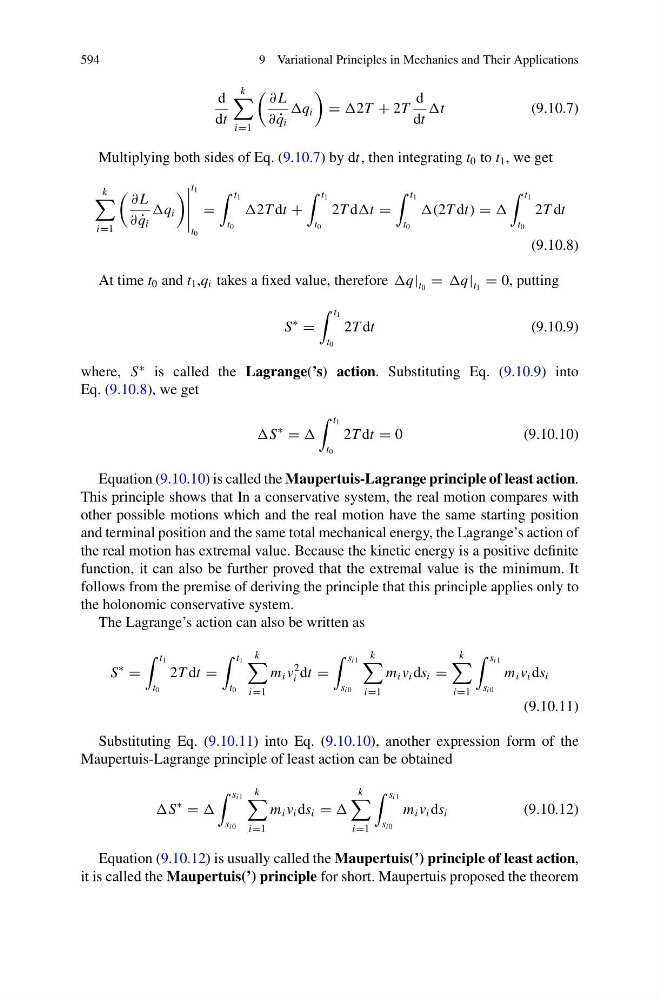
Multiplying both sides of Eq. (9.10.7) by dt, then integrating t 0 to t 1 , we get
k
i=1
∂ L
∂ ˙
q i
q i
t 1
t 0
=
t 1
t 0
2T dt +
t 1
t 0
2T dt =
t 1
t 0
(2T dt) =
t 1
t 0
2T dt
(9.10.8)
At time t 0 and t 1 ,q i takes a fixed value, therefore q| t 0 = q| t 1 = 0, putting
S
∗
=
t 1
t 0
2T dt
(9.10.9)
where, S
∗ is called the Lagrange(’s) action. Substituting Eq. (9.10.9) into
Eq. (9.10.8), we get
S
∗
=
t 1
t 0
2T dt = 0
(9.10.10)
Equation (9.10.10) is called the Maupertuis-Lagrange principle of least action.
This principle shows that In a conservative system, the real motion compares with
other possible motions which and the real motion have the same starting position
and terminal position and the same total mechanical energy, the Lagrange’s action of
the real motion has extremal value. Because the kinetic energy is a positive definite
function, it can also be further proved that the extremal value is the minimum. It
follows from the premise of deriving the principle that this principle applies only to
the holonomic conservative system.
The Lagrange’s action can also be written as
S
∗
=
t 1
t 0
2T dt =
t 1
t 0
k
i=1
m i v
2
i dt =
s i1
s i0
k
i=1
m i v i ds i =
k
i=1
s i1
s i0
m i v i ds i
(9.10.11)
Substituting Eq. (9.10.11) into Eq. (9.10.10), another expression form of the
Maupertuis-Lagrange principle of least action can be obtained
S
∗
=
s i1
s i0
k
i=1
m i v i ds i =
k
i=1
s i1
s i0
m i v i ds i
(9.10.12)
Equation (9.10.12) is usually called the Maupertuis(’) principle of least action,
it is called the Maupertuis(’) principle for short. Maupertuis proposed the theorem
9 Variational Principles in Mechanics and Their Applications
d
dt
k
i=1
∂ L
∂ ˙
q i
q i
= 2T + 2T
d
dt
t
(9.10.7)
Multiplying both sides of Eq. (9.10.7) by dt, then integrating t 0 to t 1 , we get
k
i=1
∂ L
∂ ˙
q i
q i
t 1
t 0
=
t 1
t 0
2T dt +
t 1
t 0
2T dt =
t 1
t 0
(2T dt) =
t 1
t 0
2T dt
(9.10.8)
At time t 0 and t 1 ,q i takes a fixed value, therefore q| t 0 = q| t 1 = 0, putting
S
∗
=
t 1
t 0
2T dt
(9.10.9)
where, S
∗ is called the Lagrange(’s) action. Substituting Eq. (9.10.9) into
Eq. (9.10.8), we get
S
∗
=
t 1
t 0
2T dt = 0
(9.10.10)
Equation (9.10.10) is called the Maupertuis-Lagrange principle of least action.
This principle shows that In a conservative system, the real motion compares with
other possible motions which and the real motion have the same starting position
and terminal position and the same total mechanical energy, the Lagrange’s action of
the real motion has extremal value. Because the kinetic energy is a positive definite
function, it can also be further proved that the extremal value is the minimum. It
follows from the premise of deriving the principle that this principle applies only to
the holonomic conservative system.
The Lagrange’s action can also be written as
S
∗
=
t 1
t 0
2T dt =
t 1
t 0
k
i=1
m i v
2
i dt =
s i1
s i0
k
i=1
m i v i ds i =
k
i=1
s i1
s i0
m i v i ds i
(9.10.11)
Substituting Eq. (9.10.11) into Eq. (9.10.10), another expression form of the
Maupertuis-Lagrange principle of least action can be obtained
S
∗
=
s i1
s i0
k
i=1
m i v i ds i =
k
i=1
s i1
s i0
m i v i ds i
(9.10.12)
Equation (9.10.12) is usually called the Maupertuis(’) principle of least action,
it is called the Maupertuis(’) principle for short. Maupertuis proposed the theorem