

9.10 The Maupertuis-Lagrange Principle of Least Action
597
θ + c 2 =
c 1 dr
r
hr 2 + 2r − c
2
1
= arccos
c
2
1 − r
r
hc
2
1 + 1
(10)
Put e =
hc
2
1 + 1, p = c
2
1 , Eq. (10) can be written as
r =
p
1 + e cos(θ + c 2 )
(11)
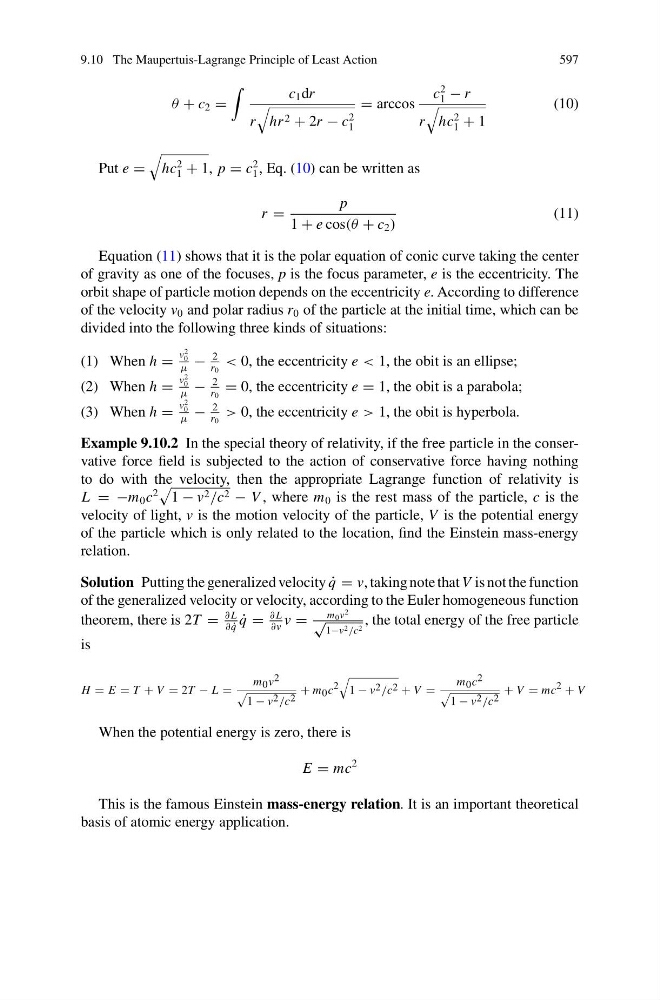
Equation (11) shows that it is the polar equation of conic curve taking the center
of gravity as one of the focuses, p is the focus parameter, e is the eccentricity. The
orbit shape of particle motion depends on the eccentricity e. According to difference
of the velocity v 0 and polar radius r 0 of the particle at the initial time, which can be
divided into the following three kinds of situations:
(1) When h =
v
2
0
μ
−
2
r 0
< 0, the eccentricity e < 1, the obit is an ellipse;
(2) When h =
v
2
0
μ
−
2
r 0
= 0, the eccentricity e = 1, the obit is a parabola;
(3) When h =
v
2
0
μ
−
2
r 0
> 0, the eccentricity e > 1, the obit is hyperbola.
Example 9.10.2 In the special theory of relativity, if the free particle in the conservative force field is subjected to the action of conservative force having nothing
to do with the velocity, then the appropriate Lagrange function of relativity is
L = −m 0 c
2
1 − v 2 /c 2 − V , where m 0 is the rest mass of the particle, c is the
velocity of light, v is the motion velocity of the particle, V is the potential energy
of the particle which is only related to the location, find the Einstein mass-energy
relation.
Solution Putting the generalized velocity ˙
q = v, taking note that V is not the function
of the generalized velocity or velocity, according to the Euler homogeneous function
theorem, there is 2T =
∂ L
∂ ˙
q
˙
q =
∂ L
∂v
v =
m 0 v
2
√
1−v 2 /c 2
, the total energy of the free particle
is
H = E = T + V = 2T − L =
m 0 v 2
1 − v 2 /c 2
+ m 0 c 2
1 − v 2 /c 2 + V =
m 0 c 2
1 − v 2 /c 2
+ V = mc 2 + V
When the potential energy is zero, there is
E = mc
2
This is the famous Einstein mass-energy relation. It is an important theoretical
basis of atomic energy application.
597
θ + c 2 =
c 1 dr
r
hr 2 + 2r − c
2
1
= arccos
c
2
1 − r
r
hc
2
1 + 1
(10)
Put e =
hc
2
1 + 1, p = c
2
1 , Eq. (10) can be written as
r =
p
1 + e cos(θ + c 2 )
(11)
Equation (11) shows that it is the polar equation of conic curve taking the center
of gravity as one of the focuses, p is the focus parameter, e is the eccentricity. The
orbit shape of particle motion depends on the eccentricity e. According to difference
of the velocity v 0 and polar radius r 0 of the particle at the initial time, which can be
divided into the following three kinds of situations:
(1) When h =
v
2
0
μ
−
2
r 0
< 0, the eccentricity e < 1, the obit is an ellipse;
(2) When h =
v
2
0
μ
−
2
r 0
= 0, the eccentricity e = 1, the obit is a parabola;
(3) When h =
v
2
0
μ
−
2
r 0
> 0, the eccentricity e > 1, the obit is hyperbola.
Example 9.10.2 In the special theory of relativity, if the free particle in the conservative force field is subjected to the action of conservative force having nothing
to do with the velocity, then the appropriate Lagrange function of relativity is
L = −m 0 c
2
1 − v 2 /c 2 − V , where m 0 is the rest mass of the particle, c is the
velocity of light, v is the motion velocity of the particle, V is the potential energy
of the particle which is only related to the location, find the Einstein mass-energy
relation.
Solution Putting the generalized velocity ˙
q = v, taking note that V is not the function
of the generalized velocity or velocity, according to the Euler homogeneous function
theorem, there is 2T =
∂ L
∂ ˙
q
˙
q =
∂ L
∂v
v =
m 0 v
2
√
1−v 2 /c 2
, the total energy of the free particle
is
H = E = T + V = 2T − L =
m 0 v 2
1 − v 2 /c 2
+ m 0 c 2
1 − v 2 /c 2 + V =
m 0 c 2
1 − v 2 /c 2
+ V = mc 2 + V
When the potential energy is zero, there is
E = mc
2
This is the famous Einstein mass-energy relation. It is an important theoretical
basis of atomic energy application.