

9.6 The Hamilton Principles and Their Applications
571
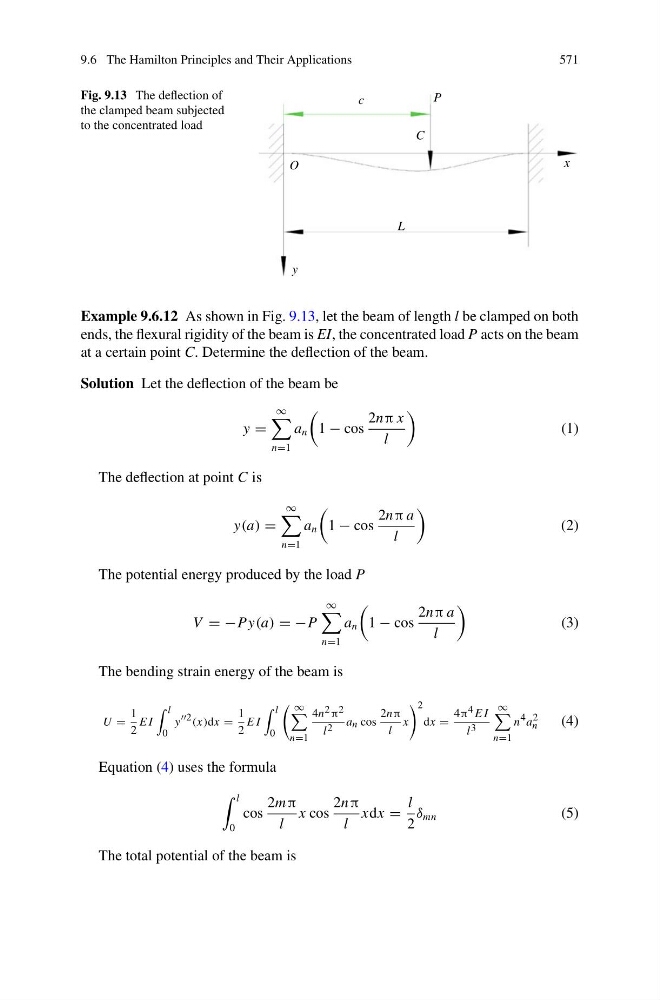
Fig. 9.13 The deflection of
the clamped beam subjected
to the concentrated load
O
x
y
c
C
L
P
Example 9.6.12 As shown in Fig. 9.13, let the beam of length l be clamped on both
ends, the flexural rigidity of the beam is EI, the concentrated load P acts on the beam
at a certain point C. Determine the deflection of the beam.
Solution Let the deflection of the beam be
y =
∞
n=1
a n
1 − cos
2nπ x
l
(1)
The deflection at point C is
y(a) =
∞
n=1
a n
1 − cos
2nπ a
l
(2)
The potential energy produced by the load P
V = −Py(a) = −P
∞
n=1
a n
1 − cos
2nπ a
l
(3)
The bending strain energy of the beam is
U =
1
2
E I
l
0
y (x)dx =
1
2
E I
l
0
∞
n=1
4n 2 π 2
l 2 a n cos
2nπ
l
x
2
dx =
4π 4 E I
l 3
∞
n=1
n 4 a 2
n
(4)
Equation (4) uses the formula
l
0
cos
2mπ
l
x cos
2nπ
l
xdx =
l
2
δ mn
(5)
The total potential of the beam is
571
Fig. 9.13 The deflection of
the clamped beam subjected
to the concentrated load
O
x
y
c
C
L
P
Example 9.6.12 As shown in Fig. 9.13, let the beam of length l be clamped on both
ends, the flexural rigidity of the beam is EI, the concentrated load P acts on the beam
at a certain point C. Determine the deflection of the beam.
Solution Let the deflection of the beam be
y =
∞
n=1
a n
1 − cos
2nπ x
l
(1)
The deflection at point C is
y(a) =
∞
n=1
a n
1 − cos
2nπ a
l
(2)
The potential energy produced by the load P
V = −Py(a) = −P
∞
n=1
a n
1 − cos
2nπ a
l
(3)
The bending strain energy of the beam is
U =
1
2
E I
l
0
y (x)dx =
1
2
E I
l
0
∞
n=1
4n 2 π 2
l 2 a n cos
2nπ
l
x
2
dx =
4π 4 E I
l 3
∞
n=1
n 4 a 2
n
(4)
Equation (4) uses the formula
l
0
cos
2mπ
l
x cos
2nπ
l
xdx =
l
2
δ mn
(5)
The total potential of the beam is