

9.6 The Hamilton Principles and Their Applications
569
U =
1
2
E I
l
0
y
2 dx =
1
2
E I
l
0
∞
n=1
n
2
π
2
l 2 a n sin
nπ
l
x
2
dx =
π
4 E I
4l 3
∞
n=1
n
4 a
2
n
(3)
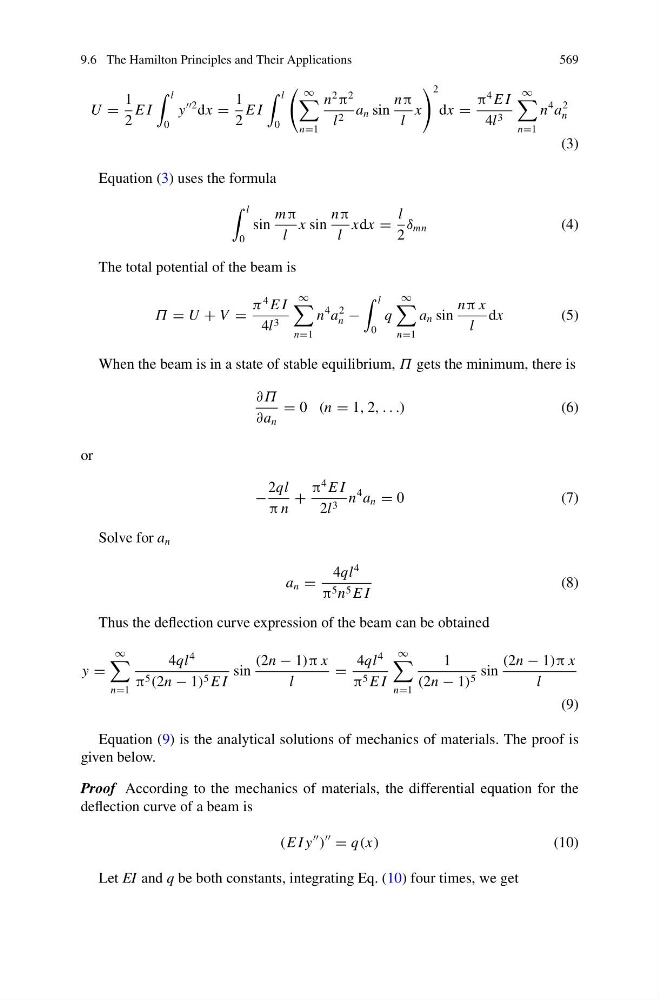
Equation (3) uses the formula
l
0
sin
mπ
l
x sin
nπ
l
xdx =
l
2
δ mn
(4)
The total potential of the beam is
Π = U + V =
π
4 E I
4l 3
∞
n=1
n
4 a
2
n −
l
0
q
∞
n=1
a n sin
nπ x
l
dx
(5)
When the beam is in a state of stable equilibrium, Π gets the minimum, there is
∂Π
∂a n
= 0 (n = 1, 2, . . .)
(6)
or
−
2ql
π n
+
π
4 E I
2l 3 n
4 a n = 0
( 7 )
Solve for a n
a n =
4ql
4
π 5 n 5 E I
(8)
Thus the deflection curve expression of the beam can be obtained
y =
∞
n=1
4ql
4
π 5 (2n − 1) 5 E I
sin
(2n − 1)π x
l
=
4ql
4
π 5 E I
∞
n=1
1
(2n − 1) 5 sin
(2n − 1)π x
l
(9)
Equation (9) is the analytical solutions of mechanics of materials. The proof is
given below.
Proof According to the mechanics of materials, the differential equation for the
deflection curve of a beam is
(E I y
)
= q(x)
(10)
Let EI and q be both constants, integrating Eq. (10) four times, we get
569
U =
1
2
E I
l
0
y
2 dx =
1
2
E I
l
0
∞
n=1
n
2
π
2
l 2 a n sin
nπ
l
x
2
dx =
π
4 E I
4l 3
∞
n=1
n
4 a
2
n
(3)
Equation (3) uses the formula
l
0
sin
mπ
l
x sin
nπ
l
xdx =
l
2
δ mn
(4)
The total potential of the beam is
Π = U + V =
π
4 E I
4l 3
∞
n=1
n
4 a
2
n −
l
0
q
∞
n=1
a n sin
nπ x
l
dx
(5)
When the beam is in a state of stable equilibrium, Π gets the minimum, there is
∂Π
∂a n
= 0 (n = 1, 2, . . .)
(6)
or
−
2ql
π n
+
π
4 E I
2l 3 n
4 a n = 0
( 7 )
Solve for a n
a n =
4ql
4
π 5 n 5 E I
(8)
Thus the deflection curve expression of the beam can be obtained
y =
∞
n=1
4ql
4
π 5 (2n − 1) 5 E I
sin
(2n − 1)π x
l
=
4ql
4
π 5 E I
∞
n=1
1
(2n − 1) 5 sin
(2n − 1)π x
l
(9)
Equation (9) is the analytical solutions of mechanics of materials. The proof is
given below.
Proof According to the mechanics of materials, the differential equation for the
deflection curve of a beam is
(E I y
)
= q(x)
(10)
Let EI and q be both constants, integrating Eq. (10) four times, we get