

1.4 Coordinate Transformations Between Rectangular …
41
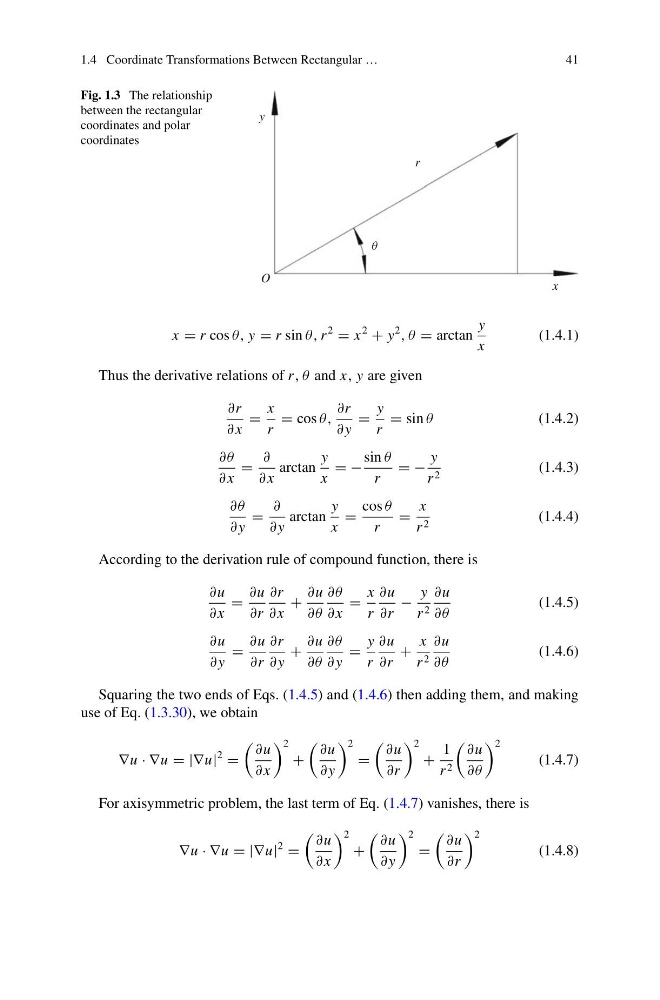
Fig. 1.3 The relationship
between the rectangular
coordinates and polar
coordinates
O
x
y
r
θ
x = r cos θ, y = r sin θ, r
2
= x
2
+ y
2
, θ = arctan
y
x
(1.4.1)
Thus the derivative relations of r , θ and x, y are given
∂r
∂ x
=
x
r
= cos θ,
∂r
∂ y
=
y
r
= sin θ
(1.4.2)
∂θ
∂ x
=
∂
∂ x
arctan
y
x
= −
sin θ
r
= −
y
r 2
(1.4.3)
∂θ
∂ y
=
∂
∂ y
arctan
y
x
=
cos θ
r
=
x
r 2
(1.4.4)
According to the derivation rule of compound function, there is
∂u
∂ x
=
∂u
∂r
∂r
∂ x
+
∂u
∂θ
∂θ
∂ x
=
x
r
∂u
∂r
−
y
r 2
∂u
∂θ
(1.4.5)
∂u
∂ y
=
∂u
∂r
∂r
∂ y
+
∂u
∂θ
∂θ
∂ y
=
y
r
∂u
∂r
+
x
r 2
∂u
∂θ
(1.4.6)
Squaring the two ends of Eqs. (1.4.5) and (1.4.6) then adding them, and making
use of Eq. (1.3.30), we obtain
∇u · ∇u = |∇u|
2
=
∂u
∂ x
2
+
∂u
∂ y
2
=
∂u
∂r
2
+
1
r 2
∂u
∂θ
2
(1.4.7)
For axisymmetric problem, the last term of Eq. (1.4.7) vanishes, there is
∇u · ∇u = |∇u|
2
=
∂u
∂ x
2
+
∂u
∂ y
2
=
∂u
∂r
2
(1.4.8)
41
Fig. 1.3 The relationship
between the rectangular
coordinates and polar
coordinates
O
x
y
r
θ
x = r cos θ, y = r sin θ, r
2
= x
2
+ y
2
, θ = arctan
y
x
(1.4.1)
Thus the derivative relations of r , θ and x, y are given
∂r
∂ x
=
x
r
= cos θ,
∂r
∂ y
=
y
r
= sin θ
(1.4.2)
∂θ
∂ x
=
∂
∂ x
arctan
y
x
= −
sin θ
r
= −
y
r 2
(1.4.3)
∂θ
∂ y
=
∂
∂ y
arctan
y
x
=
cos θ
r
=
x
r 2
(1.4.4)
According to the derivation rule of compound function, there is
∂u
∂ x
=
∂u
∂r
∂r
∂ x
+
∂u
∂θ
∂θ
∂ x
=
x
r
∂u
∂r
−
y
r 2
∂u
∂θ
(1.4.5)
∂u
∂ y
=
∂u
∂r
∂r
∂ y
+
∂u
∂θ
∂θ
∂ y
=
y
r
∂u
∂r
+
x
r 2
∂u
∂θ
(1.4.6)
Squaring the two ends of Eqs. (1.4.5) and (1.4.6) then adding them, and making
use of Eq. (1.3.30), we obtain
∇u · ∇u = |∇u|
2
=
∂u
∂ x
2
+
∂u
∂ y
2
=
∂u
∂r
2
+
1
r 2
∂u
∂θ
2
(1.4.7)
For axisymmetric problem, the last term of Eq. (1.4.7) vanishes, there is
∇u · ∇u = |∇u|
2
=
∂u
∂ x
2
+
∂u
∂ y
2
=
∂u
∂r
2
(1.4.8)