

40
1 Preliminaries
or
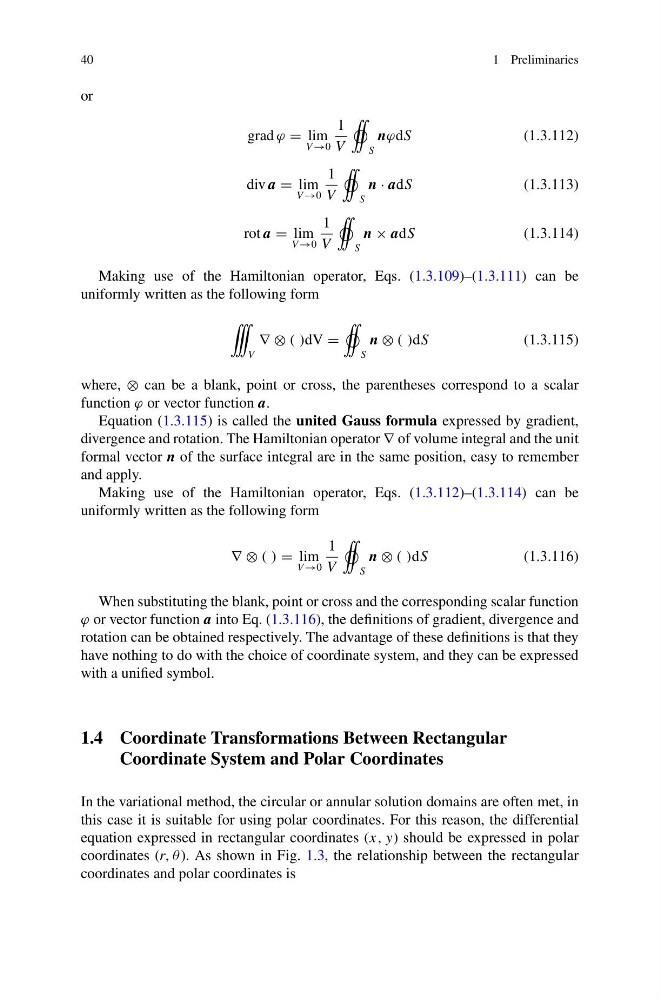
grad ϕ = lim
V →0
1
V
S
nϕdS
(1.3.112)
div a = lim
V →0
1
V
S
n · adS
(1.3.113)
rot a = lim
V →0
1
V
S
n × adS
(1.3.114)
Making use of the Hamiltonian operator, Eqs. (1.3.109)–(1.3.111) can be
uniformly written as the following form
V
∇ ⊗ ( )dV =
S
n ⊗ ( )dS
(1.3.115)
where, ⊗ can be a blank, point or cross, the parentheses correspond to a scalar
function ϕ or vector function a.
Equation (1.3.115) is called the united Gauss formula expressed by gradient,
divergence and rotation. The Hamiltonian operator ∇ of volume integral and the unit
formal vector n of the surface integral are in the same position, easy to remember
and apply.
Making use of the Hamiltonian operator, Eqs. (1.3.112)–(1.3.114) can be
uniformly written as the following form
∇ ⊗ ( ) = lim
V →0
1
V
S
n ⊗ ( )dS
(1.3.116)
When substituting the blank, point or cross and the corresponding scalar function
ϕ or vector function a into Eq. (1.3.116), the definitions of gradient, divergence and
rotation can be obtained respectively. The advantage of these definitions is that they
have nothing to do with the choice of coordinate system, and they can be expressed
with a unified symbol.
1.4 Coordinate Transformations Between Rectangular
Coordinate System and Polar Coordinates
In the variational method, the circular or annular solution domains are often met, in
this case it is suitable for using polar coordinates. For this reason, the differential
equation expressed in rectangular coordinates (x, y) should be expressed in polar
coordinates (r, θ). As shown in Fig. 1.3, the relationship between the rectangular
coordinates and polar coordinates is
1 Preliminaries
or
grad ϕ = lim
V →0
1
V
S
nϕdS
(1.3.112)
div a = lim
V →0
1
V
S
n · adS
(1.3.113)
rot a = lim
V →0
1
V
S
n × adS
(1.3.114)
Making use of the Hamiltonian operator, Eqs. (1.3.109)–(1.3.111) can be
uniformly written as the following form
V
∇ ⊗ ( )dV =
S
n ⊗ ( )dS
(1.3.115)
where, ⊗ can be a blank, point or cross, the parentheses correspond to a scalar
function ϕ or vector function a.
Equation (1.3.115) is called the united Gauss formula expressed by gradient,
divergence and rotation. The Hamiltonian operator ∇ of volume integral and the unit
formal vector n of the surface integral are in the same position, easy to remember
and apply.
Making use of the Hamiltonian operator, Eqs. (1.3.112)–(1.3.114) can be
uniformly written as the following form
∇ ⊗ ( ) = lim
V →0
1
V
S
n ⊗ ( )dS
(1.3.116)
When substituting the blank, point or cross and the corresponding scalar function
ϕ or vector function a into Eq. (1.3.116), the definitions of gradient, divergence and
rotation can be obtained respectively. The advantage of these definitions is that they
have nothing to do with the choice of coordinate system, and they can be expressed
with a unified symbol.
1.4 Coordinate Transformations Between Rectangular
Coordinate System and Polar Coordinates
In the variational method, the circular or annular solution domains are often met, in
this case it is suitable for using polar coordinates. For this reason, the differential
equation expressed in rectangular coordinates (x, y) should be expressed in polar
coordinates (r, θ). As shown in Fig. 1.3, the relationship between the rectangular
coordinates and polar coordinates is