

1.3 Fundamentals of the Theory of Field
39
Quod erat demonstrandum.
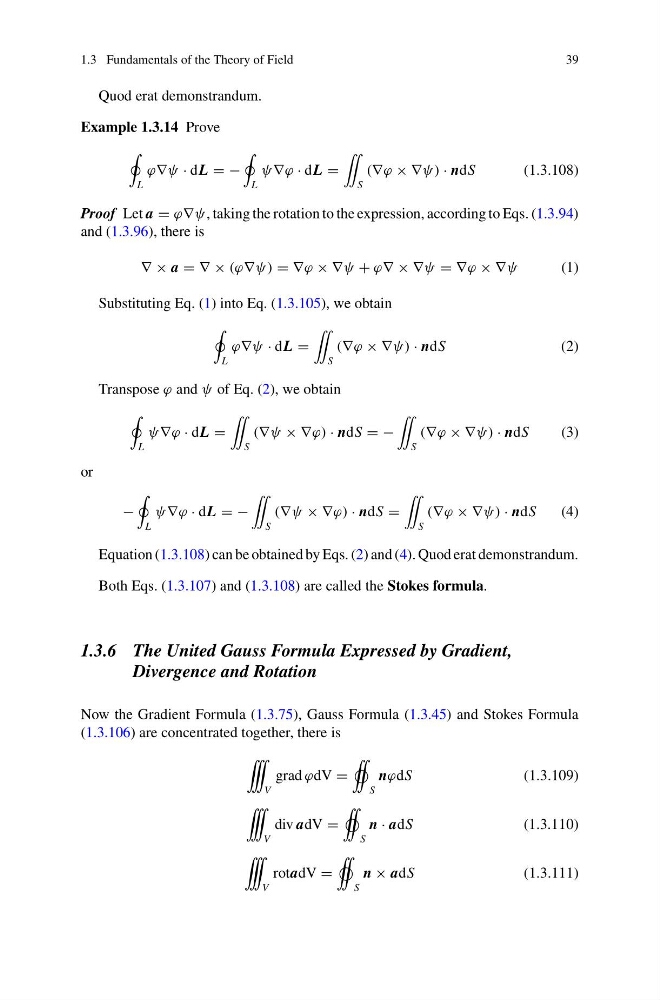
Example 1.3.14 Prove
L
ϕ∇ψ · dL = −
L
ψ∇ϕ · dL =
¨
S
(∇ϕ × ∇ψ) · ndS
(1.3.108)
Proof Let a = ϕ∇ψ, taking the rotation to the expression, according to Eqs. (1.3.94)
and (1.3.96), there is
∇ × a = ∇ × (ϕ∇ψ) = ∇ϕ × ∇ψ + ϕ∇ × ∇ψ = ∇ϕ × ∇ψ
(1)
Substituting Eq. (1) into Eq. (1.3.105), we obtain
L
ϕ∇ψ · dL =
¨
S
(∇ϕ × ∇ψ) · ndS
(2)
Transpose ϕ and ψ of Eq. (2), we obtain
L
ψ∇ϕ · dL =
¨
S
(∇ψ × ∇ϕ) · ndS = −
¨
S
(∇ϕ × ∇ψ) · ndS
(3)
or
−
L
ψ∇ϕ · dL = −
¨
S
(∇ψ × ∇ϕ) · ndS =
¨
S
(∇ϕ × ∇ψ) · ndS
(4)
Equation (1.3.108) can be obtained by Eqs. (2) and (4). Quod erat demonstrandum.
Both Eqs. (1.3.107) and (1.3.108) are called the Stokes formula.
1.3.6 The United Gauss Formula Expressed by Gradient,
Divergence and Rotation
Now the Gradient Formula (1.3.75), Gauss Formula (1.3.45) and Stokes Formula
(1.3.106) are concentrated together, there is
V
grad ϕdV =
S
nϕdS
(1.3.109)
V
div adV =
S
n · adS
(1.3.110)
V
rotadV =
S
n × adS
(1.3.111)
39
Quod erat demonstrandum.
Example 1.3.14 Prove
L
ϕ∇ψ · dL = −
L
ψ∇ϕ · dL =
¨
S
(∇ϕ × ∇ψ) · ndS
(1.3.108)
Proof Let a = ϕ∇ψ, taking the rotation to the expression, according to Eqs. (1.3.94)
and (1.3.96), there is
∇ × a = ∇ × (ϕ∇ψ) = ∇ϕ × ∇ψ + ϕ∇ × ∇ψ = ∇ϕ × ∇ψ
(1)
Substituting Eq. (1) into Eq. (1.3.105), we obtain
L
ϕ∇ψ · dL =
¨
S
(∇ϕ × ∇ψ) · ndS
(2)
Transpose ϕ and ψ of Eq. (2), we obtain
L
ψ∇ϕ · dL =
¨
S
(∇ψ × ∇ϕ) · ndS = −
¨
S
(∇ϕ × ∇ψ) · ndS
(3)
or
−
L
ψ∇ϕ · dL = −
¨
S
(∇ψ × ∇ϕ) · ndS =
¨
S
(∇ϕ × ∇ψ) · ndS
(4)
Equation (1.3.108) can be obtained by Eqs. (2) and (4). Quod erat demonstrandum.
Both Eqs. (1.3.107) and (1.3.108) are called the Stokes formula.
1.3.6 The United Gauss Formula Expressed by Gradient,
Divergence and Rotation
Now the Gradient Formula (1.3.75), Gauss Formula (1.3.45) and Stokes Formula
(1.3.106) are concentrated together, there is
V
grad ϕdV =
S
nϕdS
(1.3.109)
V
div adV =
S
n · adS
(1.3.110)
V
rotadV =
S
n × adS
(1.3.111)