

38
1 Preliminaries
S
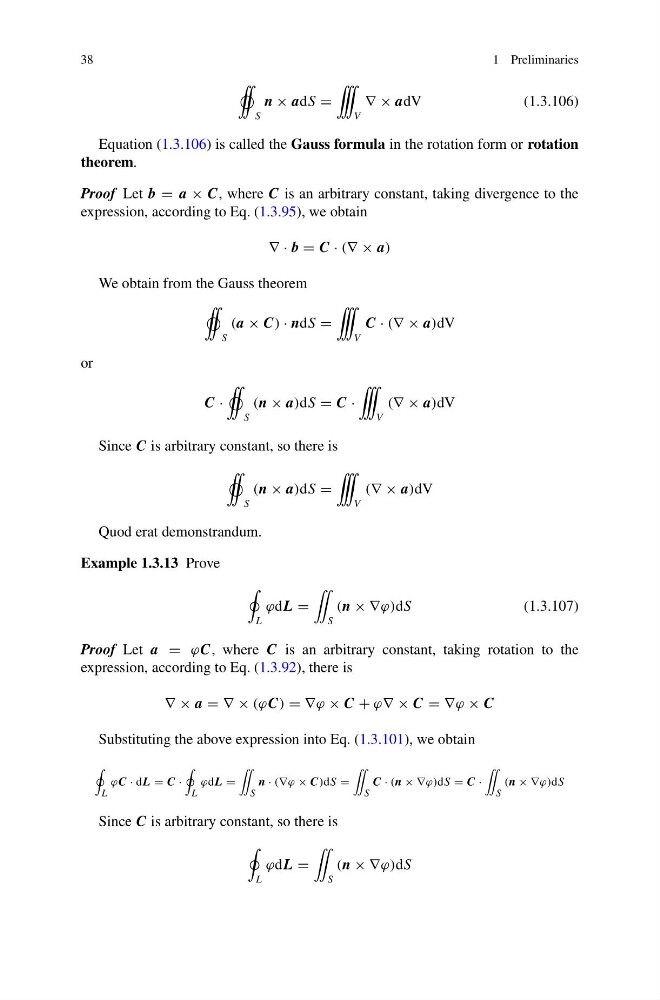
n × adS =
V
∇ × adV
(1.3.106)
Equation (1.3.106) is called the Gauss formula in the rotation form or rotation
theorem.
Proof Let b = a × C, where C is an arbitrary constant, taking divergence to the
expression, according to Eq. (1.3.95), we obtain
∇ · b = C · (∇ × a)
We obtain from the Gauss theorem
S
(a × C) · ndS =
V
C · (∇ × a)dV
or
C ·
S
(n × a)dS = C ·
V
(∇ × a)dV
Since C is arbitrary constant, so there is
S
(n × a)dS =
V
(∇ × a)dV
Quod erat demonstrandum.
Example 1.3.13 Prove
L
ϕdL =
¨
S
(n × ∇ϕ)dS
(1.3.107)
Proof Let a = ϕC, where C is an arbitrary constant, taking rotation to the
expression, according to Eq. (1.3.92), there is
∇ × a = ∇ × (ϕC) = ∇ϕ × C + ϕ∇ × C = ∇ϕ × C
Substituting the above expression into Eq. (1.3.101), we obtain
L
ϕC · dL = C ·
L
ϕdL =
¨
S
n · (∇ϕ × C)dS =
¨
S
C · (n × ∇ϕ)dS = C ·
¨
S
(n × ∇ϕ)dS
Since C is arbitrary constant, so there is
L
ϕdL =
¨
S
(n × ∇ϕ)dS
1 Preliminaries
S
n × adS =
V
∇ × adV
(1.3.106)
Equation (1.3.106) is called the Gauss formula in the rotation form or rotation
theorem.
Proof Let b = a × C, where C is an arbitrary constant, taking divergence to the
expression, according to Eq. (1.3.95), we obtain
∇ · b = C · (∇ × a)
We obtain from the Gauss theorem
S
(a × C) · ndS =
V
C · (∇ × a)dV
or
C ·
S
(n × a)dS = C ·
V
(∇ × a)dV
Since C is arbitrary constant, so there is
S
(n × a)dS =
V
(∇ × a)dV
Quod erat demonstrandum.
Example 1.3.13 Prove
L
ϕdL =
¨
S
(n × ∇ϕ)dS
(1.3.107)
Proof Let a = ϕC, where C is an arbitrary constant, taking rotation to the
expression, according to Eq. (1.3.92), there is
∇ × a = ∇ × (ϕC) = ∇ϕ × C + ϕ∇ × C = ∇ϕ × C
Substituting the above expression into Eq. (1.3.101), we obtain
L
ϕC · dL = C ·
L
ϕdL =
¨
S
n · (∇ϕ × C)dS =
¨
S
C · (n × ∇ϕ)dS = C ·
¨
S
(n × ∇ϕ)dS
Since C is arbitrary constant, so there is
L
ϕdL =
¨
S
(n × ∇ϕ)dS