

9.6 The Hamilton Principles and Their Applications
565
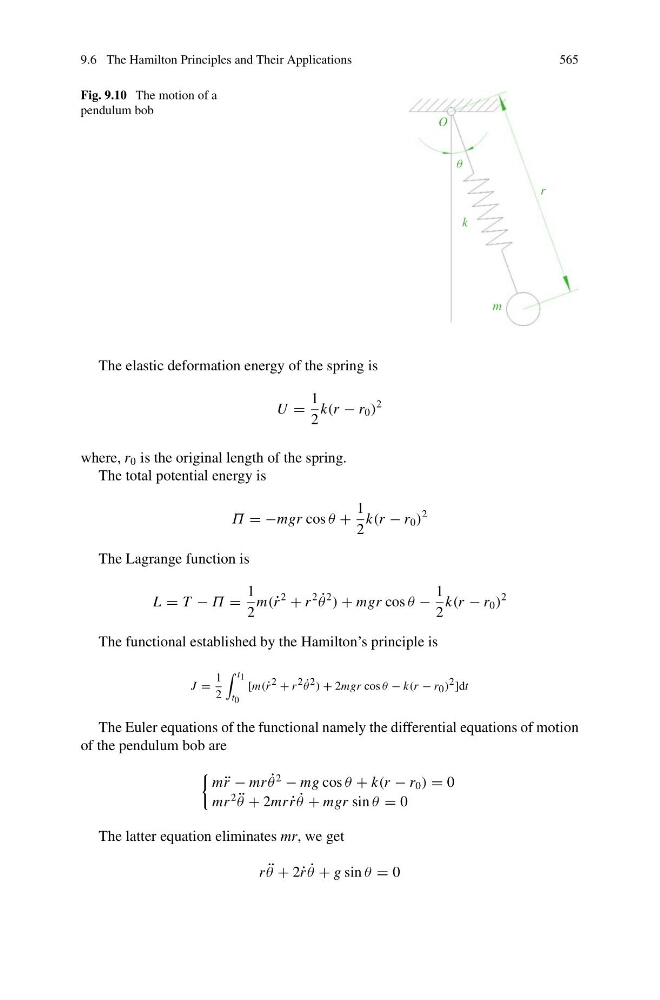
Fig. 9.10 The motion of a
pendulum bob
O
k
m
r
θ
The elastic deformation energy of the spring is
U =
1
2
k(r − r 0 )
2
where, r 0 is the original length of the spring.
The total potential energy is
Π = −mgr cos θ +
1
2
k(r − r 0 )
2
The Lagrange function is
L = T − Π =
1
2
m(˙ r
2
+ r
2 ˙
θ
2
) + mgr cos θ −
1
2
k(r − r 0 )
2
The functional established by the Hamilton’s principle is
J =
1
2
t 1
t 0
[m(˙ r 2 + r 2 ˙
θ 2 ) + 2mgr cos θ − k(r − r 0 ) 2 ]dt
The Euler equations of the functional namely the differential equations of motion
of the pendulum bob are
m ¨
r − mr ˙
θ
2
− mg cos θ + k(r − r 0 ) = 0
mr
2 ¨
θ + 2mr ˙
r ˙
θ + mgr sin θ = 0
The latter equation eliminates mr, we get
r ¨
θ + 2˙ r ˙
θ + g sin θ = 0
565
Fig. 9.10 The motion of a
pendulum bob
O
k
m
r
θ
The elastic deformation energy of the spring is
U =
1
2
k(r − r 0 )
2
where, r 0 is the original length of the spring.
The total potential energy is
Π = −mgr cos θ +
1
2
k(r − r 0 )
2
The Lagrange function is
L = T − Π =
1
2
m(˙ r
2
+ r
2 ˙
θ
2
) + mgr cos θ −
1
2
k(r − r 0 )
2
The functional established by the Hamilton’s principle is
J =
1
2
t 1
t 0
[m(˙ r 2 + r 2 ˙
θ 2 ) + 2mgr cos θ − k(r − r 0 ) 2 ]dt
The Euler equations of the functional namely the differential equations of motion
of the pendulum bob are
m ¨
r − mr ˙
θ
2
− mg cos θ + k(r − r 0 ) = 0
mr
2 ¨
θ + 2mr ˙
r ˙
θ + mgr sin θ = 0
The latter equation eliminates mr, we get
r ¨
θ + 2˙ r ˙
θ + g sin θ = 0