

566
9 Variational Principles in Mechanics and Their Applications
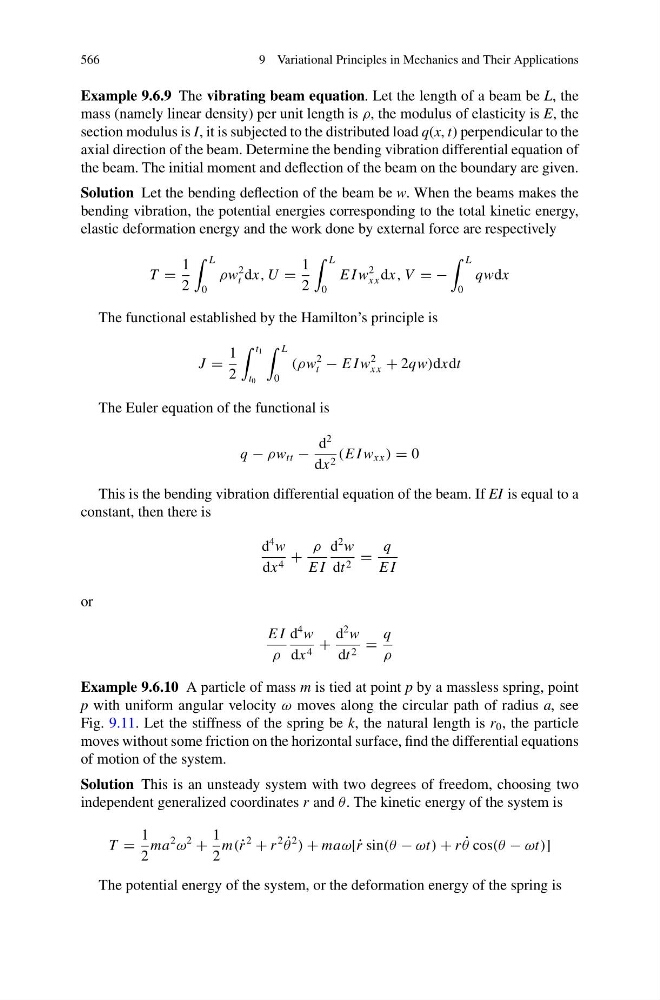
Example 9.6.9 The vibrating beam equation. Let the length of a beam be L, the
mass (namely linear density) per unit length is ρ, the modulus of elasticity is E, the
section modulus is I, it is subjected to the distributed load q(x, t) perpendicular to the
axial direction of the beam. Determine the bending vibration differential equation of
the beam. The initial moment and deflection of the beam on the boundary are given.
Solution Let the bending deflection of the beam be w. When the beams makes the
bending vibration, the potential energies corresponding to the total kinetic energy,
elastic deformation energy and the work done by external force are respectively
T =
1
2
L
0
ρw
2
t dx, U =
1
2
L
0
E I w
2
xx dx, V = −
L
0
qwdx
The functional established by the Hamilton’s principle is
J =
1
2
t 1
t 0
L
0
(ρw
2
t − E I w
2
xx + 2qw)dxdt
The Euler equation of the functional is
q − ρw tt −
d
2
dx 2 (E I w xx ) = 0
This is the bending vibration differential equation of the beam. If EI is equal to a
constant, then there is
d
4 w
dx 4 +
ρ
E I
d
2 w
dt 2 =
q
E I
or
E I
ρ
d
4 w
dx 4 +
d
2 w
dt 2 =
q
ρ
Example 9.6.10 A particle of mass m is tied at point p by a massless spring, point
p with uniform angular velocity ω moves along the circular path of radius a, see
Fig. 9.11. Let the stiffness of the spring be k, the natural length is r 0 , the particle
moves without some friction on the horizontal surface, find the differential equations
of motion of the system.
Solution This is an unsteady system with two degrees of freedom, choosing two
independent generalized coordinates r and θ. The kinetic energy of the system is
T =
1
2
ma
2
ω
2
+
1
2
m(˙ r
2
+ r
2 ˙
θ
2
) + maω[˙ r sin(θ − ωt) + r ˙
θ cos(θ − ωt)]
The potential energy of the system, or the deformation energy of the spring is
9 Variational Principles in Mechanics and Their Applications
Example 9.6.9 The vibrating beam equation. Let the length of a beam be L, the
mass (namely linear density) per unit length is ρ, the modulus of elasticity is E, the
section modulus is I, it is subjected to the distributed load q(x, t) perpendicular to the
axial direction of the beam. Determine the bending vibration differential equation of
the beam. The initial moment and deflection of the beam on the boundary are given.
Solution Let the bending deflection of the beam be w. When the beams makes the
bending vibration, the potential energies corresponding to the total kinetic energy,
elastic deformation energy and the work done by external force are respectively
T =
1
2
L
0
ρw
2
t dx, U =
1
2
L
0
E I w
2
xx dx, V = −
L
0
qwdx
The functional established by the Hamilton’s principle is
J =
1
2
t 1
t 0
L
0
(ρw
2
t − E I w
2
xx + 2qw)dxdt
The Euler equation of the functional is
q − ρw tt −
d
2
dx 2 (E I w xx ) = 0
This is the bending vibration differential equation of the beam. If EI is equal to a
constant, then there is
d
4 w
dx 4 +
ρ
E I
d
2 w
dt 2 =
q
E I
or
E I
ρ
d
4 w
dx 4 +
d
2 w
dt 2 =
q
ρ
Example 9.6.10 A particle of mass m is tied at point p by a massless spring, point
p with uniform angular velocity ω moves along the circular path of radius a, see
Fig. 9.11. Let the stiffness of the spring be k, the natural length is r 0 , the particle
moves without some friction on the horizontal surface, find the differential equations
of motion of the system.
Solution This is an unsteady system with two degrees of freedom, choosing two
independent generalized coordinates r and θ. The kinetic energy of the system is
T =
1
2
ma
2
ω
2
+
1
2
m(˙ r
2
+ r
2 ˙
θ
2
) + maω[˙ r sin(θ − ωt) + r ˙
θ cos(θ − ωt)]
The potential energy of the system, or the deformation energy of the spring is