

564
9 Variational Principles in Mechanics and Their Applications
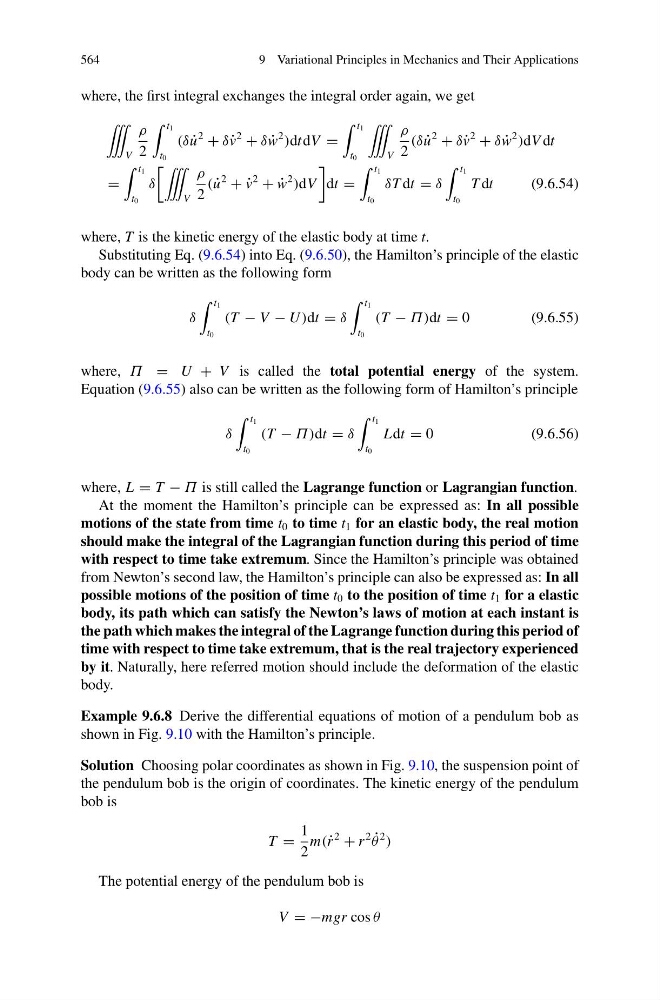
where, the first integral exchanges the integral order again, we get
˚
V
ρ
2
t 1
t 0
(δ ˙
u
2
+ δ ˙
v
2
+ δ ˙
w
2
)dtdV =
t 1
t 0
˚
V
ρ
2
(δ ˙
u
2
+ δ ˙
v
2
+ δ ˙
w
2
)dV dt
=
t 1
t 0
δ
˚
V
ρ
2
( ˙
u
2
+ ˙
v
2
+ ˙
w
2
)dV
dt =
t 1
t 0
δT dt = δ
t 1
t 0
T dt
(9.6.54)
where, T is the kinetic energy of the elastic body at time t.
Substituting Eq. (9.6.54) into Eq. (9.6.50), the Hamilton’s principle of the elastic
body can be written as the following form
δ
t 1
t 0
(T − V − U )dt = δ
t 1
t 0
(T − Π)dt = 0
(9.6.55)
where, Π = U + V is called the total potential energy of the system.
Equation (9.6.55) also can be written as the following form of Hamilton’s principle
δ
t 1
t 0
(T − Π)dt = δ
t 1
t 0
Ldt = 0
(9.6.56)
where, L = T − Π is still called the Lagrange function or Lagrangian function.
At the moment the Hamilton’s principle can be expressed as: In all possible
motions of the state from time t 0 to time t 1 for an elastic body, the real motion
should make the integral of the Lagrangian function during this period of time
with respect to time take extremum. Since the Hamilton’s principle was obtained
from Newton’s second law, the Hamilton’s principle can also be expressed as: In all
possible motions of the position of time t 0 to the position of time t 1 for a elastic
body, its path which can satisfy the Newton’s laws of motion at each instant is
the path which makes the integral of the Lagrange function during this period of
time with respect to time take extremum, that is the real trajectory experienced
by it. Naturally, here referred motion should include the deformation of the elastic
body.
Example 9.6.8 Derive the differential equations of motion of a pendulum bob as
shown in Fig. 9.10 with the Hamilton’s principle.
Solution Choosing polar coordinates as shown in Fig. 9.10, the suspension point of
the pendulum bob is the origin of coordinates. The kinetic energy of the pendulum
bob is
T =
1
2
m(˙ r
2
+ r
2 ˙
θ
2
)
The potential energy of the pendulum bob is
V = −mgr cos θ
9 Variational Principles in Mechanics and Their Applications
where, the first integral exchanges the integral order again, we get
˚
V
ρ
2
t 1
t 0
(δ ˙
u
2
+ δ ˙
v
2
+ δ ˙
w
2
)dtdV =
t 1
t 0
˚
V
ρ
2
(δ ˙
u
2
+ δ ˙
v
2
+ δ ˙
w
2
)dV dt
=
t 1
t 0
δ
˚
V
ρ
2
( ˙
u
2
+ ˙
v
2
+ ˙
w
2
)dV
dt =
t 1
t 0
δT dt = δ
t 1
t 0
T dt
(9.6.54)
where, T is the kinetic energy of the elastic body at time t.
Substituting Eq. (9.6.54) into Eq. (9.6.50), the Hamilton’s principle of the elastic
body can be written as the following form
δ
t 1
t 0
(T − V − U )dt = δ
t 1
t 0
(T − Π)dt = 0
(9.6.55)
where, Π = U + V is called the total potential energy of the system.
Equation (9.6.55) also can be written as the following form of Hamilton’s principle
δ
t 1
t 0
(T − Π)dt = δ
t 1
t 0
Ldt = 0
(9.6.56)
where, L = T − Π is still called the Lagrange function or Lagrangian function.
At the moment the Hamilton’s principle can be expressed as: In all possible
motions of the state from time t 0 to time t 1 for an elastic body, the real motion
should make the integral of the Lagrangian function during this period of time
with respect to time take extremum. Since the Hamilton’s principle was obtained
from Newton’s second law, the Hamilton’s principle can also be expressed as: In all
possible motions of the position of time t 0 to the position of time t 1 for a elastic
body, its path which can satisfy the Newton’s laws of motion at each instant is
the path which makes the integral of the Lagrange function during this period of
time with respect to time take extremum, that is the real trajectory experienced
by it. Naturally, here referred motion should include the deformation of the elastic
body.
Example 9.6.8 Derive the differential equations of motion of a pendulum bob as
shown in Fig. 9.10 with the Hamilton’s principle.
Solution Choosing polar coordinates as shown in Fig. 9.10, the suspension point of
the pendulum bob is the origin of coordinates. The kinetic energy of the pendulum
bob is
T =
1
2
m(˙ r
2
+ r
2 ˙
θ
2
)
The potential energy of the pendulum bob is
V = −mgr cos θ