

9.6 The Hamilton Principles and Their Applications
563
−
˚
V
ρ
d
2 u
dt 2 δu +
d
2 v
dt 2 δv +
d
2 w
dt 2 δw
dV − δV − δU = 0
(9.6.48)
Since these variables which are the displacements u, v, w, the potential energy V
and the strain energy U in the equation should be a function of time, Eq. (9.6.48) for
the object at any time t in the motion process holds. Taking the integral of the above
equation with respect to time between limits t 0 and t 1 , we get
−
t 1
t 0
˚
V
ρ
d
2 u
dt 2 δu +
d
2 v
dt 2 δv +
d
2 w
dt 2 δw
dV dt −
t 1
t 0
δV dt −
t 1
t 0
δU dt = 0
(9.6.49)
Exchanging the order of volume integral and time integral of the first term in
Eq. (9.6.49), while for the second and the third two terms exchanging the operation
order of integral and variation, and taking note that the density ρ is not the function
of time, it can be put the outside of the integral sign of the integral with respect to
time, we give
−
˚
V
ρ
t 1
t 0
d
2 u
dt 2 δu +
d
2 v
dt 2 δv +
d
2 w
dt 2 δw
dtdV − δ
t 1
t 0
V dt − δ
t 1
t 0
U dt = 0
(9.6.50)
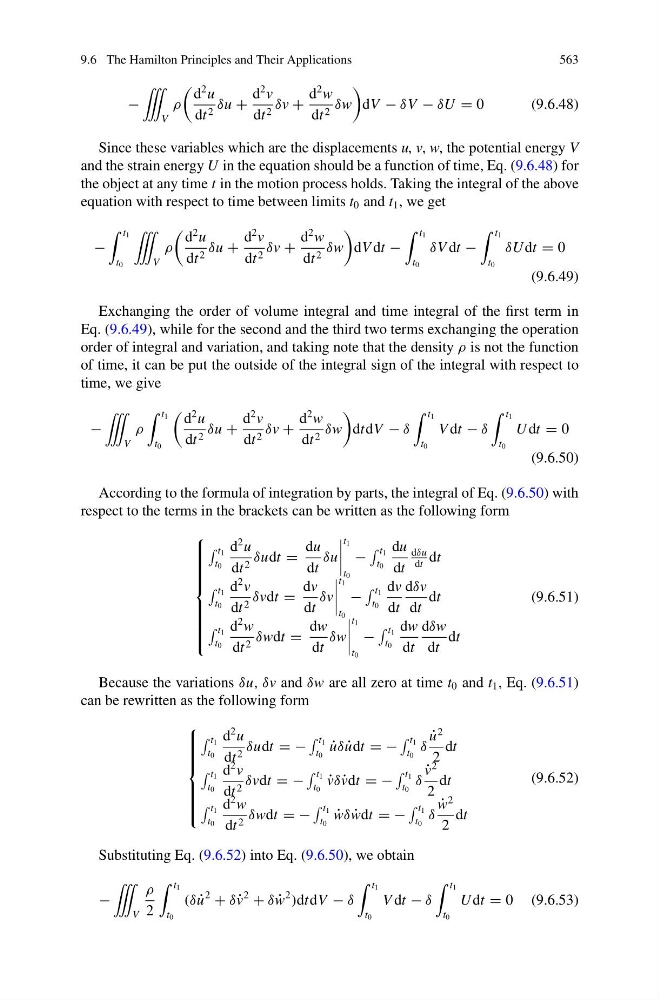
According to the formula of integration by parts, the integral of Eq. (9.6.50) with
respect to the terms in the brackets can be written as the following form
⎧
⎪ ⎪ ⎪ ⎪ ⎪ ⎪ ⎪ ⎨
⎪ ⎪ ⎪ ⎪ ⎪ ⎪ ⎪ ⎩
t 1
t 0
d
2 u
dt 2 δudt =
du
dt
δu
t 1
t 0
−
t 1
t 0
du
dt
dδu
dt
dt
t 1
t 0
d
2 v
dt 2 δvdt =
dv
dt
δv
t 1
t 0
−
t 1
t 0
dv
dt
dδv
dt
dt
t 1
t 0
d
2 w
dt 2 δwdt =
dw
dt
δw
t 1
t 0
−
t 1
t 0
dw
dt
dδw
dt
dt
(9.6.51)
Because the variations δu, δv and δw are all zero at time t 0 and t 1 , Eq. (9.6.51)
can be rewritten as the following form
⎧
⎪ ⎪ ⎪ ⎪ ⎪ ⎨
⎪ ⎪ ⎪ ⎪ ⎪ ⎩
t 1
t 0
d
2 u
dt 2 δudt = −
t 1
t 0
˙
uδ ˙
udt = −
t 1
t 0
δ
˙
u
2
2
dt
t 1
t 0
d
2 v
dt 2 δvdt = −
t 1
t 0
˙
vδ ˙
vdt = −
t 1
t 0
δ
˙
v
2
2
dt
t 1
t 0
d
2 w
dt 2 δwdt = −
t 1
t 0
˙
wδ ˙
wdt = −
t 1
t 0
δ
˙
w
2
2
dt
(9.6.52)
Substituting Eq. (9.6.52) into Eq. (9.6.50), we obtain
−
˚
V
ρ
2
t 1
t 0
(δ ˙
u
2
+ δ ˙
v
2
+ δ ˙
w
2
)dtdV − δ
t 1
t 0
V dt − δ
t 1
t 0
U dt = 0 (9.6.53)
563
−
˚
V
ρ
d
2 u
dt 2 δu +
d
2 v
dt 2 δv +
d
2 w
dt 2 δw
dV − δV − δU = 0
(9.6.48)
Since these variables which are the displacements u, v, w, the potential energy V
and the strain energy U in the equation should be a function of time, Eq. (9.6.48) for
the object at any time t in the motion process holds. Taking the integral of the above
equation with respect to time between limits t 0 and t 1 , we get
−
t 1
t 0
˚
V
ρ
d
2 u
dt 2 δu +
d
2 v
dt 2 δv +
d
2 w
dt 2 δw
dV dt −
t 1
t 0
δV dt −
t 1
t 0
δU dt = 0
(9.6.49)
Exchanging the order of volume integral and time integral of the first term in
Eq. (9.6.49), while for the second and the third two terms exchanging the operation
order of integral and variation, and taking note that the density ρ is not the function
of time, it can be put the outside of the integral sign of the integral with respect to
time, we give
−
˚
V
ρ
t 1
t 0
d
2 u
dt 2 δu +
d
2 v
dt 2 δv +
d
2 w
dt 2 δw
dtdV − δ
t 1
t 0
V dt − δ
t 1
t 0
U dt = 0
(9.6.50)
According to the formula of integration by parts, the integral of Eq. (9.6.50) with
respect to the terms in the brackets can be written as the following form
⎧
⎪ ⎪ ⎪ ⎪ ⎪ ⎪ ⎪ ⎨
⎪ ⎪ ⎪ ⎪ ⎪ ⎪ ⎪ ⎩
t 1
t 0
d
2 u
dt 2 δudt =
du
dt
δu
t 1
t 0
−
t 1
t 0
du
dt
dδu
dt
dt
t 1
t 0
d
2 v
dt 2 δvdt =
dv
dt
δv
t 1
t 0
−
t 1
t 0
dv
dt
dδv
dt
dt
t 1
t 0
d
2 w
dt 2 δwdt =
dw
dt
δw
t 1
t 0
−
t 1
t 0
dw
dt
dδw
dt
dt
(9.6.51)
Because the variations δu, δv and δw are all zero at time t 0 and t 1 , Eq. (9.6.51)
can be rewritten as the following form
⎧
⎪ ⎪ ⎪ ⎪ ⎪ ⎨
⎪ ⎪ ⎪ ⎪ ⎪ ⎩
t 1
t 0
d
2 u
dt 2 δudt = −
t 1
t 0
˙
uδ ˙
udt = −
t 1
t 0
δ
˙
u
2
2
dt
t 1
t 0
d
2 v
dt 2 δvdt = −
t 1
t 0
˙
vδ ˙
vdt = −
t 1
t 0
δ
˙
v
2
2
dt
t 1
t 0
d
2 w
dt 2 δwdt = −
t 1
t 0
˙
wδ ˙
wdt = −
t 1
t 0
δ
˙
w
2
2
dt
(9.6.52)
Substituting Eq. (9.6.52) into Eq. (9.6.50), we obtain
−
˚
V
ρ
2
t 1
t 0
(δ ˙
u
2
+ δ ˙
v
2
+ δ ˙
w
2
)dtdV − δ
t 1
t 0
V dt − δ
t 1
t 0
U dt = 0 (9.6.53)