

562
9 Variational Principles in Mechanics and Their Applications
where, c 1 , c 2 are the integral constants, they are determined by the initial condition.
Thus, the vibration period of the elliptical pendulum is
T = 2π
m 1 L
(m 1 + m 2 )g
(16)
It can be seen that the period is less than the period of the simple pendulum. When
m 1 >> m 2 , T = 2π
L
g
, at this time, m 1 is approximate to static, the elliptical
pendulum is equivalent to the single pendulum.
9.6.2 The Hamilton Principle of Elastic Body
Below the Hamilton’s principle is generalized from discrete particle system to elastic
continuous system.
The D’ Alembert’s principle expresses the Newton’s second law as the following
form
F − ma = 0
(9.6.46)
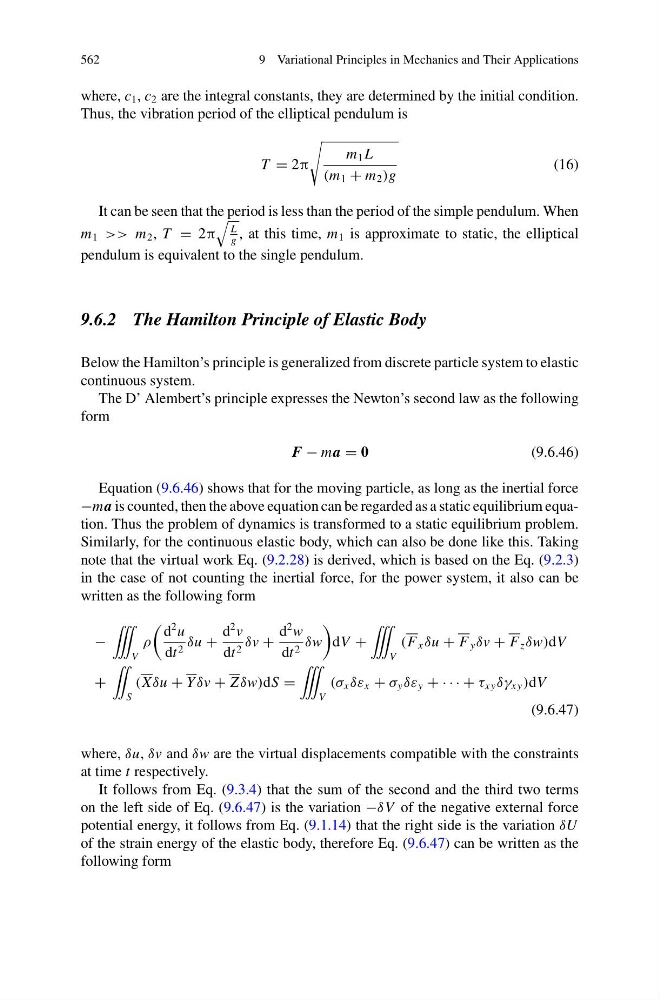
Equation (9.6.46) shows that for the moving particle, as long as the inertial force
−ma is counted, then the above equation can be regarded as a static equilibrium equation. Thus the problem of dynamics is transformed to a static equilibrium problem.
Similarly, for the continuous elastic body, which can also be done like this. Taking
note that the virtual work Eq. (9.2.28) is derived, which is based on the Eq. (9.2.3)
in the case of not counting the inertial force, for the power system, it also can be
written as the following form
−
˚
V
ρ
d
2 u
dt 2 δu +
d
2 v
dt 2 δv +
d
2 w
dt 2 δw
dV +
˚
V
(F x δu + F y δv + F z δw)dV
+
¨
S
(X δu + Y δv + Z δw)dS =
˚
V
(σ x δε x + σ y δε y + · · · + τ xy δγ xy )dV
(9.6.47)
where, δu, δv and δw are the virtual displacements compatible with the constraints
at time t respectively.
It follows from Eq. (9.3.4) that the sum of the second and the third two terms
on the left side of Eq. (9.6.47) is the variation −δV of the negative external force
potential energy, it follows from Eq. (9.1.14) that the right side is the variation δU
of the strain energy of the elastic body, therefore Eq. (9.6.47) can be written as the
following form
9 Variational Principles in Mechanics and Their Applications
where, c 1 , c 2 are the integral constants, they are determined by the initial condition.
Thus, the vibration period of the elliptical pendulum is
T = 2π
m 1 L
(m 1 + m 2 )g
(16)
It can be seen that the period is less than the period of the simple pendulum. When
m 1 >> m 2 , T = 2π
L
g
, at this time, m 1 is approximate to static, the elliptical
pendulum is equivalent to the single pendulum.
9.6.2 The Hamilton Principle of Elastic Body
Below the Hamilton’s principle is generalized from discrete particle system to elastic
continuous system.
The D’ Alembert’s principle expresses the Newton’s second law as the following
form
F − ma = 0
(9.6.46)
Equation (9.6.46) shows that for the moving particle, as long as the inertial force
−ma is counted, then the above equation can be regarded as a static equilibrium equation. Thus the problem of dynamics is transformed to a static equilibrium problem.
Similarly, for the continuous elastic body, which can also be done like this. Taking
note that the virtual work Eq. (9.2.28) is derived, which is based on the Eq. (9.2.3)
in the case of not counting the inertial force, for the power system, it also can be
written as the following form
−
˚
V
ρ
d
2 u
dt 2 δu +
d
2 v
dt 2 δv +
d
2 w
dt 2 δw
dV +
˚
V
(F x δu + F y δv + F z δw)dV
+
¨
S
(X δu + Y δv + Z δw)dS =
˚
V
(σ x δε x + σ y δε y + · · · + τ xy δγ xy )dV
(9.6.47)
where, δu, δv and δw are the virtual displacements compatible with the constraints
at time t respectively.
It follows from Eq. (9.3.4) that the sum of the second and the third two terms
on the left side of Eq. (9.6.47) is the variation −δV of the negative external force
potential energy, it follows from Eq. (9.1.14) that the right side is the variation δU
of the strain energy of the elastic body, therefore Eq. (9.6.47) can be written as the
following form