

9.6 The Hamilton Principles and Their Applications
561
L = T − V =
1
2
(m 1 + m 2 ) ˙
x
2
+ m 2 L ˙
x ˙
θ cos θ +
1
2
m 2 (L ˙
θ)
2
+ m 2 gL cos θ (5)
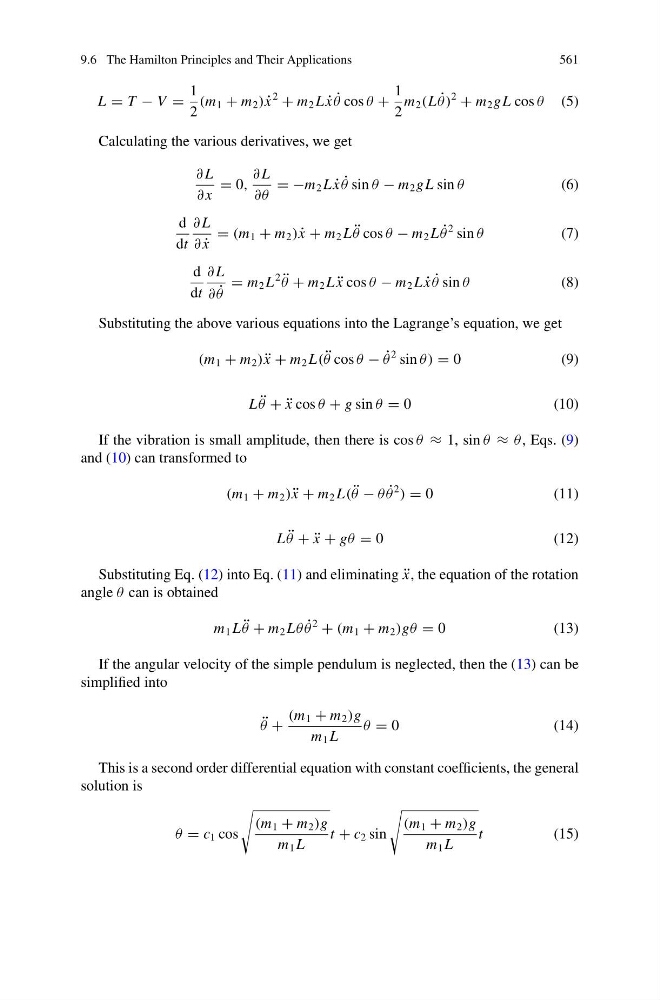
Calculating the various derivatives, we get
∂ L
∂ x
= 0,
∂ L
∂θ
= −m 2 L ˙
x ˙
θ sin θ − m 2 gL sin θ
(6)
d
dt
∂ L
∂ ˙
x
= (m 1 + m 2 ) ˙
x + m 2 L ¨
θ cos θ − m 2 L ˙
θ
2 sin θ
(7)
d
dt
∂ L
∂ ˙
θ
= m 2 L
2 ¨
θ + m 2 L ¨
x cos θ − m 2 L ˙
x ˙
θ sin θ
(8)
Substituting the above various equations into the Lagrange’s equation, we get
(m 1 + m 2 ) ¨
x + m 2 L( ¨
θ cos θ − ˙
θ
2 sin θ) = 0
( 9 )
L ¨
θ + ¨
x cos θ + g sin θ = 0
( 1 0 )
If the vibration is small amplitude, then there is cos θ ≈ 1, sin θ ≈ θ , Eqs. (9)
and (10) can transformed to
(m 1 + m 2 ) ¨
x + m 2 L( ¨
θ − θ ˙
θ
2
) = 0
(11)
L ¨
θ + ¨
x + gθ = 0
( 1 2 )
Substituting Eq. (12) into Eq. (11) and eliminating ¨
x, the equation of the rotation
angle θ can is obtained
m 1 L ¨
θ + m 2 Lθ ˙
θ
2
+ (m 1 + m 2 )gθ = 0
(13)
If the angular velocity of the simple pendulum is neglected, then the (13) can be
simplified into
¨
θ +
(m 1 + m 2 )g
m 1 L
θ = 0
( 1 4 )
This is a second order differential equation with constant coefficients, the general
solution is
θ = c 1 cos
(m 1 + m 2 )g
m 1 L
t + c 2 sin
(m 1 + m 2 )g
m 1 L
t
(15)
561
L = T − V =
1
2
(m 1 + m 2 ) ˙
x
2
+ m 2 L ˙
x ˙
θ cos θ +
1
2
m 2 (L ˙
θ)
2
+ m 2 gL cos θ (5)
Calculating the various derivatives, we get
∂ L
∂ x
= 0,
∂ L
∂θ
= −m 2 L ˙
x ˙
θ sin θ − m 2 gL sin θ
(6)
d
dt
∂ L
∂ ˙
x
= (m 1 + m 2 ) ˙
x + m 2 L ¨
θ cos θ − m 2 L ˙
θ
2 sin θ
(7)
d
dt
∂ L
∂ ˙
θ
= m 2 L
2 ¨
θ + m 2 L ¨
x cos θ − m 2 L ˙
x ˙
θ sin θ
(8)
Substituting the above various equations into the Lagrange’s equation, we get
(m 1 + m 2 ) ¨
x + m 2 L( ¨
θ cos θ − ˙
θ
2 sin θ) = 0
( 9 )
L ¨
θ + ¨
x cos θ + g sin θ = 0
( 1 0 )
If the vibration is small amplitude, then there is cos θ ≈ 1, sin θ ≈ θ , Eqs. (9)
and (10) can transformed to
(m 1 + m 2 ) ¨
x + m 2 L( ¨
θ − θ ˙
θ
2
) = 0
(11)
L ¨
θ + ¨
x + gθ = 0
( 1 2 )
Substituting Eq. (12) into Eq. (11) and eliminating ¨
x, the equation of the rotation
angle θ can is obtained
m 1 L ¨
θ + m 2 Lθ ˙
θ
2
+ (m 1 + m 2 )gθ = 0
(13)
If the angular velocity of the simple pendulum is neglected, then the (13) can be
simplified into
¨
θ +
(m 1 + m 2 )g
m 1 L
θ = 0
( 1 4 )
This is a second order differential equation with constant coefficients, the general
solution is
θ = c 1 cos
(m 1 + m 2 )g
m 1 L
t + c 2 sin
(m 1 + m 2 )g
m 1 L
t
(15)