

538
9 Variational Principles in Mechanics and Their Applications
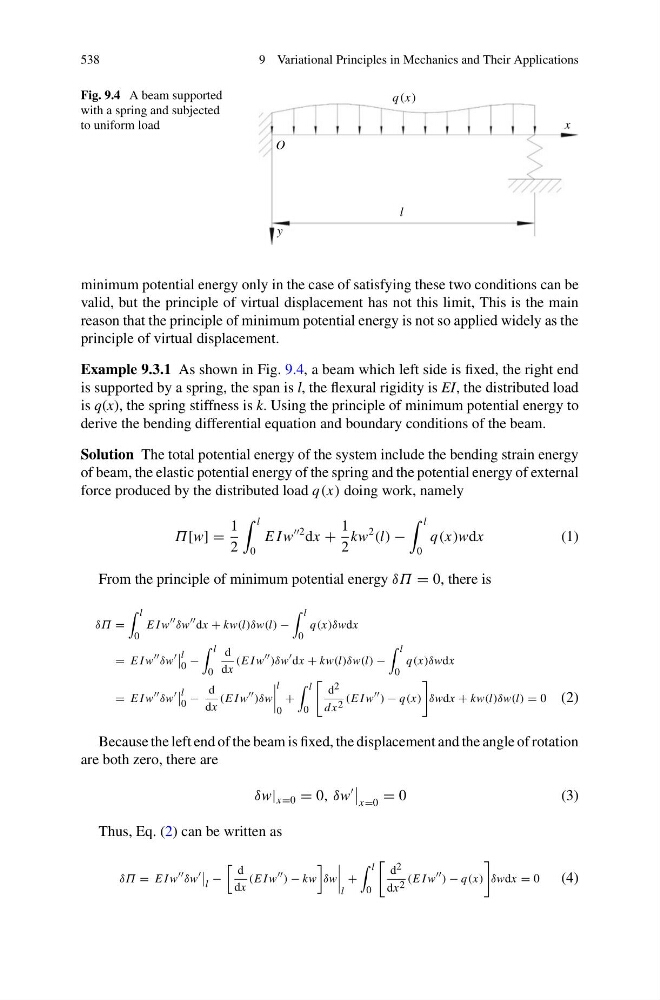
Fig. 9.4 A beam supported
with a spring and subjected
to uniform load
O
x
y
l
q(x)
minimum potential energy only in the case of satisfying these two conditions can be
valid, but the principle of virtual displacement has not this limit, This is the main
reason that the principle of minimum potential energy is not so applied widely as the
principle of virtual displacement.
Example 9.3.1 As shown in Fig. 9.4, a beam which left side is fixed, the right end
is supported by a spring, the span is l, the flexural rigidity is EI, the distributed load
is q(x), the spring stiffness is k. Using the principle of minimum potential energy to
derive the bending differential equation and boundary conditions of the beam.
Solution The total potential energy of the system include the bending strain energy
of beam, the elastic potential energy of the spring and the potential energy of external
force produced by the distributed load q(x) doing work, namely
Π [w] =
1
2
l
0
E I w
dx +
1
2
kw
2
(l) −
l
0
q(x)wdx
(1)
From the principle of minimum potential energy δΠ = 0, there is
δΠ =
l
0
E I w δw dx + kw(l)δw(l) −
l
0
q(x)δwdx
= E I w δw
l
0 −
l
0
d
dx
(E I w )δw dx + kw(l)δw(l) −
l
0
q(x)δwdx
= E I w δw
l
0 −
d
dx
(E I w )δw
l
0
+
l
0
d 2
dx 2 (E I w ) − q(x)
δwdx + kw(l)δw(l) = 0 (2)
Because the left end of the beam is fixed, the displacement and the angle of rotation
are both zero, there are
δw| x=0 = 0, δw
x=0
= 0
( 3 )
Thus, Eq. (2) can be written as
δΠ = E I w δw
l −
d
dx
(E I w ) − kw
δw
l
+
l
0
d 2
dx 2 (E I w ) − q(x)
δwdx = 0
(4)
9 Variational Principles in Mechanics and Their Applications
Fig. 9.4 A beam supported
with a spring and subjected
to uniform load
O
x
y
l
q(x)
minimum potential energy only in the case of satisfying these two conditions can be
valid, but the principle of virtual displacement has not this limit, This is the main
reason that the principle of minimum potential energy is not so applied widely as the
principle of virtual displacement.
Example 9.3.1 As shown in Fig. 9.4, a beam which left side is fixed, the right end
is supported by a spring, the span is l, the flexural rigidity is EI, the distributed load
is q(x), the spring stiffness is k. Using the principle of minimum potential energy to
derive the bending differential equation and boundary conditions of the beam.
Solution The total potential energy of the system include the bending strain energy
of beam, the elastic potential energy of the spring and the potential energy of external
force produced by the distributed load q(x) doing work, namely
Π [w] =
1
2
l
0
E I w
dx +
1
2
kw
2
(l) −
l
0
q(x)wdx
(1)
From the principle of minimum potential energy δΠ = 0, there is
δΠ =
l
0
E I w δw dx + kw(l)δw(l) −
l
0
q(x)δwdx
= E I w δw
l
0 −
l
0
d
dx
(E I w )δw dx + kw(l)δw(l) −
l
0
q(x)δwdx
= E I w δw
l
0 −
d
dx
(E I w )δw
l
0
+
l
0
d 2
dx 2 (E I w ) − q(x)
δwdx + kw(l)δw(l) = 0 (2)
Because the left end of the beam is fixed, the displacement and the angle of rotation
are both zero, there are
δw| x=0 = 0, δw
x=0
= 0
( 3 )
Thus, Eq. (2) can be written as
δΠ = E I w δw
l −
d
dx
(E I w ) − kw
δw
l
+
l
0
d 2
dx 2 (E I w ) − q(x)
δwdx = 0
(4)