

9.3 Principle of the Minimum Potential Energy
537
δ
2
Π =
˚
V
1
2!
∂
2 U 0
∂ε 2
x
δε
2
x + · · · +
∂
2 U 0
∂γ 2
xy
δγ
2
xy
dV
(9.3.11)
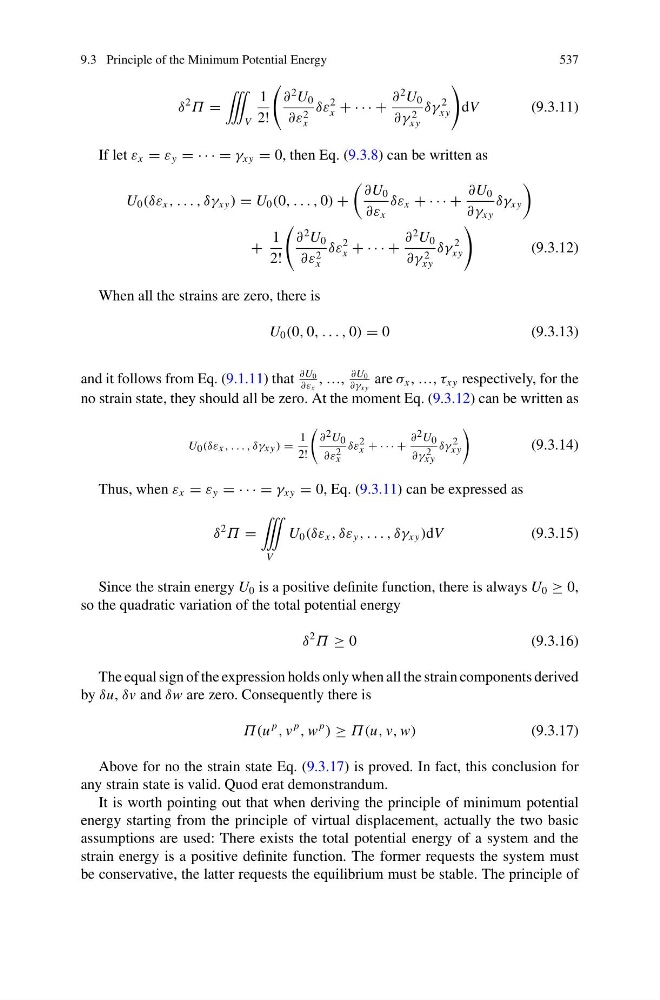
If let ε x = ε y = · · · = γ xy = 0, then Eq. (9.3.8) can be written as
U 0 (δε x , . . . , δγ xy ) = U 0 (0, . . . , 0) +
∂U 0
∂ε x
δε x + · · · +
∂U 0
∂γ xy
δγ xy
+
1
2!
∂
2 U 0
∂ε 2
x
δε
2
x + · · · +
∂
2 U 0
∂γ 2
xy
δγ
2
xy
(9.3.12)
When all the strains are zero, there is
U 0 (0, 0, . . . , 0) = 0
(9.3.13)
and it follows from Eq. (9.1.11) that
∂U 0
∂ε x
, …,
∂U 0
∂γ xy
are σ x , …, τ xy respectively, for the
no strain state, they should all be zero. At the moment Eq. (9.3.12) can be written as
U 0 (δε x , . . . , δγ xy ) =
1
2!
∂ 2 U 0
∂ε 2
x
δε 2
x + · · · +
∂ 2 U 0
∂γ 2
xy
δγ 2
xy
(9.3.14)
Thus, when ε x = ε y = · · · = γ xy = 0, Eq. (9.3.11) can be expressed as
δ
2
Π =
˚
V
U 0 (δε x , δε y , . . . , δγ xy )dV
(9.3.15)
Since the strain energy U 0 is a positive definite function, there is always U 0 ≥ 0,
so the quadratic variation of the total potential energy
δ
2
Π ≥ 0
(9.3.16)
The equal sign of the expression holds only when all the strain components derived
by δu, δv and δw are zero. Consequently there is
Π(u
p
, v
p
, w
p
) ≥ Π(u, v, w)
(9.3.17)
Above for no the strain state Eq. (9.3.17) is proved. In fact, this conclusion for
any strain state is valid. Quod erat demonstrandum.
It is worth pointing out that when deriving the principle of minimum potential
energy starting from the principle of virtual displacement, actually the two basic
assumptions are used: There exists the total potential energy of a system and the
strain energy is a positive definite function. The former requests the system must
be conservative, the latter requests the equilibrium must be stable. The principle of
537
δ
2
Π =
˚
V
1
2!
∂
2 U 0
∂ε 2
x
δε
2
x + · · · +
∂
2 U 0
∂γ 2
xy
δγ
2
xy
dV
(9.3.11)
If let ε x = ε y = · · · = γ xy = 0, then Eq. (9.3.8) can be written as
U 0 (δε x , . . . , δγ xy ) = U 0 (0, . . . , 0) +
∂U 0
∂ε x
δε x + · · · +
∂U 0
∂γ xy
δγ xy
+
1
2!
∂
2 U 0
∂ε 2
x
δε
2
x + · · · +
∂
2 U 0
∂γ 2
xy
δγ
2
xy
(9.3.12)
When all the strains are zero, there is
U 0 (0, 0, . . . , 0) = 0
(9.3.13)
and it follows from Eq. (9.1.11) that
∂U 0
∂ε x
, …,
∂U 0
∂γ xy
are σ x , …, τ xy respectively, for the
no strain state, they should all be zero. At the moment Eq. (9.3.12) can be written as
U 0 (δε x , . . . , δγ xy ) =
1
2!
∂ 2 U 0
∂ε 2
x
δε 2
x + · · · +
∂ 2 U 0
∂γ 2
xy
δγ 2
xy
(9.3.14)
Thus, when ε x = ε y = · · · = γ xy = 0, Eq. (9.3.11) can be expressed as
δ
2
Π =
˚
V
U 0 (δε x , δε y , . . . , δγ xy )dV
(9.3.15)
Since the strain energy U 0 is a positive definite function, there is always U 0 ≥ 0,
so the quadratic variation of the total potential energy
δ
2
Π ≥ 0
(9.3.16)
The equal sign of the expression holds only when all the strain components derived
by δu, δv and δw are zero. Consequently there is
Π(u
p
, v
p
, w
p
) ≥ Π(u, v, w)
(9.3.17)
Above for no the strain state Eq. (9.3.17) is proved. In fact, this conclusion for
any strain state is valid. Quod erat demonstrandum.
It is worth pointing out that when deriving the principle of minimum potential
energy starting from the principle of virtual displacement, actually the two basic
assumptions are used: There exists the total potential energy of a system and the
strain energy is a positive definite function. The former requests the system must
be conservative, the latter requests the equilibrium must be stable. The principle of