

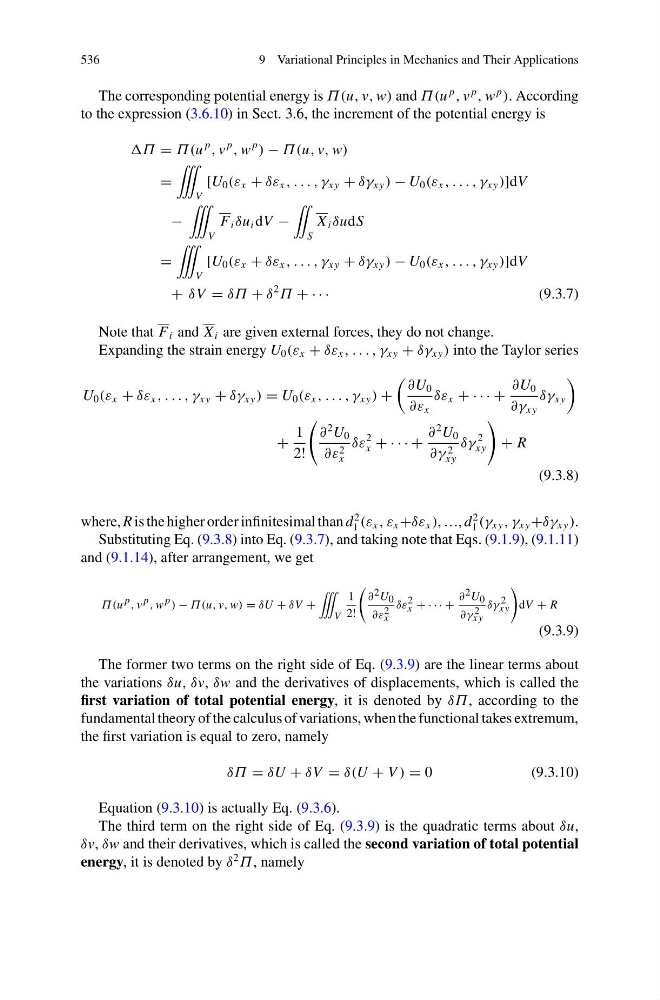
536
9 Variational Principles in Mechanics and Their Applications
The corresponding potential energy is Π(u, v, w) and Π(u
p
, v
p
, w
p
). According
to the expression (3.6.10) in Sect. 3.6, the increment of the potential energy is
Π = Π(u
p
, v
p
, w
p
) − Π(u, v, w)
=
˚
V
[U 0 (ε x + δε x , . . . , γ xy + δγ xy ) − U 0 (ε x , . . . , γ xy )]dV
−
˚
V
F i δu i dV −
¨
S
X i δudS
=
˚
V
[U 0 (ε x + δε x , . . . , γ xy + δγ xy ) − U 0 (ε x , . . . , γ xy )]dV
+ δV = δΠ + δ
2
Π + · · ·
(9.3.7)
Note that F i and X i are given external forces, they do not change.
Expanding the strain energy U 0 (ε x + δε x , . . . , γ xy + δγ xy ) into the Taylor series
U 0 (ε x + δε x , . . . , γ xy + δγ xy ) = U 0 (ε x , . . . , γ xy ) +
∂U 0
∂ε x
δε x + · · · +
∂U 0
∂γ xy
δγ xy
+
1
2!
∂
2 U 0
∂ε 2
x
δε
2
x + · · · +
∂
2 U 0
∂γ 2
xy
δγ
2
xy
+ R
(9.3.8)
where, R is the higher order infinitesimal than d
2
1 (ε x , ε x +δε x ), …, d
2
1 (γ xy , γ xy +δγ xy ).
Substituting Eq. (9.3.8) into Eq. (9.3.7), and taking note that Eqs. (9.1.9), (9.1.11)
and (9.1.14), after arrangement, we get
Π(u p , v p , w p ) − Π(u, v, w) = δU + δV +
˚
V
1
2!
∂ 2 U 0
∂ε 2
x
δε 2
x + · · · +
∂ 2 U 0
∂γ 2
xy
δγ 2
xy
dV + R
(9.3.9)
The former two terms on the right side of Eq. (9.3.9) are the linear terms about
the variations δu, δv, δw and the derivatives of displacements, which is called the
first variation of total potential energy, it is denoted by δΠ, according to the
fundamental theory of the calculus of variations, when the functional takes extremum,
the first variation is equal to zero, namely
δΠ = δU + δV = δ(U + V ) = 0
(9.3.10)
Equation (9.3.10) is actually Eq. (9.3.6).
The third term on the right side of Eq. (9.3.9) is the quadratic terms about δu,
δv, δw and their derivatives, which is called the second variation of total potential
energy, it is denoted by δ
2
Π , namely
9 Variational Principles in Mechanics and Their Applications
The corresponding potential energy is Π(u, v, w) and Π(u
p
, v
p
, w
p
). According
to the expression (3.6.10) in Sect. 3.6, the increment of the potential energy is
Π = Π(u
p
, v
p
, w
p
) − Π(u, v, w)
=
˚
V
[U 0 (ε x + δε x , . . . , γ xy + δγ xy ) − U 0 (ε x , . . . , γ xy )]dV
−
˚
V
F i δu i dV −
¨
S
X i δudS
=
˚
V
[U 0 (ε x + δε x , . . . , γ xy + δγ xy ) − U 0 (ε x , . . . , γ xy )]dV
+ δV = δΠ + δ
2
Π + · · ·
(9.3.7)
Note that F i and X i are given external forces, they do not change.
Expanding the strain energy U 0 (ε x + δε x , . . . , γ xy + δγ xy ) into the Taylor series
U 0 (ε x + δε x , . . . , γ xy + δγ xy ) = U 0 (ε x , . . . , γ xy ) +
∂U 0
∂ε x
δε x + · · · +
∂U 0
∂γ xy
δγ xy
+
1
2!
∂
2 U 0
∂ε 2
x
δε
2
x + · · · +
∂
2 U 0
∂γ 2
xy
δγ
2
xy
+ R
(9.3.8)
where, R is the higher order infinitesimal than d
2
1 (ε x , ε x +δε x ), …, d
2
1 (γ xy , γ xy +δγ xy ).
Substituting Eq. (9.3.8) into Eq. (9.3.7), and taking note that Eqs. (9.1.9), (9.1.11)
and (9.1.14), after arrangement, we get
Π(u p , v p , w p ) − Π(u, v, w) = δU + δV +
˚
V
1
2!
∂ 2 U 0
∂ε 2
x
δε 2
x + · · · +
∂ 2 U 0
∂γ 2
xy
δγ 2
xy
dV + R
(9.3.9)
The former two terms on the right side of Eq. (9.3.9) are the linear terms about
the variations δu, δv, δw and the derivatives of displacements, which is called the
first variation of total potential energy, it is denoted by δΠ, according to the
fundamental theory of the calculus of variations, when the functional takes extremum,
the first variation is equal to zero, namely
δΠ = δU + δV = δ(U + V ) = 0
(9.3.10)
Equation (9.3.10) is actually Eq. (9.3.6).
The third term on the right side of Eq. (9.3.9) is the quadratic terms about δu,
δv, δw and their derivatives, which is called the second variation of total potential
energy, it is denoted by δ
2
Π , namely