

9.3 Principle of the Minimum Potential Energy
539
From the arbitrariness of the variations δw and δw
, and consider that E I = 0,
we obtain
d
2
dx 2 (E I w
) = q(x) (0 < x < l)
(5)
w
= 0 (x = l)
(6)
d
dx
(E I w
) = kw(l) (x = l)
(7)
where, Eq. (5) is the bending differential equation of the beam, Eqs. (6) and (7) are
the natural boundary conditions of the beam at x = l.
9.4 Principle of Complementary Virtual Work
The principle of virtual work and the principle of minimum potential energy both
take the displacements as unknown functions, the resulting solution is the displacements. Then according to the displacements to find the strain and stress components.
However, in the engineering the most interested thing is still the stress components,
if still adopting the method of first to solve the displacements, and then to solve
the stress and strain through the differential, so the precision of the solution will be
affected, therefore it is particularly necessary to take the stress as unknown function
to solve.
Let an elastic body be in a state of equilibrium under the action of the given volume
force and surface force. The real strain components and displacement components
at a point are expressed by ε x , ε y , ε z , γ yz , γ zx , γ xy and u, v, w respectively, and the
stress components corresponding to the strain components are expressed by σ x , σ y ,
σ z , τ yz , τ zx , τ xy . If the stress components have small changes, then there are
σ
p
x = σ x + δσ x , σ
p
y = σ y + δσ y , . . . , τ
p
xy = τ xy + δτ xy
(9.4.1)
where, δσ x , δσ y , δσ z , δτ yz , δτ zx , δτ xy are called the variation of stress or virtual
stress.
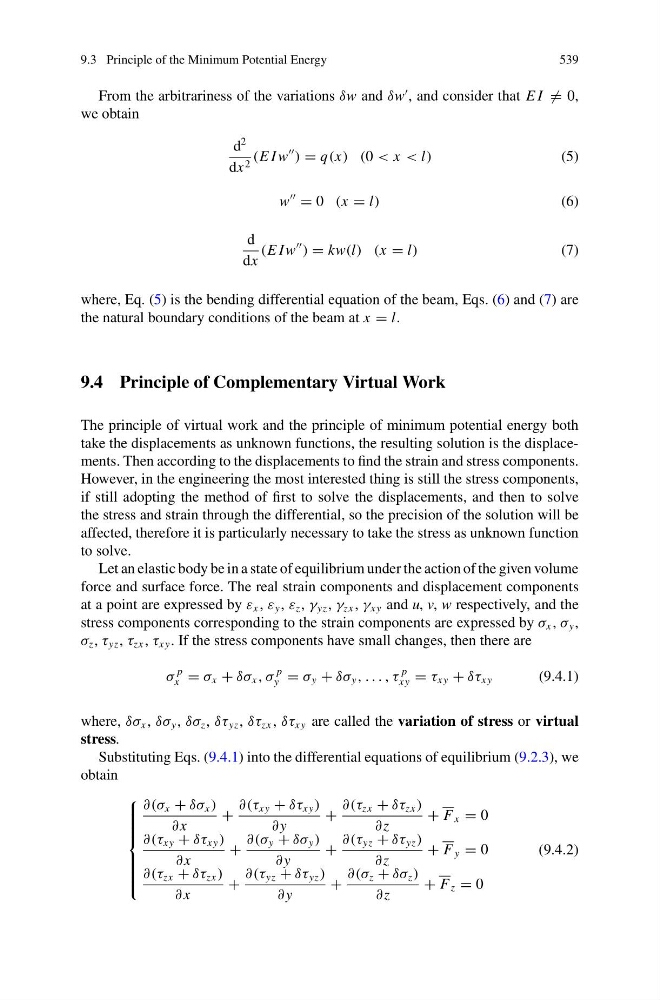
Substituting Eqs. (9.4.1) into the differential equations of equilibrium (9.2.3), we
obtain
⎧
⎪ ⎪ ⎪ ⎪ ⎪ ⎨
⎪ ⎪ ⎪ ⎪ ⎪ ⎩
∂(σ x + δσ x )
∂ x
+
∂(τ xy + δτ xy )
∂ y
+
∂(τ zx + δτ zx )
∂z
+ F x = 0
∂(τ xy + δτ xy )
∂ x
+
∂(σ y + δσ y )
∂ y
+
∂(τ yz + δτ yz )
∂z
+ F y = 0
∂(τ zx + δτ zx )
∂ x
+
∂(τ yz + δτ yz )
∂ y
+
∂(σ z + δσ z )
∂z
+ F z = 0
(9.4.2)
539
From the arbitrariness of the variations δw and δw
, and consider that E I = 0,
we obtain
d
2
dx 2 (E I w
) = q(x) (0 < x < l)
(5)
w
= 0 (x = l)
(6)
d
dx
(E I w
) = kw(l) (x = l)
(7)
where, Eq. (5) is the bending differential equation of the beam, Eqs. (6) and (7) are
the natural boundary conditions of the beam at x = l.
9.4 Principle of Complementary Virtual Work
The principle of virtual work and the principle of minimum potential energy both
take the displacements as unknown functions, the resulting solution is the displacements. Then according to the displacements to find the strain and stress components.
However, in the engineering the most interested thing is still the stress components,
if still adopting the method of first to solve the displacements, and then to solve
the stress and strain through the differential, so the precision of the solution will be
affected, therefore it is particularly necessary to take the stress as unknown function
to solve.
Let an elastic body be in a state of equilibrium under the action of the given volume
force and surface force. The real strain components and displacement components
at a point are expressed by ε x , ε y , ε z , γ yz , γ zx , γ xy and u, v, w respectively, and the
stress components corresponding to the strain components are expressed by σ x , σ y ,
σ z , τ yz , τ zx , τ xy . If the stress components have small changes, then there are
σ
p
x = σ x + δσ x , σ
p
y = σ y + δσ y , . . . , τ
p
xy = τ xy + δτ xy
(9.4.1)
where, δσ x , δσ y , δσ z , δτ yz , δτ zx , δτ xy are called the variation of stress or virtual
stress.
Substituting Eqs. (9.4.1) into the differential equations of equilibrium (9.2.3), we
obtain
⎧
⎪ ⎪ ⎪ ⎪ ⎪ ⎨
⎪ ⎪ ⎪ ⎪ ⎪ ⎩
∂(σ x + δσ x )
∂ x
+
∂(τ xy + δτ xy )
∂ y
+
∂(τ zx + δτ zx )
∂z
+ F x = 0
∂(τ xy + δτ xy )
∂ x
+
∂(σ y + δσ y )
∂ y
+
∂(τ yz + δτ yz )
∂z
+ F y = 0
∂(τ zx + δτ zx )
∂ x
+
∂(τ yz + δτ yz )
∂ y
+
∂(σ z + δσ z )
∂z
+ F z = 0
(9.4.2)