

9.2 Principle of Virtual Displacement
527
∂σ i j
∂ x j
+ F i = 0 (or ρu itt )
(9.2.4)
where, u itt =
∂
2 u i
∂t 2 .
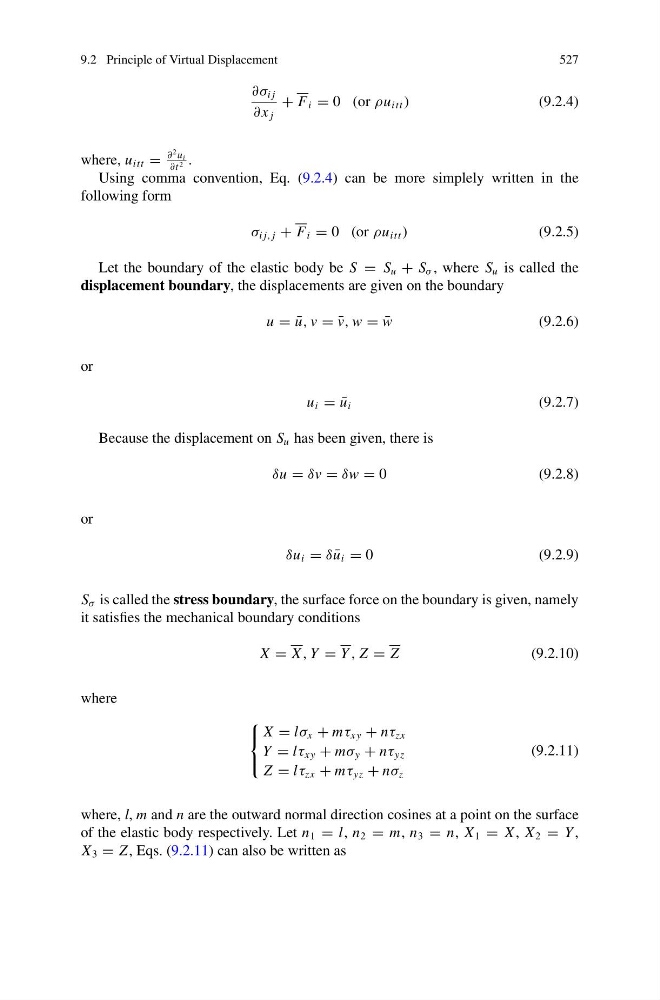
Using comma convention, Eq. (9.2.4) can be more simplely written in the
following form
σ i j, j + F i = 0 (or ρu itt )
(9.2.5)
Let the boundary of the elastic body be S = S u + S σ , where S u is called the
displacement boundary, the displacements are given on the boundary
u = ¯
u, v = ¯
v, w = ¯
w
(9.2.6)
or
u i = ¯
u i
(9.2.7)
Because the displacement on S u has been given, there is
δu = δv = δw = 0
(9.2.8)
or
δu i = δ ¯
u i = 0
(9.2.9)
S σ is called the stress boundary, the surface force on the boundary is given, namely
it satisfies the mechanical boundary conditions
X = X , Y = Y , Z = Z
(9.2.10)
where
⎧
⎨
⎩
X = lσ x + mτ xy + nτ zx
Y = lτ xy + mσ y + nτ yz
Z = lτ zx + mτ yz + nσ z
(9.2.11)
where, l, m and n are the outward normal direction cosines at a point on the surface
of the elastic body respectively. Let n 1 = l, n 2 = m, n 3 = n, X 1 = X , X 2 = Y ,
X 3 = Z , Eqs. (9.2.11) can also be written as
527
∂σ i j
∂ x j
+ F i = 0 (or ρu itt )
(9.2.4)
where, u itt =
∂
2 u i
∂t 2 .
Using comma convention, Eq. (9.2.4) can be more simplely written in the
following form
σ i j, j + F i = 0 (or ρu itt )
(9.2.5)
Let the boundary of the elastic body be S = S u + S σ , where S u is called the
displacement boundary, the displacements are given on the boundary
u = ¯
u, v = ¯
v, w = ¯
w
(9.2.6)
or
u i = ¯
u i
(9.2.7)
Because the displacement on S u has been given, there is
δu = δv = δw = 0
(9.2.8)
or
δu i = δ ¯
u i = 0
(9.2.9)
S σ is called the stress boundary, the surface force on the boundary is given, namely
it satisfies the mechanical boundary conditions
X = X , Y = Y , Z = Z
(9.2.10)
where
⎧
⎨
⎩
X = lσ x + mτ xy + nτ zx
Y = lτ xy + mσ y + nτ yz
Z = lτ zx + mτ yz + nσ z
(9.2.11)
where, l, m and n are the outward normal direction cosines at a point on the surface
of the elastic body respectively. Let n 1 = l, n 2 = m, n 3 = n, X 1 = X , X 2 = Y ,
X 3 = Z , Eqs. (9.2.11) can also be written as