

526
9 Variational Principles in Mechanics and Their Applications
is zero. Thus, from all possible motions of the system, it indeed selects the balance
such a real motion state, to be the corresponding real motion (i.e., equilibrium state)
when the virtual work of a functional takes extremum (virtual work is zero).
9.2.2 Principle of Generalized Virtual Displacement
for Elastic Body
The virtual displacement principle can be applied to the deformed body. Below the
expression of the principle of generalized virtual displacement for the elastic body
is derived.
Let the volume of an elastic body in rectangular coordinate system be V, the
surface is S, taking the elemental volume dV , the volume forces per unit vome are
F x , F y and F z , they are denoted by F i (i = 1, 2, 3), adding a bar on a letter indicates
that the quantity has been given, the surface forces per unit area are X, Y and Z, they
are denoted by X i . The stress components at a point are expressed by σ x , σ y , σ z , τ yz ,
τ zx , τ xy , they are denoted by σ i j . When an elastic body under the action of the forces
is in an equilibrium (or a motion) state, according to the theory of elastic mechanics,
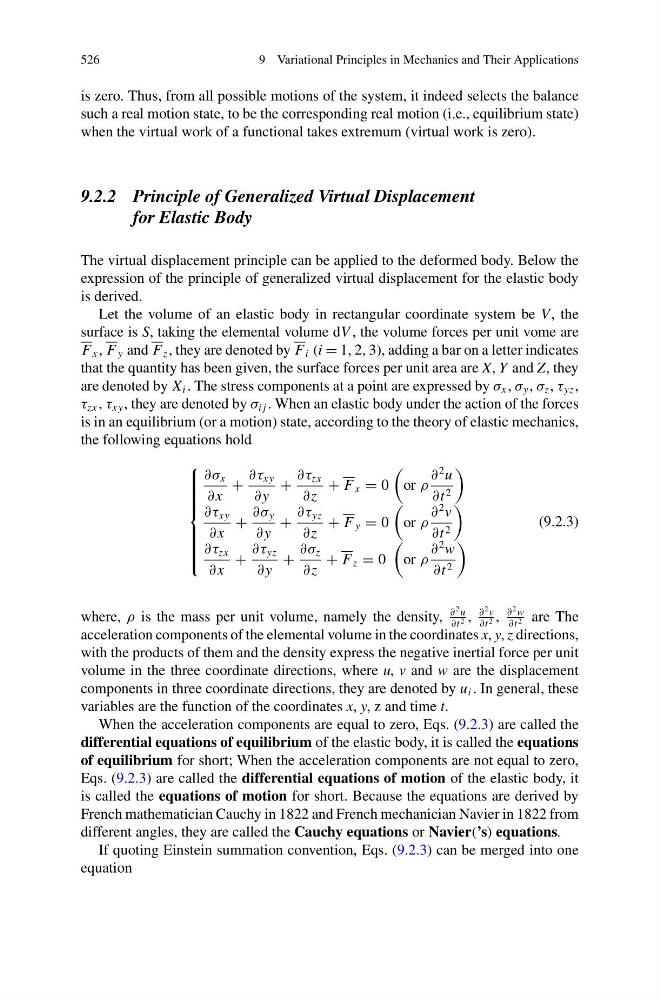
the following equations hold
⎧
⎪ ⎪ ⎪ ⎪ ⎪ ⎪ ⎨
⎪ ⎪ ⎪ ⎪ ⎪ ⎪ ⎩
∂σ x
∂ x
+
∂τ xy
∂ y
+
∂τ zx
∂z
+ F x = 0
or ρ
∂
2 u
∂t 2
∂τ xy
∂ x
+
∂σ y
∂ y
+
∂τ yz
∂z
+ F y = 0
or ρ
∂
2 v
∂t 2
∂τ zx
∂ x
+
∂τ yz
∂ y
+
∂σ z
∂z
+ F z = 0
or ρ
∂
2 w
∂t 2
(9.2.3)
where, ρ is the mass per unit volume, namely the density,
∂
2 u
∂t 2 ,
∂
2 v
∂t 2 ,
∂
2 w
∂t 2 are The
acceleration components of the elemental volume in the coordinates x, y, z directions,
with the products of them and the density express the negative inertial force per unit
volume in the three coordinate directions, where u, v and w are the displacement
components in three coordinate directions, they are denoted by u i . In general, these
variables are the function of the coordinates x, y, z and time t.
When the acceleration components are equal to zero, Eqs. (9.2.3) are called the
differential equations of equilibrium of the elastic body, it is called the equations
of equilibrium for short; When the acceleration components are not equal to zero,
Eqs. (9.2.3) are called the differential equations of motion of the elastic body, it
is called the equations of motion for short. Because the equations are derived by
French mathematician Cauchy in 1822 and French mechanician Navier in 1822 from
different angles, they are called the Cauchy equations or Navier(’s) equations.
If quoting Einstein summation convention, Eqs. (9.2.3) can be merged into one
equation
9 Variational Principles in Mechanics and Their Applications
is zero. Thus, from all possible motions of the system, it indeed selects the balance
such a real motion state, to be the corresponding real motion (i.e., equilibrium state)
when the virtual work of a functional takes extremum (virtual work is zero).
9.2.2 Principle of Generalized Virtual Displacement
for Elastic Body
The virtual displacement principle can be applied to the deformed body. Below the
expression of the principle of generalized virtual displacement for the elastic body
is derived.
Let the volume of an elastic body in rectangular coordinate system be V, the
surface is S, taking the elemental volume dV , the volume forces per unit vome are
F x , F y and F z , they are denoted by F i (i = 1, 2, 3), adding a bar on a letter indicates
that the quantity has been given, the surface forces per unit area are X, Y and Z, they
are denoted by X i . The stress components at a point are expressed by σ x , σ y , σ z , τ yz ,
τ zx , τ xy , they are denoted by σ i j . When an elastic body under the action of the forces
is in an equilibrium (or a motion) state, according to the theory of elastic mechanics,
the following equations hold
⎧
⎪ ⎪ ⎪ ⎪ ⎪ ⎪ ⎨
⎪ ⎪ ⎪ ⎪ ⎪ ⎪ ⎩
∂σ x
∂ x
+
∂τ xy
∂ y
+
∂τ zx
∂z
+ F x = 0
or ρ
∂
2 u
∂t 2
∂τ xy
∂ x
+
∂σ y
∂ y
+
∂τ yz
∂z
+ F y = 0
or ρ
∂
2 v
∂t 2
∂τ zx
∂ x
+
∂τ yz
∂ y
+
∂σ z
∂z
+ F z = 0
or ρ
∂
2 w
∂t 2
(9.2.3)
where, ρ is the mass per unit volume, namely the density,
∂
2 u
∂t 2 ,
∂
2 v
∂t 2 ,
∂
2 w
∂t 2 are The
acceleration components of the elemental volume in the coordinates x, y, z directions,
with the products of them and the density express the negative inertial force per unit
volume in the three coordinate directions, where u, v and w are the displacement
components in three coordinate directions, they are denoted by u i . In general, these
variables are the function of the coordinates x, y, z and time t.
When the acceleration components are equal to zero, Eqs. (9.2.3) are called the
differential equations of equilibrium of the elastic body, it is called the equations
of equilibrium for short; When the acceleration components are not equal to zero,
Eqs. (9.2.3) are called the differential equations of motion of the elastic body, it
is called the equations of motion for short. Because the equations are derived by
French mathematician Cauchy in 1822 and French mechanician Navier in 1822 from
different angles, they are called the Cauchy equations or Navier(’s) equations.
If quoting Einstein summation convention, Eqs. (9.2.3) can be merged into one
equation