

518
9 Variational Principles in Mechanics and Their Applications
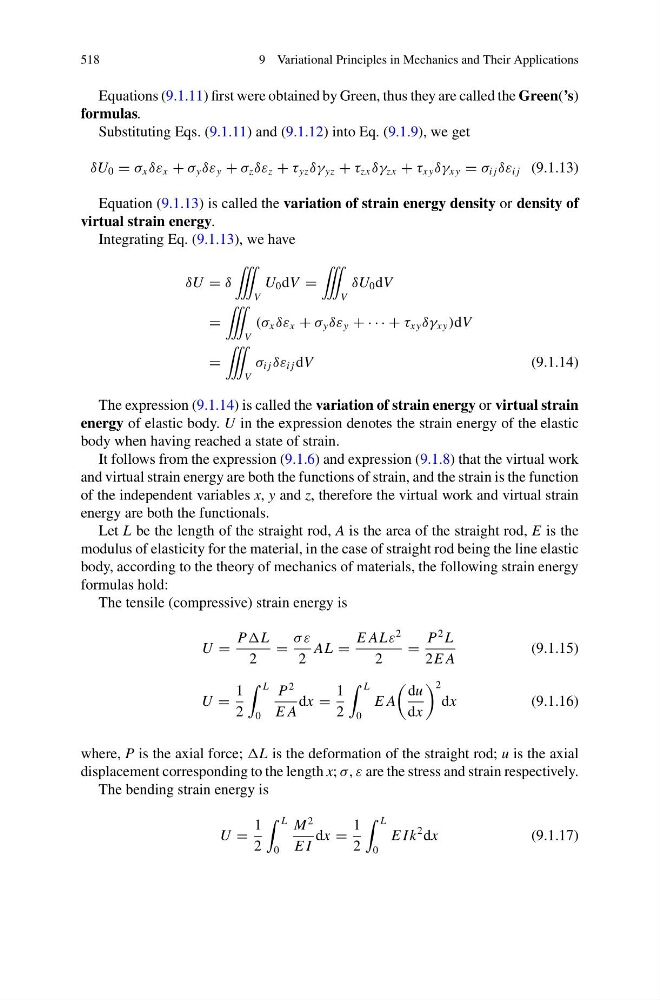
Equations (9.1.11) first were obtained by Green, thus they are called the Green(’s)
formulas.
Substituting Eqs. (9.1.11) and (9.1.12) into Eq. (9.1.9), we get
δU 0 = σ x δε x + σ y δε y + σ z δε z + τ yz δγ yz + τ zx δγ zx + τ xy δγ xy = σ i j δε i j (9.1.13)
Equation (9.1.13) is called the variation of strain energy density or density of
virtual strain energy.
Integrating Eq. (9.1.13), we have
δU = δ
˚
V
U 0 dV =
˚
V
δU 0 dV
=
˚
V
(σ x δε x + σ y δε y + · · · + τ xy δγ xy )dV
=
˚
V
σ i j δε i j dV
(9.1.14)
The expression (9.1.14) is called the variation of strain energy or virtual strain
energy of elastic body. U in the expression denotes the strain energy of the elastic
body when having reached a state of strain.
It follows from the expression (9.1.6) and expression (9.1.8) that the virtual work
and virtual strain energy are both the functions of strain, and the strain is the function
of the independent variables x, y and z, therefore the virtual work and virtual strain
energy are both the functionals.
Let L be the length of the straight rod, A is the area of the straight rod, E is the
modulus of elasticity for the material, in the case of straight rod being the line elastic
body, according to the theory of mechanics of materials, the following strain energy
formulas hold:
The tensile (compressive) strain energy is
U =
PL
2
=
σ ε
2
AL =
E ALε
2
2
=
P
2 L
2E A
(9.1.15)
U =
1
2
L
0
P
2
E A
dx =
1
2
L
0
E A
du
dx
2
dx
(9.1.16)
where, P is the axial force; L is the deformation of the straight rod; u is the axial
displacement corresponding to the length x; σ, ε are the stress and strain respectively.
The bending strain energy is
U =
1
2
L
0
M
2
E I
dx =
1
2
L
0
E I k
2 dx
(9.1.17)
9 Variational Principles in Mechanics and Their Applications
Equations (9.1.11) first were obtained by Green, thus they are called the Green(’s)
formulas.
Substituting Eqs. (9.1.11) and (9.1.12) into Eq. (9.1.9), we get
δU 0 = σ x δε x + σ y δε y + σ z δε z + τ yz δγ yz + τ zx δγ zx + τ xy δγ xy = σ i j δε i j (9.1.13)
Equation (9.1.13) is called the variation of strain energy density or density of
virtual strain energy.
Integrating Eq. (9.1.13), we have
δU = δ
˚
V
U 0 dV =
˚
V
δU 0 dV
=
˚
V
(σ x δε x + σ y δε y + · · · + τ xy δγ xy )dV
=
˚
V
σ i j δε i j dV
(9.1.14)
The expression (9.1.14) is called the variation of strain energy or virtual strain
energy of elastic body. U in the expression denotes the strain energy of the elastic
body when having reached a state of strain.
It follows from the expression (9.1.6) and expression (9.1.8) that the virtual work
and virtual strain energy are both the functions of strain, and the strain is the function
of the independent variables x, y and z, therefore the virtual work and virtual strain
energy are both the functionals.
Let L be the length of the straight rod, A is the area of the straight rod, E is the
modulus of elasticity for the material, in the case of straight rod being the line elastic
body, according to the theory of mechanics of materials, the following strain energy
formulas hold:
The tensile (compressive) strain energy is
U =
PL
2
=
σ ε
2
AL =
E ALε
2
2
=
P
2 L
2E A
(9.1.15)
U =
1
2
L
0
P
2
E A
dx =
1
2
L
0
E A
du
dx
2
dx
(9.1.16)
where, P is the axial force; L is the deformation of the straight rod; u is the axial
displacement corresponding to the length x; σ, ε are the stress and strain respectively.
The bending strain energy is
U =
1
2
L
0
M
2
E I
dx =
1
2
L
0
E I k
2 dx
(9.1.17)