

9.1 Fundamental Conceptions in Mechanics
517
where, W 0 is total work per unit volume, it is called the specific work, δW 0 is the
increment of specific work.
When the object under the action of external load produces elastic strain, then the
external load does the work to elastic body, namely the outside in the form of work of
the external force inputs energy to the elastic body. If the energy loss in the process
of deformation, the kinetic energy of the elastic body and the external damping etc.
are not considered, then the work done by the external force will put all the energy
stored in the elastic body. When the external load is removed, the energy stored in the
elastic body will all be released, such that the object is restored to the original shape,
This kind of energy storing in the elastic body often is called the strain energy or
energy of deformation, it is denoted by U. The strain energy only depends on the
strain or stress state, it is the function of strain or stress, and has nothing to do with
the force exerted and deformation process. It follows that the strain energy represents
the work done by the external force to the object. The strain energy per unit volume
is called the strain energy density or specific strain energy, it is called the strain
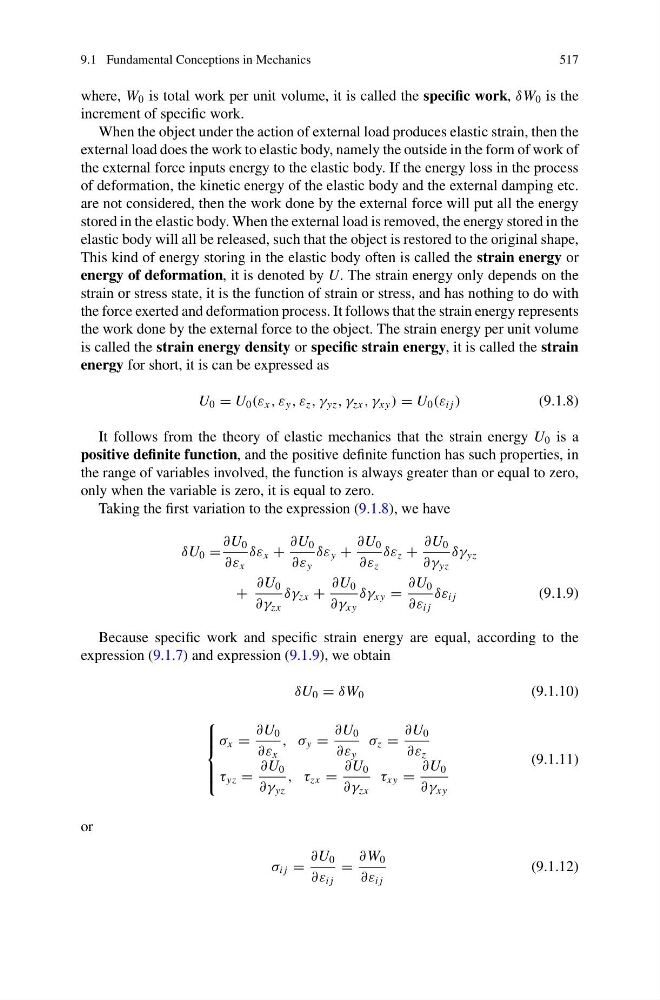
energy for short, it is can be expressed as
U 0 = U 0 (ε x , ε y , ε z , γ yz , γ zx , γ xy ) = U 0 (ε i j )
(9.1.8)
It follows from the theory of elastic mechanics that the strain energy U 0 is a
positive definite function, and the positive definite function has such properties, in
the range of variables involved, the function is always greater than or equal to zero,
only when the variable is zero, it is equal to zero.
Taking the first variation to the expression (9.1.8), we have
δU 0 =
∂U 0
∂ε x
δε x +
∂U 0
∂ε y
δε y +
∂U 0
∂ε z
δε z +
∂U 0
∂γ yz
δγ yz
+
∂U 0
∂γ zx
δγ zx +
∂U 0
∂γ xy
δγ xy =
∂U 0
∂ε i j
δε i j
(9.1.9)
Because specific work and specific strain energy are equal, according to the
expression (9.1.7) and expression (9.1.9), we obtain
δU 0 = δW 0
(9.1.10)
⎧
⎪ ⎪ ⎨
⎪ ⎪ ⎩
σ x =
∂U 0
∂ε x
, σ y =
∂U 0
∂ε y
σ z =
∂U 0
∂ε z
τ yz =
∂U 0
∂γ yz
, τ zx =
∂U 0
∂γ zx
τ xy =
∂U 0
∂γ xy
(9.1.11)
or
σ i j =
∂U 0
∂ε i j
=
∂ W 0
∂ε i j
(9.1.12)
517
where, W 0 is total work per unit volume, it is called the specific work, δW 0 is the
increment of specific work.
When the object under the action of external load produces elastic strain, then the
external load does the work to elastic body, namely the outside in the form of work of
the external force inputs energy to the elastic body. If the energy loss in the process
of deformation, the kinetic energy of the elastic body and the external damping etc.
are not considered, then the work done by the external force will put all the energy
stored in the elastic body. When the external load is removed, the energy stored in the
elastic body will all be released, such that the object is restored to the original shape,
This kind of energy storing in the elastic body often is called the strain energy or
energy of deformation, it is denoted by U. The strain energy only depends on the
strain or stress state, it is the function of strain or stress, and has nothing to do with
the force exerted and deformation process. It follows that the strain energy represents
the work done by the external force to the object. The strain energy per unit volume
is called the strain energy density or specific strain energy, it is called the strain
energy for short, it is can be expressed as
U 0 = U 0 (ε x , ε y , ε z , γ yz , γ zx , γ xy ) = U 0 (ε i j )
(9.1.8)
It follows from the theory of elastic mechanics that the strain energy U 0 is a
positive definite function, and the positive definite function has such properties, in
the range of variables involved, the function is always greater than or equal to zero,
only when the variable is zero, it is equal to zero.
Taking the first variation to the expression (9.1.8), we have
δU 0 =
∂U 0
∂ε x
δε x +
∂U 0
∂ε y
δε y +
∂U 0
∂ε z
δε z +
∂U 0
∂γ yz
δγ yz
+
∂U 0
∂γ zx
δγ zx +
∂U 0
∂γ xy
δγ xy =
∂U 0
∂ε i j
δε i j
(9.1.9)
Because specific work and specific strain energy are equal, according to the
expression (9.1.7) and expression (9.1.9), we obtain
δU 0 = δW 0
(9.1.10)
⎧
⎪ ⎪ ⎨
⎪ ⎪ ⎩
σ x =
∂U 0
∂ε x
, σ y =
∂U 0
∂ε y
σ z =
∂U 0
∂ε z
τ yz =
∂U 0
∂γ yz
, τ zx =
∂U 0
∂γ zx
τ xy =
∂U 0
∂γ xy
(9.1.11)
or
σ i j =
∂U 0
∂ε i j
=
∂ W 0
∂ε i j
(9.1.12)