

9.1 Fundamental Conceptions in Mechanics
519
where, M is the bending moment; k is the curvature; EI is flexural rigidity of the
straight rod; I is the moment of inertia of the section.
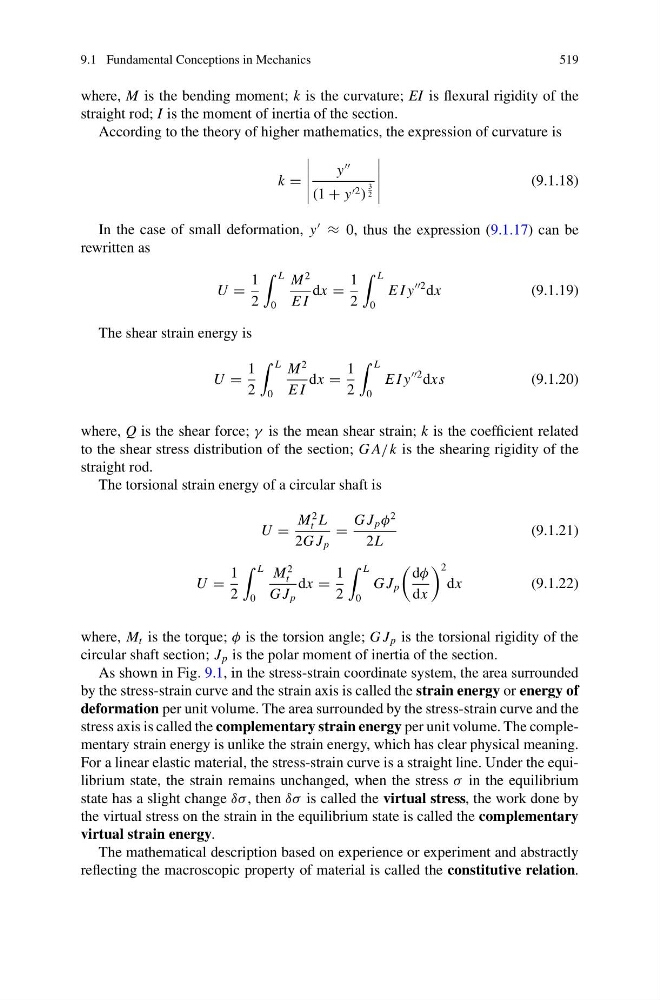
According to the theory of higher mathematics, the expression of curvature is
k =
y
(1 + y 2 )
3
2
(9.1.18)
In the case of small deformation, y
≈ 0, thus the expression (9.1.17) can be
rewritten as
U =
1
2
L
0
M
2
E I
dx =
1
2
L
0
E I y
2 dx
(9.1.19)
The shear strain energy is
U =
1
2
L
0
M
2
E I
dx =
1
2
L
0
E I y
2 dxs
(9.1.20)
where, Q is the shear force; γ is the mean shear strain; k is the coefficient related
to the shear stress distribution of the section; G A/k is the shearing rigidity of the
straight rod.
The torsional strain energy of a circular shaft is
U =
M
2
t L
2G J p
=
G J p φ
2
2L
(9.1.21)
U =
1
2
L
0
M
2
t
G J p
dx =
1
2
L
0
G J p
dφ
dx
2
dx
(9.1.22)
where, M t is the torque; φ is the torsion angle; G J p is the torsional rigidity of the
circular shaft section; J p is the polar moment of inertia of the section.
As shown in Fig. 9.1, in the stress-strain coordinate system, the area surrounded
by the stress-strain curve and the strain axis is called the strain energy or energy of
deformation per unit volume. The area surrounded by the stress-strain curve and the
stress axis is called the complementary strain energy per unit volume. The complementary strain energy is unlike the strain energy, which has clear physical meaning.
For a linear elastic material, the stress-strain curve is a straight line. Under the equilibrium state, the strain remains unchanged, when the stress σ in the equilibrium
state has a slight change δσ, then δσ is called the virtual stress, the work done by
the virtual stress on the strain in the equilibrium state is called the complementary
virtual strain energy.
The mathematical description based on experience or experiment and abstractly
reflecting the macroscopic property of material is called the constitutive relation.
519
where, M is the bending moment; k is the curvature; EI is flexural rigidity of the
straight rod; I is the moment of inertia of the section.
According to the theory of higher mathematics, the expression of curvature is
k =
y
(1 + y 2 )
3
2
(9.1.18)
In the case of small deformation, y
≈ 0, thus the expression (9.1.17) can be
rewritten as
U =
1
2
L
0
M
2
E I
dx =
1
2
L
0
E I y
2 dx
(9.1.19)
The shear strain energy is
U =
1
2
L
0
M
2
E I
dx =
1
2
L
0
E I y
2 dxs
(9.1.20)
where, Q is the shear force; γ is the mean shear strain; k is the coefficient related
to the shear stress distribution of the section; G A/k is the shearing rigidity of the
straight rod.
The torsional strain energy of a circular shaft is
U =
M
2
t L
2G J p
=
G J p φ
2
2L
(9.1.21)
U =
1
2
L
0
M
2
t
G J p
dx =
1
2
L
0
G J p
dφ
dx
2
dx
(9.1.22)
where, M t is the torque; φ is the torsion angle; G J p is the torsional rigidity of the
circular shaft section; J p is the polar moment of inertia of the section.
As shown in Fig. 9.1, in the stress-strain coordinate system, the area surrounded
by the stress-strain curve and the strain axis is called the strain energy or energy of
deformation per unit volume. The area surrounded by the stress-strain curve and the
stress axis is called the complementary strain energy per unit volume. The complementary strain energy is unlike the strain energy, which has clear physical meaning.
For a linear elastic material, the stress-strain curve is a straight line. Under the equilibrium state, the strain remains unchanged, when the stress σ in the equilibrium
state has a slight change δσ, then δσ is called the virtual stress, the work done by
the virtual stress on the strain in the equilibrium state is called the complementary
virtual strain energy.
The mathematical description based on experience or experiment and abstractly
reflecting the macroscopic property of material is called the constitutive relation.