

462
8 Direct Methods of Variational Problems
y n =
n
k=1
a k ϕ k (x)
(8.3.2)
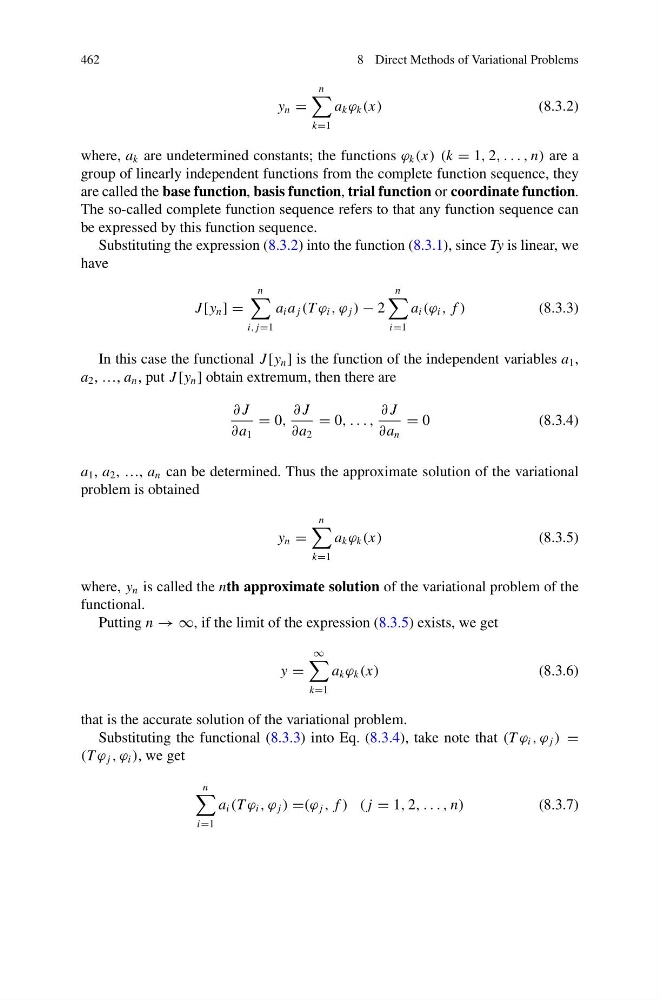
where, a k are undetermined constants; the functions ϕ k (x) (k = 1, 2, . . . , n) are a
group of linearly independent functions from the complete function sequence, they
are called the base function, basis function, trial function or coordinate function.
The so-called complete function sequence refers to that any function sequence can
be expressed by this function sequence.
Substituting the expression (8.3.2) into the function (8.3.1), since Ty is linear, we
have
J [y n ] =
n
i, j=1
a i a j (T ϕ i , ϕ j ) − 2
n
i=1
a i (ϕ i , f )
(8.3.3)
In this case the functional J [y n ] is the function of the independent variables a 1 ,
a 2 , …, a n , put J [y n ] obtain extremum, then there are
∂ J
∂a 1
= 0,
∂ J
∂a 2
= 0, . . . ,
∂ J
∂a n
= 0
(8.3.4)
a 1 , a 2 , …, a n can be determined. Thus the approximate solution of the variational
problem is obtained
y n =
n
k=1
a k ϕ k (x)
(8.3.5)
where, y n is called the nth approximate solution of the variational problem of the
functional.
Putting n → ∞, if the limit of the expression (8.3.5) exists, we get
y =
∞
k=1
a k ϕ k (x)
(8.3.6)
that is the accurate solution of the variational problem.
Substituting the functional (8.3.3) into Eq. (8.3.4), take note that (T ϕ i , ϕ j ) =
(T ϕ j , ϕ i ), we get
n
i=1
a i (T ϕ i , ϕ j ) =(ϕ j , f ) ( j = 1, 2, . . . , n)
(8.3.7)
8 Direct Methods of Variational Problems
y n =
n
k=1
a k ϕ k (x)
(8.3.2)
where, a k are undetermined constants; the functions ϕ k (x) (k = 1, 2, . . . , n) are a
group of linearly independent functions from the complete function sequence, they
are called the base function, basis function, trial function or coordinate function.
The so-called complete function sequence refers to that any function sequence can
be expressed by this function sequence.
Substituting the expression (8.3.2) into the function (8.3.1), since Ty is linear, we
have
J [y n ] =
n
i, j=1
a i a j (T ϕ i , ϕ j ) − 2
n
i=1
a i (ϕ i , f )
(8.3.3)
In this case the functional J [y n ] is the function of the independent variables a 1 ,
a 2 , …, a n , put J [y n ] obtain extremum, then there are
∂ J
∂a 1
= 0,
∂ J
∂a 2
= 0, . . . ,
∂ J
∂a n
= 0
(8.3.4)
a 1 , a 2 , …, a n can be determined. Thus the approximate solution of the variational
problem is obtained
y n =
n
k=1
a k ϕ k (x)
(8.3.5)
where, y n is called the nth approximate solution of the variational problem of the
functional.
Putting n → ∞, if the limit of the expression (8.3.5) exists, we get
y =
∞
k=1
a k ϕ k (x)
(8.3.6)
that is the accurate solution of the variational problem.
Substituting the functional (8.3.3) into Eq. (8.3.4), take note that (T ϕ i , ϕ j ) =
(T ϕ j , ϕ i ), we get
n
i=1
a i (T ϕ i , ϕ j ) =(ϕ j , f ) ( j = 1, 2, . . . , n)
(8.3.7)