

450
7 Variational Principles
Problems 7
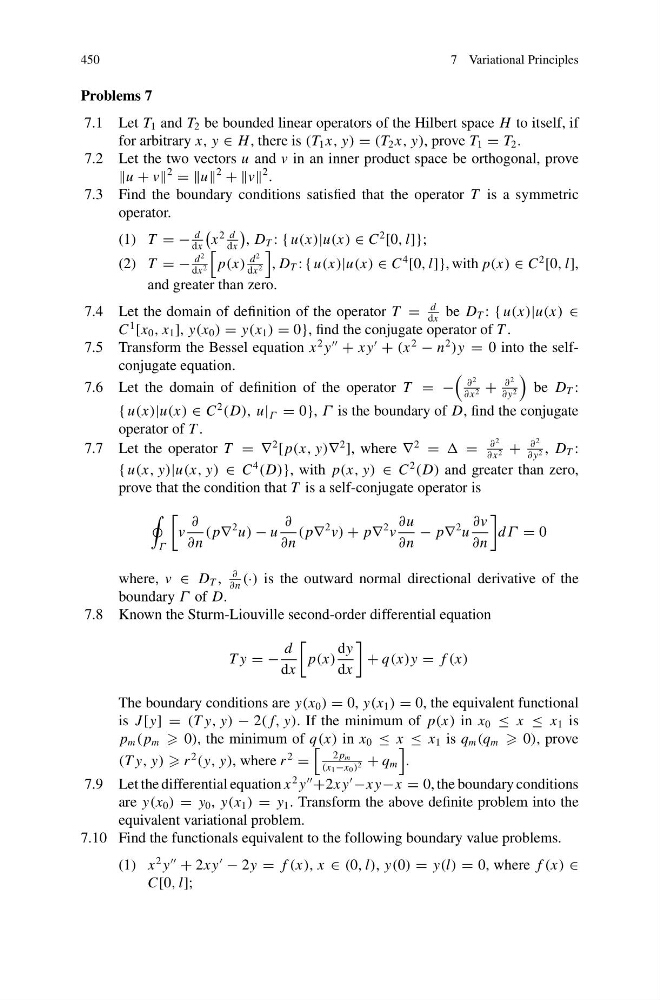
7.1 Let T 1 and T 2 be bounded linear operators of the Hilbert space H to itself, if
for arbitrary x, y ∈ H , there is (T 1 x, y) = (T 2 x, y), prove T 1 = T 2 .
7.2 Let the two vectors u and v in an inner product space be orthogonal, prove
u + v
2
= u
2
+ v
2 .
7.3 Find the boundary conditions satisfied that the operator T is a symmetric
operator.
(1) T = −
d
dx
x
2 d
dx
, D T : {u(x)|u(x) ∈ C
2
[0, l]};
(2) T = −
d
2
dx 2
p(x)
d
2
dx 2
, D T : { u(x)|u(x) ∈ C
4
[0, l]}, with p(x) ∈ C
2
[0, l],
and greater than zero.
7.4 Let the domain of definition of the operator T =
d
dx
be D T : {u(x)|u(x) ∈
C
1
[x 0 , x 1 ], y(x 0 ) = y(x 1 ) = 0}, find the conjugate operator of T .
7.5 Transform the Bessel equation x
2 y
+ x y
+ (x
2
− n
2
)y = 0 into the selfconjugate equation.
7.6 Let the domain of definition of the operator T = −
∂
2
∂ x 2 +
∂
2
∂ y 2
be D T :
{ u(x)|u(x) ∈ C
2
(D), u| Γ = 0}, Γ is the boundary of D, find the conjugate
operator of T .
7.7 Let the operator T = ∇
2
[ p(x, y)∇
2
], where ∇
2
= =
∂
2
∂ x 2 +
∂
2
∂ y 2 , D T :
{ u(x, y)|u(x, y) ∈ C
4
(D)}, with p(x, y) ∈ C
2
(D) and greater than zero,
prove that the condition that T is a self-conjugate operator is
Γ
v
∂
∂n
( p∇
2 u) − u
∂
∂n
( p∇
2 v) + p∇
2 v
∂u
∂n
− p∇
2 u
∂v
∂n
dΓ = 0
where, v ∈ D T ,
∂
∂n
(·) is the outward normal directional derivative of the
boundary Γ of D.
7.8 Known the Sturm-Liouville second-order differential equation
T y = −
d
dx
p(x)
dy
dx
+ q(x)y = f (x)
The boundary conditions are y(x 0 ) = 0, y(x 1 ) = 0, the equivalent functional
is J [y] = (T y, y) − 2( f, y). If the minimum of p(x) in x 0 ≤ x ≤ x 1 is
p m ( p m 0), the minimum of q(x) in x 0 ≤ x ≤ x 1 is q m (q m 0), prove
(T y, y) r
2
(y, y), where r
2
=
2 p m
(x 1 −x 0 ) 2 + q m
.
7.9 Let the differential equation x
2 y
+2x y
−x y−x = 0, the boundary conditions
are y(x 0 ) = y 0 , y(x 1 ) = y 1 . Transform the above definite problem into the
equivalent variational problem.
7.10 Find the functionals equivalent to the following boundary value problems.
(1) x
2 y
+ 2x y
− 2y = f (x), x ∈ (0, l), y(0) = y(l) = 0, where f (x) ∈
C[0, l];
7 Variational Principles
Problems 7
7.1 Let T 1 and T 2 be bounded linear operators of the Hilbert space H to itself, if
for arbitrary x, y ∈ H , there is (T 1 x, y) = (T 2 x, y), prove T 1 = T 2 .
7.2 Let the two vectors u and v in an inner product space be orthogonal, prove
u + v
2
= u
2
+ v
2 .
7.3 Find the boundary conditions satisfied that the operator T is a symmetric
operator.
(1) T = −
d
dx
x
2 d
dx
, D T : {u(x)|u(x) ∈ C
2
[0, l]};
(2) T = −
d
2
dx 2
p(x)
d
2
dx 2
, D T : { u(x)|u(x) ∈ C
4
[0, l]}, with p(x) ∈ C
2
[0, l],
and greater than zero.
7.4 Let the domain of definition of the operator T =
d
dx
be D T : {u(x)|u(x) ∈
C
1
[x 0 , x 1 ], y(x 0 ) = y(x 1 ) = 0}, find the conjugate operator of T .
7.5 Transform the Bessel equation x
2 y
+ x y
+ (x
2
− n
2
)y = 0 into the selfconjugate equation.
7.6 Let the domain of definition of the operator T = −
∂
2
∂ x 2 +
∂
2
∂ y 2
be D T :
{ u(x)|u(x) ∈ C
2
(D), u| Γ = 0}, Γ is the boundary of D, find the conjugate
operator of T .
7.7 Let the operator T = ∇
2
[ p(x, y)∇
2
], where ∇
2
= =
∂
2
∂ x 2 +
∂
2
∂ y 2 , D T :
{ u(x, y)|u(x, y) ∈ C
4
(D)}, with p(x, y) ∈ C
2
(D) and greater than zero,
prove that the condition that T is a self-conjugate operator is
Γ
v
∂
∂n
( p∇
2 u) − u
∂
∂n
( p∇
2 v) + p∇
2 v
∂u
∂n
− p∇
2 u
∂v
∂n
dΓ = 0
where, v ∈ D T ,
∂
∂n
(·) is the outward normal directional derivative of the
boundary Γ of D.
7.8 Known the Sturm-Liouville second-order differential equation
T y = −
d
dx
p(x)
dy
dx
+ q(x)y = f (x)
The boundary conditions are y(x 0 ) = 0, y(x 1 ) = 0, the equivalent functional
is J [y] = (T y, y) − 2( f, y). If the minimum of p(x) in x 0 ≤ x ≤ x 1 is
p m ( p m 0), the minimum of q(x) in x 0 ≤ x ≤ x 1 is q m (q m 0), prove
(T y, y) r
2
(y, y), where r
2
=
2 p m
(x 1 −x 0 ) 2 + q m
.
7.9 Let the differential equation x
2 y
+2x y
−x y−x = 0, the boundary conditions
are y(x 0 ) = y 0 , y(x 1 ) = y 1 . Transform the above definite problem into the
equivalent variational problem.
7.10 Find the functionals equivalent to the following boundary value problems.
(1) x
2 y
+ 2x y
− 2y = f (x), x ∈ (0, l), y(0) = y(l) = 0, where f (x) ∈
C[0, l];