

7.10 To the Famous Scientists
451
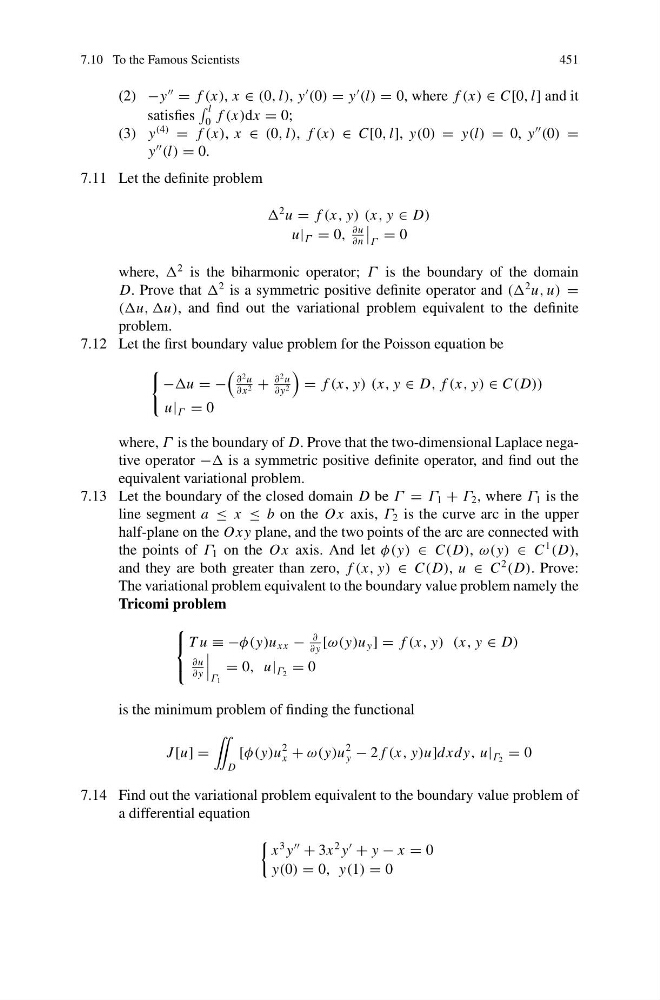
(2) −y
= f (x), x ∈ (0, l), y
(0) = y
(l) = 0, where f (x) ∈ C[0, l] and it
satisfies
l
0 f (x)dx = 0;
(3) y
(4)
= f (x), x ∈ (0, l), f (x) ∈ C[0, l], y(0) = y(l) = 0, y
(0) =
y
(l) = 0.
7.11 Let the definite problem
2 u = f (x, y) (x, y ∈ D)
u| Γ = 0,
∂u
∂n
Γ
= 0
where,
2 is the biharmonic operator; Γ is the boundary of the domain
D. Prove that
2 is a symmetric positive definite operator and ((
2 u, u) =
((u, ,u), and find out the variational problem equivalent to the definite
problem.
7.12 Let the first boundary value problem for the Poisson equation be
−u = −
∂
2 u
∂ x 2 +
∂
2 u
∂ y 2
= f (x, y) (x, y ∈ D, f (x, y) ∈ C(D))
u| Γ = 0
where, Γ is the boundary of D. Prove that the two-dimensional Laplace negative operator − is a symmetric positive definite operator, and find out the
equivalent variational problem.
7.13 Let the boundary of the closed domain D be Γ = Γ 1 + Γ 2 , where Γ 1 is the
line segment a ≤ x ≤ b on the Ox axis, Γ 2 is the curve arc in the upper
half-plane on the Ox y plane, and the two points of the arc are connected with
the points of Γ 1 on the Ox axis. And let φ(y) ∈ C(D), ω(y) ∈ C
1
(D),
and they are both greater than zero, f (x, y) ∈ C(D), u ∈ C
2
(D). Prove:
The variational problem equivalent to the boundary value problem namely the
Tricomi problem
⎧
⎨
⎩
T u ≡ −φ(y)u xx −
∂
∂ y
[ω(y)u y ] = f (x, y) (x, y ∈ D)
∂u
∂ y
Γ 1
= 0, u| Γ 2 = 0
is the minimum problem of finding the functional
J [u] =
¨
D
[φ(y)u
2
x + ω(y)u
2
y − 2 f (x, y)u]dxdy, u| Γ 2 = 0
7.14 Find out the variational problem equivalent to the boundary value problem of
a differential equation
x
3 y
+ 3x
2 y
+ y − x = 0
y(0) = 0, y(1) = 0
451
(2) −y
= f (x), x ∈ (0, l), y
(0) = y
(l) = 0, where f (x) ∈ C[0, l] and it
satisfies
l
0 f (x)dx = 0;
(3) y
(4)
= f (x), x ∈ (0, l), f (x) ∈ C[0, l], y(0) = y(l) = 0, y
(0) =
y
(l) = 0.
7.11 Let the definite problem
2 u = f (x, y) (x, y ∈ D)
u| Γ = 0,
∂u
∂n
Γ
= 0
where,
2 is the biharmonic operator; Γ is the boundary of the domain
D. Prove that
2 is a symmetric positive definite operator and ((
2 u, u) =
((u, ,u), and find out the variational problem equivalent to the definite
problem.
7.12 Let the first boundary value problem for the Poisson equation be
−u = −
∂
2 u
∂ x 2 +
∂
2 u
∂ y 2
= f (x, y) (x, y ∈ D, f (x, y) ∈ C(D))
u| Γ = 0
where, Γ is the boundary of D. Prove that the two-dimensional Laplace negative operator − is a symmetric positive definite operator, and find out the
equivalent variational problem.
7.13 Let the boundary of the closed domain D be Γ = Γ 1 + Γ 2 , where Γ 1 is the
line segment a ≤ x ≤ b on the Ox axis, Γ 2 is the curve arc in the upper
half-plane on the Ox y plane, and the two points of the arc are connected with
the points of Γ 1 on the Ox axis. And let φ(y) ∈ C(D), ω(y) ∈ C
1
(D),
and they are both greater than zero, f (x, y) ∈ C(D), u ∈ C
2
(D). Prove:
The variational problem equivalent to the boundary value problem namely the
Tricomi problem
⎧
⎨
⎩
T u ≡ −φ(y)u xx −
∂
∂ y
[ω(y)u y ] = f (x, y) (x, y ∈ D)
∂u
∂ y
Γ 1
= 0, u| Γ 2 = 0
is the minimum problem of finding the functional
J [u] =
¨
D
[φ(y)u
2
x + ω(y)u
2
y − 2 f (x, y)u]dxdy, u| Γ 2 = 0
7.14 Find out the variational problem equivalent to the boundary value problem of
a differential equation
x
3 y
+ 3x
2 y
+ y − x = 0
y(0) = 0, y(1) = 0