

7.9 The Friedrichs Inequality and Poincaré Inequality
439
g
= −
π
2
16(b − a) 2 g
(7.9.14)
so that
v
2 gg
= −
π
2
16(b − a) 2 v
2 g
2
= −
π
2
16(b − a) 2 u
2
(7.9.15)
Since
g
g
= −
π
4(b − a)
tan
π(x − a)
4(b − a)
(7.9.16)
and
g
(a)
g(a)
= 0,
g
(b)
g(b)
= −
π
4(b − a)
tan
π
4
= −
π
4(b − a)
(7.9.17)
so that
v
2 gg
b
a
= v
2 g
2 g
g
b
a
= u
2 g
g
b
a
= −
π
4(b − a)
u
2
(b)
(7.9.18)
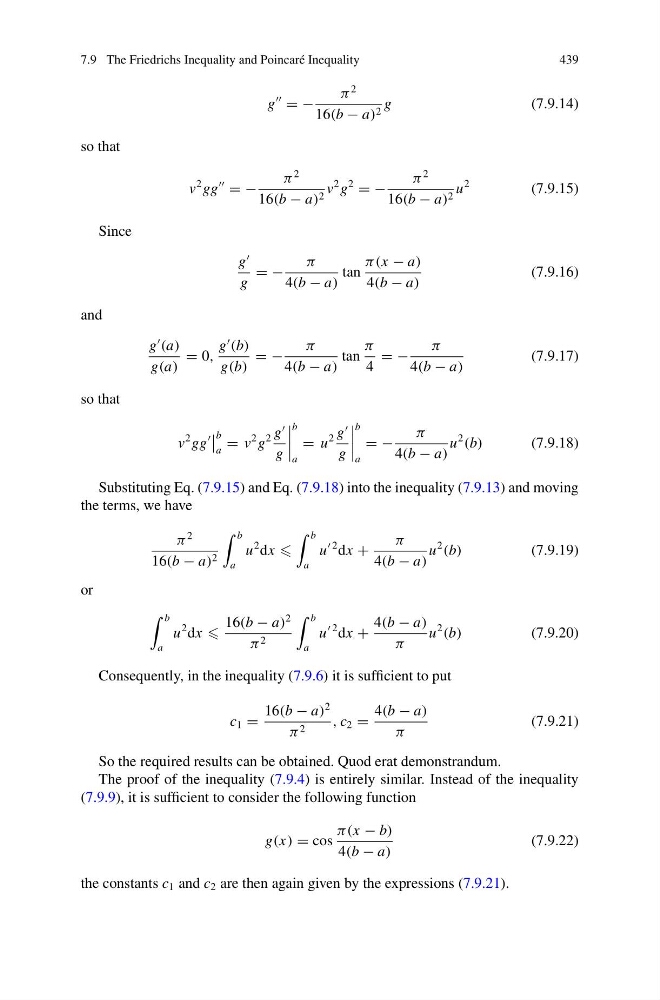
Substituting Eq. (7.9.15) and Eq. (7.9.18) into the inequality (7.9.13) and moving
the terms, we have
π
2
16(b − a) 2
b
a
u
2 dx
b
a
u
2 dx +
π
4(b − a)
u
2
(b)
(7.9.19)
or
b
a
u
2 dx
16(b − a)
2
π 2
b
a
u
2 dx +
4(b − a)
π
u
2
(b)
(7.9.20)
Consequently, in the inequality (7.9.6) it is sufficient to put
c 1 =
16(b − a)
2
π 2
, c 2 =
4(b − a)
π
(7.9.21)
So the required results can be obtained. Quod erat demonstrandum.
The proof of the inequality (7.9.4) is entirely similar. Instead of the inequality
(7.9.9), it is sufficient to consider the following function
g(x) = cos
π(x − b)
4(b − a)
(7.9.22)
the constants c 1 and c 2 are then again given by the expressions (7.9.21).
439
g
= −
π
2
16(b − a) 2 g
(7.9.14)
so that
v
2 gg
= −
π
2
16(b − a) 2 v
2 g
2
= −
π
2
16(b − a) 2 u
2
(7.9.15)
Since
g
g
= −
π
4(b − a)
tan
π(x − a)
4(b − a)
(7.9.16)
and
g
(a)
g(a)
= 0,
g
(b)
g(b)
= −
π
4(b − a)
tan
π
4
= −
π
4(b − a)
(7.9.17)
so that
v
2 gg
b
a
= v
2 g
2 g
g
b
a
= u
2 g
g
b
a
= −
π
4(b − a)
u
2
(b)
(7.9.18)
Substituting Eq. (7.9.15) and Eq. (7.9.18) into the inequality (7.9.13) and moving
the terms, we have
π
2
16(b − a) 2
b
a
u
2 dx
b
a
u
2 dx +
π
4(b − a)
u
2
(b)
(7.9.19)
or
b
a
u
2 dx
16(b − a)
2
π 2
b
a
u
2 dx +
4(b − a)
π
u
2
(b)
(7.9.20)
Consequently, in the inequality (7.9.6) it is sufficient to put
c 1 =
16(b − a)
2
π 2
, c 2 =
4(b − a)
π
(7.9.21)
So the required results can be obtained. Quod erat demonstrandum.
The proof of the inequality (7.9.4) is entirely similar. Instead of the inequality
(7.9.9), it is sufficient to consider the following function
g(x) = cos
π(x − b)
4(b − a)
(7.9.22)
the constants c 1 and c 2 are then again given by the expressions (7.9.21).