

440
7 Variational Principles
The inequality (7.9.7) is a consequence of the inequality (7.9.6) or of the inequality
(7.9.5), so that for the values of c 1 and c 2 , the expressions (7.9.21) can be taken again.
However, in this case, it is possible to improve the obtained estimates in a simple
way if the just described proof is performed with the following function
g(x) = cos
π
x −
a+b
2
4(b − a)
(7.9.23)
Then it is easily verified by direct calculation, that in the inequality (7.9.7) it is
possible to take
c 1 =
4(b − a)
2
π 2
, c 2 =
2(b − a)
π
(7.9.24)
Below to prove the inequality (7.9.8).
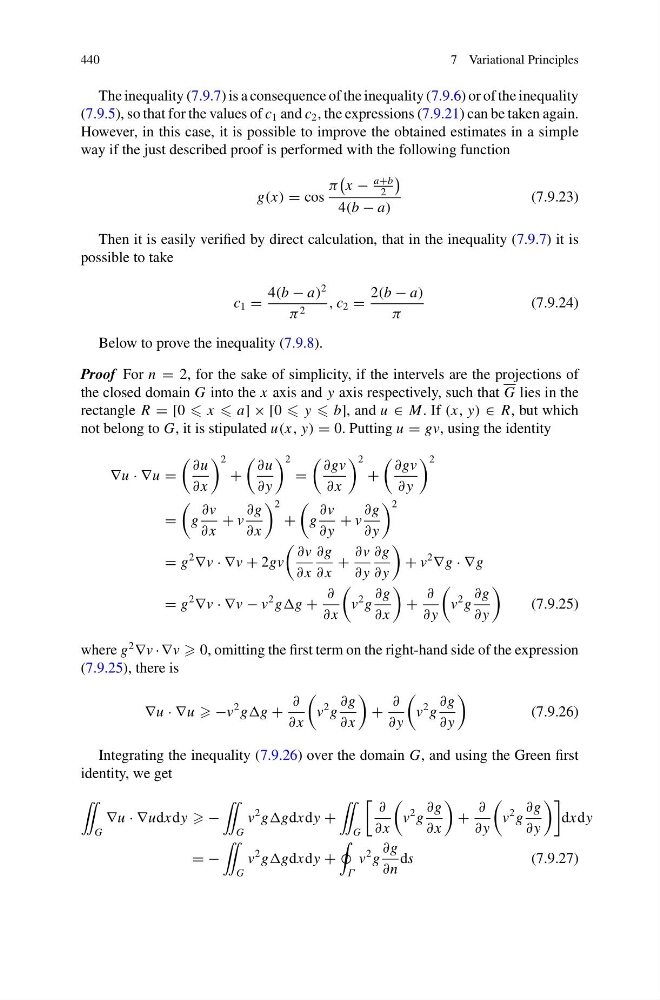
Proof For n = 2, for the sake of simplicity, if the intervels are the projections of
the closed domain G into the x axis and y axis respectively, such that G lies in the
rectangle R = [0 x a] × [0 y b], and u ∈ M. If (x, y) ∈ R, but which
not belong to G, it is stipulated u(x, y) = 0. Putting u = gv, using the identity
∇u · ∇u =
∂u
∂ x
2
+
∂u
∂ y
2
=
∂gv
∂ x
2
+
∂gv
∂ y
2
=
g
∂v
∂ x
+ v
∂g
∂ x
2
+
g
∂v
∂ y
+ v
∂g
∂ y
2
= g
2
∇v · ∇v + 2gv
∂v
∂ x
∂g
∂ x
+
∂v
∂ y
∂g
∂ y
+ v
2
∇g · ∇g
= g
2
∇v · ∇v − v
2 gg +
∂
∂ x
v
2 g
∂g
∂ x
+
∂
∂ y
v
2 g
∂g
∂ y
(7.9.25)
where g
2
∇v · ∇v 0, omitting the first term on the right-hand side of the expression
(7.9.25), there is
∇u · ∇u −v
2 gg +
∂
∂ x
v
2 g
∂g
∂ x
+
∂
∂ y
v
2 g
∂g
∂ y
(7.9.26)
Integrating the inequality (7.9.26) over the domain G, and using the Green first
identity, we get
¨
G
∇u · ∇udxdy −
¨
G
v
2 ggdxdy +
¨
G
∂
∂ x
v
2 g
∂g
∂ x
+
∂
∂ y
v
2 g
∂g
∂ y
dxdy
= −
¨
G
v
2 ggdxdy +
Γ
v
2 g
∂g
∂n
ds
(7.9.27)
7 Variational Principles
The inequality (7.9.7) is a consequence of the inequality (7.9.6) or of the inequality
(7.9.5), so that for the values of c 1 and c 2 , the expressions (7.9.21) can be taken again.
However, in this case, it is possible to improve the obtained estimates in a simple
way if the just described proof is performed with the following function
g(x) = cos
π
x −
a+b
2
4(b − a)
(7.9.23)
Then it is easily verified by direct calculation, that in the inequality (7.9.7) it is
possible to take
c 1 =
4(b − a)
2
π 2
, c 2 =
2(b − a)
π
(7.9.24)
Below to prove the inequality (7.9.8).
Proof For n = 2, for the sake of simplicity, if the intervels are the projections of
the closed domain G into the x axis and y axis respectively, such that G lies in the
rectangle R = [0 x a] × [0 y b], and u ∈ M. If (x, y) ∈ R, but which
not belong to G, it is stipulated u(x, y) = 0. Putting u = gv, using the identity
∇u · ∇u =
∂u
∂ x
2
+
∂u
∂ y
2
=
∂gv
∂ x
2
+
∂gv
∂ y
2
=
g
∂v
∂ x
+ v
∂g
∂ x
2
+
g
∂v
∂ y
+ v
∂g
∂ y
2
= g
2
∇v · ∇v + 2gv
∂v
∂ x
∂g
∂ x
+
∂v
∂ y
∂g
∂ y
+ v
2
∇g · ∇g
= g
2
∇v · ∇v − v
2 gg +
∂
∂ x
v
2 g
∂g
∂ x
+
∂
∂ y
v
2 g
∂g
∂ y
(7.9.25)
where g
2
∇v · ∇v 0, omitting the first term on the right-hand side of the expression
(7.9.25), there is
∇u · ∇u −v
2 gg +
∂
∂ x
v
2 g
∂g
∂ x
+
∂
∂ y
v
2 g
∂g
∂ y
(7.9.26)
Integrating the inequality (7.9.26) over the domain G, and using the Green first
identity, we get
¨
G
∇u · ∇udxdy −
¨
G
v
2 ggdxdy +
¨
G
∂
∂ x
v
2 g
∂g
∂ x
+
∂
∂ y
v
2 g
∂g
∂ y
dxdy
= −
¨
G
v
2 ggdxdy +
Γ
v
2 g
∂g
∂n
ds
(7.9.27)