

438
7 Variational Principles
b
a
u
2 dx c 1
b
a
u
2 dx + c 2 u
2
(a)
(7.9.5)
b
a
u
2 dx c 1
b
a
u
2 dx + c 2 u
2
(b)
(7.9.6)
b
a
u
2 dx c 1
b
a
u
2 dx + c 2 [u
2
(a) + u
2
(b)]
(7.9.7)
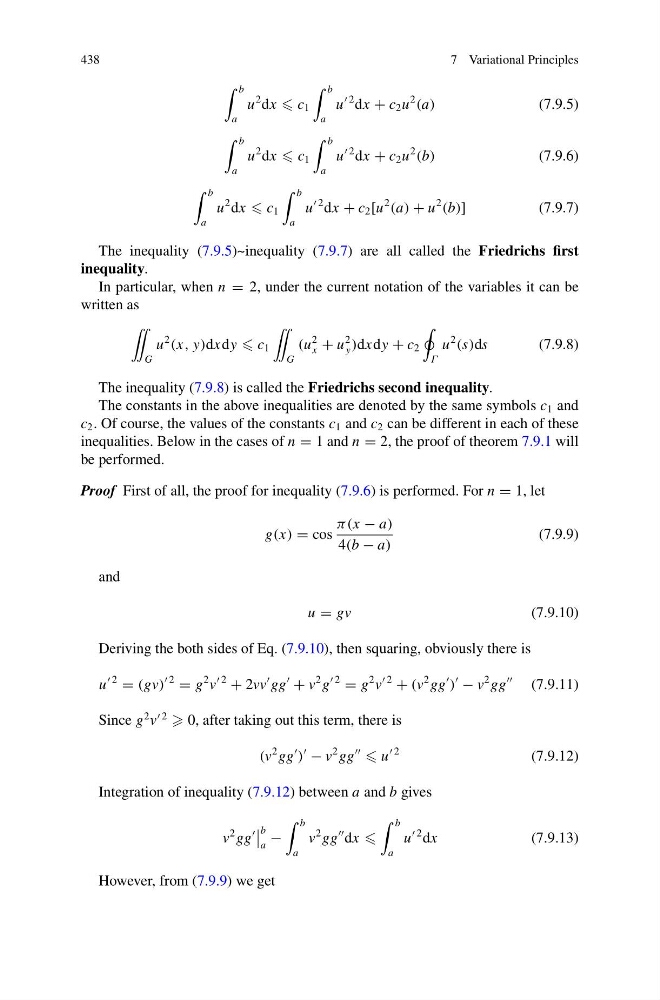
The inequality (7.9.5)~inequality (7.9.7) are all called the Friedrichs first
inequality.
In particular, when n = 2, under the current notation of the variables it can be
written as
¨
G
u
2
(x, y)dxdy c 1
¨
G
(u
2
x + u
2
y )dxdy + c 2
Γ
u
2
(s)ds
(7.9.8)
The inequality (7.9.8) is called the Friedrichs second inequality.
The constants in the above inequalities are denoted by the same symbols c 1 and
c 2 . Of course, the values of the constants c 1 and c 2 can be different in each of these
inequalities. Below in the cases of n = 1 and n = 2, the proof of theorem 7.9.1 will
be performed.
Proof First of all, the proof for inequality (7.9.6) is performed. For n = 1, let
g(x) = cos
π(x − a)
4(b − a)
(7.9.9)
and
u = gv
(7.9.10)
Deriving the both sides of Eq. (7.9.10), then squaring, obviously there is
u
2
= (gv)
2
= g
2 v
2
+ 2vv
gg
+ v
2 g
2
= g
2 v
2
+ (v
2 gg
)
− v
2 gg
(7.9.11)
Since g
2 v
2
0, after taking out this term, there is
(v
2 gg
)
− v
2 gg
u
2
(7.9.12)
Integration of inequality (7.9.12) between a and b gives
v
2 gg
b
a
−
b
a
v
2 gg
dx
b
a
u
2 dx
(7.9.13)
However, from (7.9.9) we get
7 Variational Principles
b
a
u
2 dx c 1
b
a
u
2 dx + c 2 u
2
(a)
(7.9.5)
b
a
u
2 dx c 1
b
a
u
2 dx + c 2 u
2
(b)
(7.9.6)
b
a
u
2 dx c 1
b
a
u
2 dx + c 2 [u
2
(a) + u
2
(b)]
(7.9.7)
The inequality (7.9.5)~inequality (7.9.7) are all called the Friedrichs first
inequality.
In particular, when n = 2, under the current notation of the variables it can be
written as
¨
G
u
2
(x, y)dxdy c 1
¨
G
(u
2
x + u
2
y )dxdy + c 2
Γ
u
2
(s)ds
(7.9.8)
The inequality (7.9.8) is called the Friedrichs second inequality.
The constants in the above inequalities are denoted by the same symbols c 1 and
c 2 . Of course, the values of the constants c 1 and c 2 can be different in each of these
inequalities. Below in the cases of n = 1 and n = 2, the proof of theorem 7.9.1 will
be performed.
Proof First of all, the proof for inequality (7.9.6) is performed. For n = 1, let
g(x) = cos
π(x − a)
4(b − a)
(7.9.9)
and
u = gv
(7.9.10)
Deriving the both sides of Eq. (7.9.10), then squaring, obviously there is
u
2
= (gv)
2
= g
2 v
2
+ 2vv
gg
+ v
2 g
2
= g
2 v
2
+ (v
2 gg
)
− v
2 gg
(7.9.11)
Since g
2 v
2
0, after taking out this term, there is
(v
2 gg
)
− v
2 gg
u
2
(7.9.12)
Integration of inequality (7.9.12) between a and b gives
v
2 gg
b
a
−
b
a
v
2 gg
dx
b
a
u
2 dx
(7.9.13)
However, from (7.9.9) we get