

7.9 The Friedrichs Inequality and Poincaré Inequality
437
f (x
∗
1 , x
∗
2 , · · · x
∗
n ) − f (x 1 , x 2 , · · · x n )
M
n
i=1
x
∗
i − x i
α
(7.9.2)
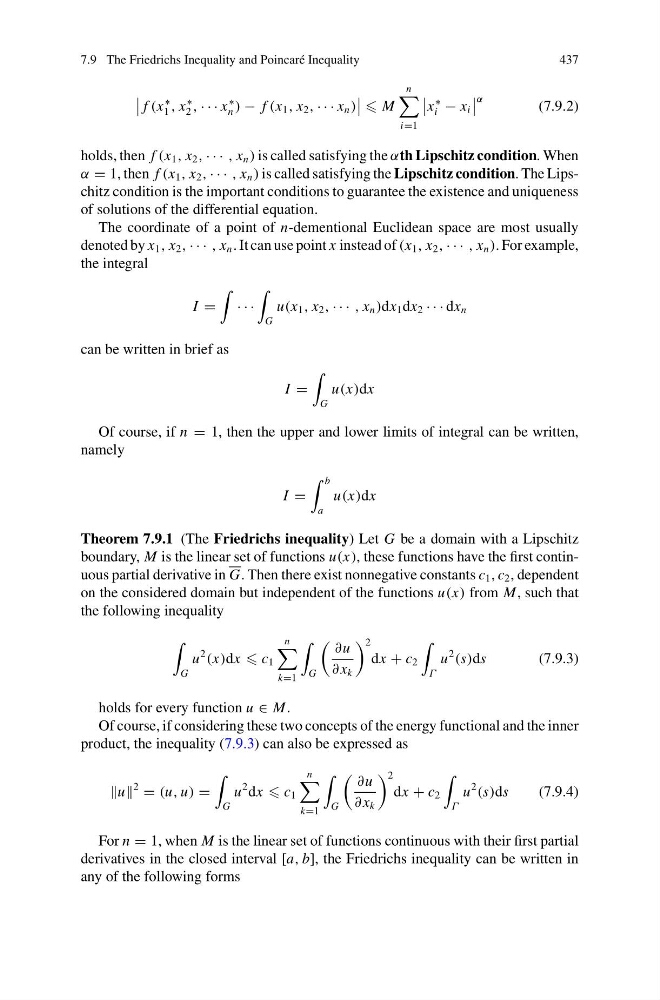
holds, then f (x 1 , x 2 , · · · , x n ) is called satisfying the αth Lipschitz condition. When
α = 1, then f (x 1 , x 2 , · · · , x n ) is called satisfying the Lipschitz condition. The Lipschitz condition is the important conditions to guarantee the existence and uniqueness
of solutions of the differential equation.
The coordinate of a point of n-dementional Euclidean space are most usually
denoted by x 1 , x 2 , · · · , x n . It can use point x instead of (x 1 , x 2 , · · · , x n ). For example,
the integral
I =
· · ·
G
u(x 1 , x 2 , · · · , x n )dx 1 dx 2 · · · dx n
can be written in brief as
I =
G
u(x)dx
Of course, if n = 1, then the upper and lower limits of integral can be written,
namely
I =
b
a
u(x)dx
Theorem 7.9.1 (The Friedrichs inequality) Let G be a domain with a Lipschitz
boundary, M is the linear set of functions u(x), these functions have the first continuous partial derivative in G. Then there exist nonnegative constants c 1 , c 2 , dependent
on the considered domain but independent of the functions u(x) from M, such that
the following inequality
G
u
2
(x)dx c 1
n
k=1
G
∂u
∂ x k
2
dx + c 2
Γ
u
2
(s)ds
(7.9.3)
holds for every function u ∈ M.
Of course, if considering these two concepts of the energy functional and the inner
product, the inequality (7.9.3) can also be expressed as
u
2
= (u, u) =
G
u
2 dx c 1
n
k=1
G
∂u
∂ x k
2
dx + c 2
Γ
u
2
(s)ds
(7.9.4)
For n = 1, when M is the linear set of functions continuous with their first partial
derivatives in the closed interval [a, b], the Friedrichs inequality can be written in
any of the following forms
437
f (x
∗
1 , x
∗
2 , · · · x
∗
n ) − f (x 1 , x 2 , · · · x n )
M
n
i=1
x
∗
i − x i
α
(7.9.2)
holds, then f (x 1 , x 2 , · · · , x n ) is called satisfying the αth Lipschitz condition. When
α = 1, then f (x 1 , x 2 , · · · , x n ) is called satisfying the Lipschitz condition. The Lipschitz condition is the important conditions to guarantee the existence and uniqueness
of solutions of the differential equation.
The coordinate of a point of n-dementional Euclidean space are most usually
denoted by x 1 , x 2 , · · · , x n . It can use point x instead of (x 1 , x 2 , · · · , x n ). For example,
the integral
I =
· · ·
G
u(x 1 , x 2 , · · · , x n )dx 1 dx 2 · · · dx n
can be written in brief as
I =
G
u(x)dx
Of course, if n = 1, then the upper and lower limits of integral can be written,
namely
I =
b
a
u(x)dx
Theorem 7.9.1 (The Friedrichs inequality) Let G be a domain with a Lipschitz
boundary, M is the linear set of functions u(x), these functions have the first continuous partial derivative in G. Then there exist nonnegative constants c 1 , c 2 , dependent
on the considered domain but independent of the functions u(x) from M, such that
the following inequality
G
u
2
(x)dx c 1
n
k=1
G
∂u
∂ x k
2
dx + c 2
Γ
u
2
(s)ds
(7.9.3)
holds for every function u ∈ M.
Of course, if considering these two concepts of the energy functional and the inner
product, the inequality (7.9.3) can also be expressed as
u
2
= (u, u) =
G
u
2 dx c 1
n
k=1
G
∂u
∂ x k
2
dx + c 2
Γ
u
2
(s)ds
(7.9.4)
For n = 1, when M is the linear set of functions continuous with their first partial
derivatives in the closed interval [a, b], the Friedrichs inequality can be written in
any of the following forms