

6.2 Isoperimetric Problems in Parametric Forms and Geodesic Line
377
where, c 1 =
c
√
1−c 2 . Thus there is
c 1 cot ϕ = cos(θ − c 2 ) = cos θ cos c 2 + sin θ sin c 2
(9)
or
cos ϕ = A cos θ sin ϕ + B sin θ sin ϕ
(10)
there
A =
cos c 2
c 1
, B =
sin c 2
c 1
(11)
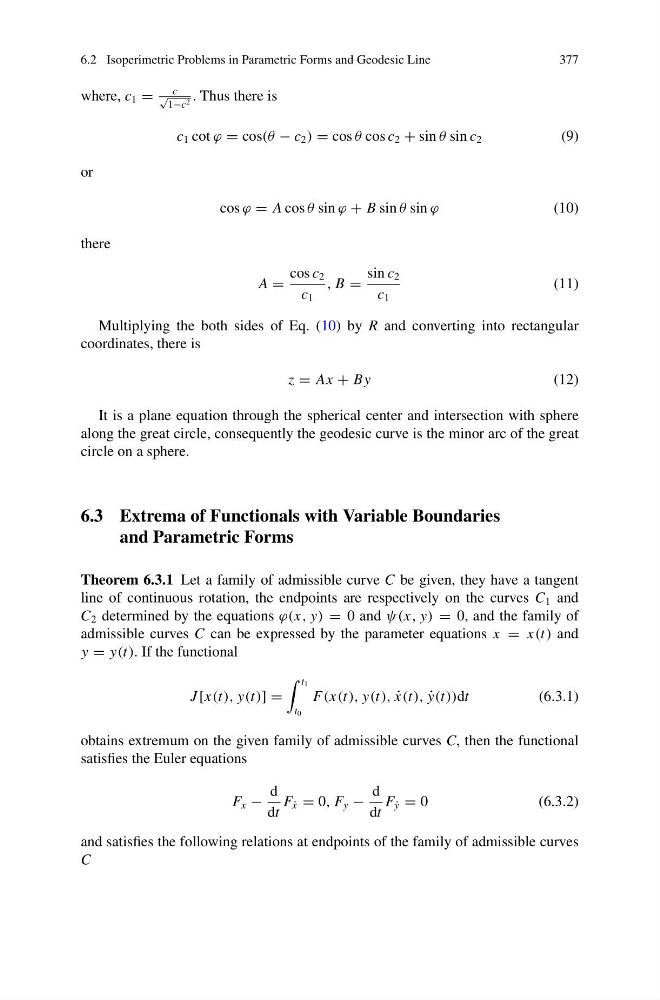
Multiplying the both sides of Eq. (10) by R and converting into rectangular
coordinates, there is
z = Ax + By
(12)
It is a plane equation through the spherical center and intersection with sphere
along the great circle, consequently the geodesic curve is the minor arc of the great
circle on a sphere.
6.3 Extrema of Functionals with Variable Boundaries
and Parametric Forms
Theorem 6.3.1 Let a family of admissible curve C be given, they have a tangent
line of continuous rotation, the endpoints are respectively on the curves C 1 and
C 2 determined by the equations ϕ(x, y) = 0 and ψ(x, y) = 0, and the family of
admissible curves C can be expressed by the parameter equations x = x(t) and
y = y(t). If the functional
J [x(t), y(t)] =
t 1
t 0
F(x(t), y(t), ˙
x(t), ˙
y(t))dt
(6.3.1)
obtains extremum on the given family of admissible curves C, then the functional
satisfies the Euler equations
F x −
d
dt
F ˙
x = 0, F y −
d
dt
F ˙
y = 0
(6.3.2)
and satisfies the following relations at endpoints of the family of admissible curves
C
377
where, c 1 =
c
√
1−c 2 . Thus there is
c 1 cot ϕ = cos(θ − c 2 ) = cos θ cos c 2 + sin θ sin c 2
(9)
or
cos ϕ = A cos θ sin ϕ + B sin θ sin ϕ
(10)
there
A =
cos c 2
c 1
, B =
sin c 2
c 1
(11)
Multiplying the both sides of Eq. (10) by R and converting into rectangular
coordinates, there is
z = Ax + By
(12)
It is a plane equation through the spherical center and intersection with sphere
along the great circle, consequently the geodesic curve is the minor arc of the great
circle on a sphere.
6.3 Extrema of Functionals with Variable Boundaries
and Parametric Forms
Theorem 6.3.1 Let a family of admissible curve C be given, they have a tangent
line of continuous rotation, the endpoints are respectively on the curves C 1 and
C 2 determined by the equations ϕ(x, y) = 0 and ψ(x, y) = 0, and the family of
admissible curves C can be expressed by the parameter equations x = x(t) and
y = y(t). If the functional
J [x(t), y(t)] =
t 1
t 0
F(x(t), y(t), ˙
x(t), ˙
y(t))dt
(6.3.1)
obtains extremum on the given family of admissible curves C, then the functional
satisfies the Euler equations
F x −
d
dt
F ˙
x = 0, F y −
d
dt
F ˙
y = 0
(6.3.2)
and satisfies the following relations at endpoints of the family of admissible curves
C