

376
6 Variational Problems in Parametric Forms
⎧
⎪ ⎪ ⎪ ⎨
⎪ ⎪ ⎪ ⎩
E u ˙
u
2
+ 2F u ˙
u ˙
v + G u ˙
v
2
√
E ˙
u 2 + 2F ˙
u ˙
v + G ˙
v 2
−
d
dt
2(E ˙
u + F ˙
v)
√
E ˙
u 2 + 2F ˙
u ˙
v + G ˙
v 2
= 0
E v ˙
u
2
+ 2F v ˙
u ˙
v + G v ˙
v
2
√
E ˙
u 2 + 2F ˙
u ˙
v + G ˙
v 2
−
d
dt
2(F ˙
u + G ˙
v)
√
E ˙
u 2 + 2F ˙
u ˙
v + G ˙
v 2
= 0
(6.2.22)
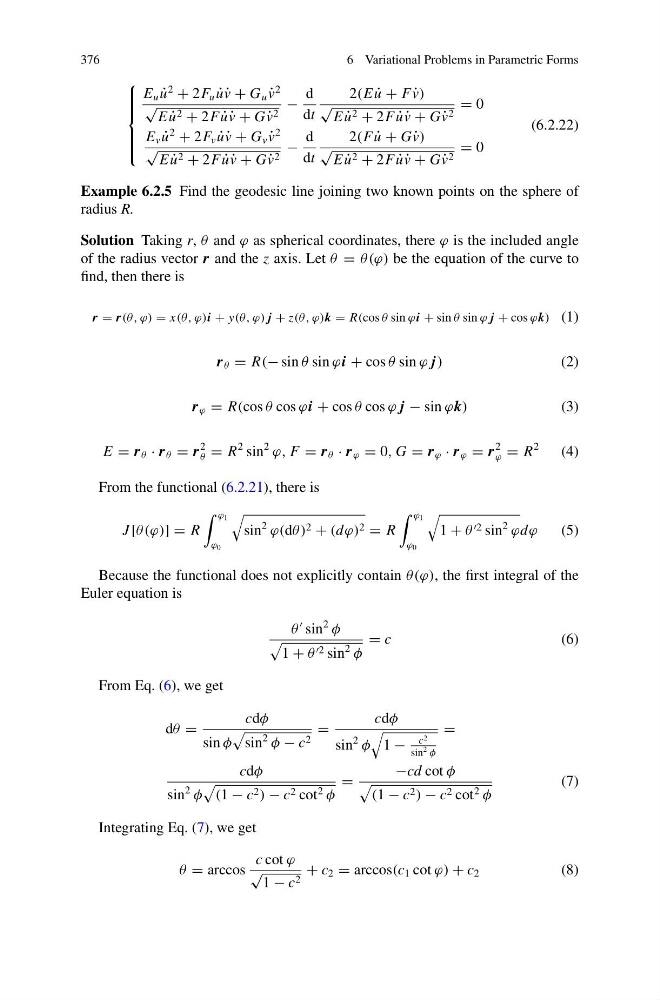
Example 6.2.5 Find the geodesic line joining two known points on the sphere of
radius R.
Solution Taking r, θ and ϕ as spherical coordinates, there ϕ is the included angle
of the radius vector r and the z axis. Let θ = θ(ϕ) be the equation of the curve to
find, then there is
r = r(θ, ϕ) = x(θ, ϕ)i + y(θ, ϕ) j + z(θ, ϕ)k = R(cos θ sin ϕi + sin θ sin ϕ j + cos ϕk) (1)
r θ = R(− sin θ sin ϕi + cos θ sin ϕ j )
(2)
r ϕ = R(cos θ cos ϕi + cos θ cos ϕ j − sin ϕk)
(3)
E = r θ · r θ = r
2
θ = R
2 sin
2
ϕ, F = r θ · r ϕ = 0, G = r ϕ · r ϕ = r
2
ϕ = R
2
(4)
From the functional (6.2.21), there is
J [θ(ϕ)] = R
ϕ 1
ϕ 0
sin
2
ϕ(dθ) 2 + (dϕ) 2 = R
ϕ 1
ϕ 0
1 + θ 2 sin
2
ϕdϕ
(5)
Because the functional does not explicitly contain θ(ϕ), the first integral of the
Euler equation is
θ
sin
2
φ
1 + θ 2 sin
2
φ
= c
(6)
From Eq. (6), we get
dθ =
cdφ
sin φ
sin
2
φ − c 2
=
cdφ
sin
2
φ
1 −
c 2
sin
2 φ
=
cdφ
sin
2
φ
(1 − c 2 ) − c 2 cot 2 φ
=
−cd cot φ
(1 − c 2 ) − c 2 cot 2 φ
(7)
Integrating Eq. (7), we get
θ = arccos
c cot ϕ
√
1 − c 2
+ c 2 = arccos(c 1 cot ϕ) + c 2
(8)
6 Variational Problems in Parametric Forms
⎧
⎪ ⎪ ⎪ ⎨
⎪ ⎪ ⎪ ⎩
E u ˙
u
2
+ 2F u ˙
u ˙
v + G u ˙
v
2
√
E ˙
u 2 + 2F ˙
u ˙
v + G ˙
v 2
−
d
dt
2(E ˙
u + F ˙
v)
√
E ˙
u 2 + 2F ˙
u ˙
v + G ˙
v 2
= 0
E v ˙
u
2
+ 2F v ˙
u ˙
v + G v ˙
v
2
√
E ˙
u 2 + 2F ˙
u ˙
v + G ˙
v 2
−
d
dt
2(F ˙
u + G ˙
v)
√
E ˙
u 2 + 2F ˙
u ˙
v + G ˙
v 2
= 0
(6.2.22)
Example 6.2.5 Find the geodesic line joining two known points on the sphere of
radius R.
Solution Taking r, θ and ϕ as spherical coordinates, there ϕ is the included angle
of the radius vector r and the z axis. Let θ = θ(ϕ) be the equation of the curve to
find, then there is
r = r(θ, ϕ) = x(θ, ϕ)i + y(θ, ϕ) j + z(θ, ϕ)k = R(cos θ sin ϕi + sin θ sin ϕ j + cos ϕk) (1)
r θ = R(− sin θ sin ϕi + cos θ sin ϕ j )
(2)
r ϕ = R(cos θ cos ϕi + cos θ cos ϕ j − sin ϕk)
(3)
E = r θ · r θ = r
2
θ = R
2 sin
2
ϕ, F = r θ · r ϕ = 0, G = r ϕ · r ϕ = r
2
ϕ = R
2
(4)
From the functional (6.2.21), there is
J [θ(ϕ)] = R
ϕ 1
ϕ 0
sin
2
ϕ(dθ) 2 + (dϕ) 2 = R
ϕ 1
ϕ 0
1 + θ 2 sin
2
ϕdϕ
(5)
Because the functional does not explicitly contain θ(ϕ), the first integral of the
Euler equation is
θ
sin
2
φ
1 + θ 2 sin
2
φ
= c
(6)
From Eq. (6), we get
dθ =
cdφ
sin φ
sin
2
φ − c 2
=
cdφ
sin
2
φ
1 −
c 2
sin
2 φ
=
cdφ
sin
2
φ
(1 − c 2 ) − c 2 cot 2 φ
=
−cd cot φ
(1 − c 2 ) − c 2 cot 2 φ
(7)
Integrating Eq. (7), we get
θ = arccos
c cot ϕ
√
1 − c 2
+ c 2 = arccos(c 1 cot ϕ) + c 2
(8)