

6.2 Isoperimetric Problems in Parametric Forms and Geodesic Line
375
At the moment the condition A ≥ 0 is transformed to the condition F 1 ≥ 0.
Consequently the following theorem can be obtained:
Theorem 6.2.1 The necessary condition of the functional obtaining minimum is
F 1 ≥ 0.
Let the surface be given by the vector equation
r = r(u, v)
(6.2.15)
where, the vector function r(u, v) has the continuously partial derived function r u
and r v , with r u × r v = 0. Again let Γ be a curve on , it is expressed as
u = u(t), v = v(t) (t 0 t t 1 )
(6.2.16)
For the vector Eq. (6.2.15), there is
dr = r u du + r v dv
(6.2.17)
If s denotes the arc length of Γ , then there is
(ds)
2
= (dr)
2
= (dr) · (dr) = r
2
u (du)
2
+ 2r u · r v dudv + r
2
v (dv)
2
(6.2.18)
Let
E = r
2
u , F = r u · r v , G = r
2
v
(6.2.19)
then the expression (6.2.18) can be written as
ϕ 1 = (ds)
2
= (dr)
2
= E(du)
2
+ 2Fdudv + G(dv)
2
(6.2.20)
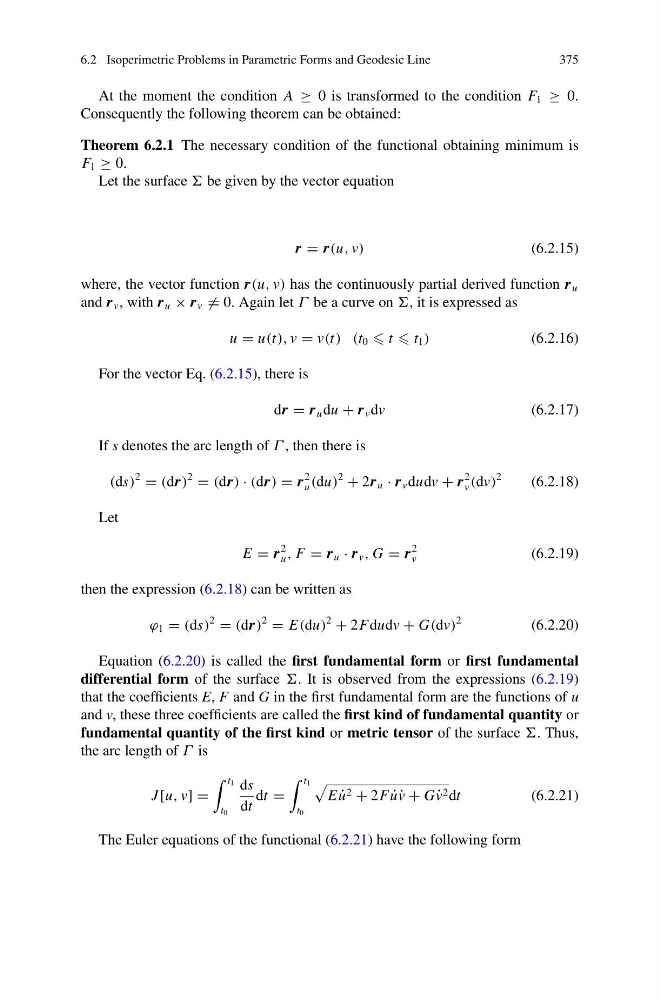
Equation (6.2.20) is called the first fundamental form or first fundamental
differential form of the surface . It is observed from the expressions (6.2.19)
that the coefficients E, F and G in the first fundamental form are the functions of u
and v, these three coefficients are called the first kind of fundamental quantity or
fundamental quantity of the first kind or metric tensor of the surface . Thus,
the arc length of Γ is
J [u, v] =
t 1
t 0
ds
dt
dt =
t 1
t 0
E ˙
u 2 + 2F ˙
u ˙
v + G ˙
v 2 dt
(6.2.21)
The Euler equations of the functional (6.2.21) have the following form
375
At the moment the condition A ≥ 0 is transformed to the condition F 1 ≥ 0.
Consequently the following theorem can be obtained:
Theorem 6.2.1 The necessary condition of the functional obtaining minimum is
F 1 ≥ 0.
Let the surface be given by the vector equation
r = r(u, v)
(6.2.15)
where, the vector function r(u, v) has the continuously partial derived function r u
and r v , with r u × r v = 0. Again let Γ be a curve on , it is expressed as
u = u(t), v = v(t) (t 0 t t 1 )
(6.2.16)
For the vector Eq. (6.2.15), there is
dr = r u du + r v dv
(6.2.17)
If s denotes the arc length of Γ , then there is
(ds)
2
= (dr)
2
= (dr) · (dr) = r
2
u (du)
2
+ 2r u · r v dudv + r
2
v (dv)
2
(6.2.18)
Let
E = r
2
u , F = r u · r v , G = r
2
v
(6.2.19)
then the expression (6.2.18) can be written as
ϕ 1 = (ds)
2
= (dr)
2
= E(du)
2
+ 2Fdudv + G(dv)
2
(6.2.20)
Equation (6.2.20) is called the first fundamental form or first fundamental
differential form of the surface . It is observed from the expressions (6.2.19)
that the coefficients E, F and G in the first fundamental form are the functions of u
and v, these three coefficients are called the first kind of fundamental quantity or
fundamental quantity of the first kind or metric tensor of the surface . Thus,
the arc length of Γ is
J [u, v] =
t 1
t 0
ds
dt
dt =
t 1
t 0
E ˙
u 2 + 2F ˙
u ˙
v + G ˙
v 2 dt
(6.2.21)
The Euler equations of the functional (6.2.21) have the following form