

374
6 Variational Problems in Parametric Forms
dr
dt
=
v w
v
dy
dt
(13)
Integrating the above equation, we get r =
v w
v
y + c, substituting y = r sin θ into
the foregoing integral result, we give
r =
c
1 −
v w
v
sin θ
(14)
This is a conic equation that the focus is at the origin,
v w
v
is the eccentricity.
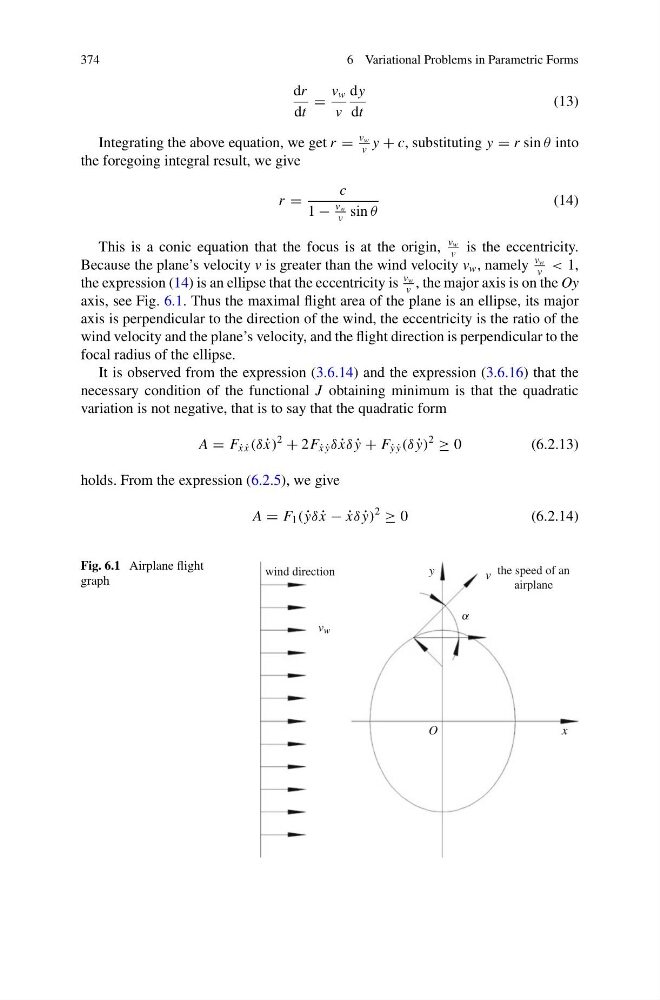
Because the plane’s velocity v is greater than the wind velocity v w , namely
v w
v
< 1,
the expression (14) is an ellipse that the eccentricity is
v w
v
, the major axis is on the Oy
axis, see Fig. 6.1. Thus the maximal flight area of the plane is an ellipse, its major
axis is perpendicular to the direction of the wind, the eccentricity is the ratio of the
wind velocity and the plane’s velocity, and the flight direction is perpendicular to the
focal radius of the ellipse.
It is observed from the expression (3.6.14) and the expression (3.6.16) that the
necessary condition of the functional J obtaining minimum is that the quadratic
variation is not negative, that is to say that the quadratic form
A = F ˙
x ˙
x (δ ˙
x)
2
+ 2F ˙
x ˙
y δ ˙
xδ ˙
y + F ˙
y ˙
y (δ ˙
y)
2
≥ 0
(6.2.13)
holds. From the expression (6.2.5), we give
A = F 1 ( ˙
yδ ˙
x − ˙
xδ ˙
y)
2
≥ 0
(6.2.14)
Fig. 6.1 Airplane flight
graph
O
x
y
v
α
wind direction
the speed of an
airplane
v w
6 Variational Problems in Parametric Forms
dr
dt
=
v w
v
dy
dt
(13)
Integrating the above equation, we get r =
v w
v
y + c, substituting y = r sin θ into
the foregoing integral result, we give
r =
c
1 −
v w
v
sin θ
(14)
This is a conic equation that the focus is at the origin,
v w
v
is the eccentricity.
Because the plane’s velocity v is greater than the wind velocity v w , namely
v w
v
< 1,
the expression (14) is an ellipse that the eccentricity is
v w
v
, the major axis is on the Oy
axis, see Fig. 6.1. Thus the maximal flight area of the plane is an ellipse, its major
axis is perpendicular to the direction of the wind, the eccentricity is the ratio of the
wind velocity and the plane’s velocity, and the flight direction is perpendicular to the
focal radius of the ellipse.
It is observed from the expression (3.6.14) and the expression (3.6.16) that the
necessary condition of the functional J obtaining minimum is that the quadratic
variation is not negative, that is to say that the quadratic form
A = F ˙
x ˙
x (δ ˙
x)
2
+ 2F ˙
x ˙
y δ ˙
xδ ˙
y + F ˙
y ˙
y (δ ˙
y)
2
≥ 0
(6.2.13)
holds. From the expression (6.2.5), we give
A = F 1 ( ˙
yδ ˙
x − ˙
xδ ˙
y)
2
≥ 0
(6.2.14)
Fig. 6.1 Airplane flight
graph
O
x
y
v
α
wind direction
the speed of an
airplane
v w