

6.2 Isoperimetric Problems in Parametric Forms and Geodesic Line
373
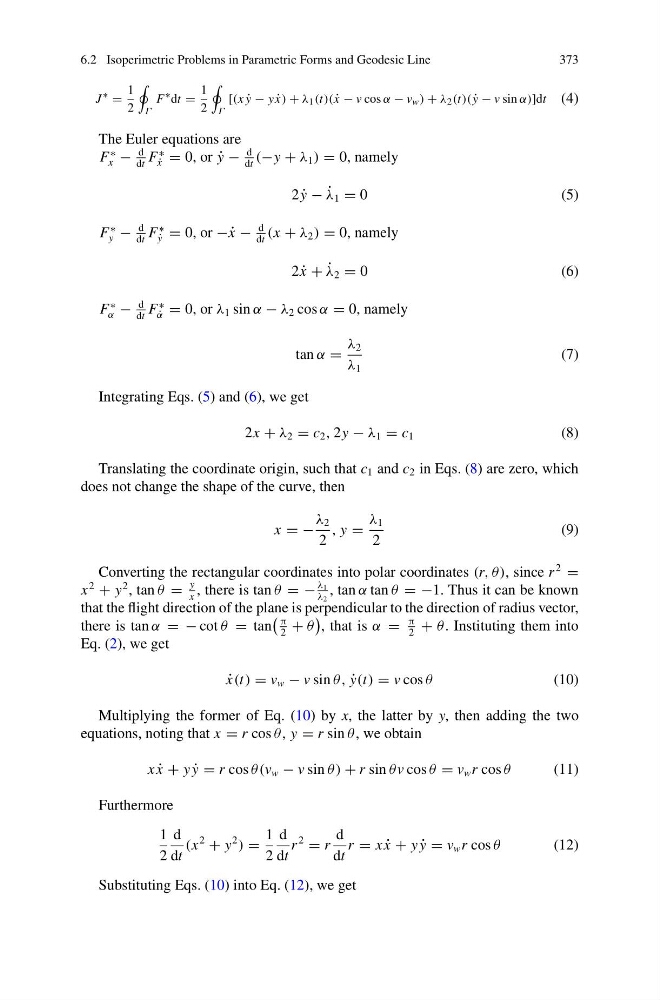
J
∗ =
1
2
Γ
F
∗ dt =
1
2
Γ
[(x ˙
y − y ˙
x) + λ 1 (t)( ˙
x − v cos α − v w ) + λ 2 (t)( ˙
y − v sin α)]dt (4)
The Euler equations are
F
∗
x −
d
dt
F
∗
˙
x = 0, or ˙
y −
d
dt
(−y + λ 1 ) = 0, namely
2 ˙
y − ˙
λ 1 = 0
( 5 )
F
∗
y −
d
dt
F
∗
˙
y = 0, or − ˙
x −
d
dt
(x + λ 2 ) = 0, namely
2 ˙
x + ˙
λ 2 = 0
( 6 )
F
∗
α −
d
dt
F
∗
˙
α = 0, or λ 1 sin α − λ 2 cos α = 0, namely
tan α =
λ 2
λ 1
(7)
Integrating Eqs. (5) and (6), we get
2x + λ 2 = c 2 , 2y − λ 1 = c 1
(8)
Translating the coordinate origin, such that c 1 and c 2 in Eqs. (8) are zero, which
does not change the shape of the curve, then
x = −
λ 2
2
, y =
λ 1
2
(9)
Converting the rectangular coordinates into polar coordinates (r, θ), since r
2
=
x
2
+ y
2 , tan θ =
y
x
, there is tan θ = −
λ 1
λ 2
, tan α tan θ = −1. Thus it can be known
that the flight direction of the plane is perpendicular to the direction of radius vector,
there is tan α = − cot θ = tan
π
2
+ θ
, that is α =
π
2
+ θ . Instituting them into
Eq. (2), we get
˙
x(t) = v w − v sin θ, ˙
y(t) = v cos θ
(10)
Multiplying the former of Eq. (10) by x, the latter by y, then adding the two
equations, noting that x = r cos θ , y = r sin θ , we obtain
x ˙
x + y ˙
y = r cos θ(v w − v sin θ) + r sin θ v cos θ = v w r cos θ
(11)
Furthermore
1
2
d
dt
(x
2
+ y
2
) =
1
2
d
dt
r
2
= r
d
dt
r = x ˙
x + y ˙
y = v w r cos θ
(12)
Substituting Eqs. (10) into Eq. (12), we get
373
J
∗ =
1
2
Γ
F
∗ dt =
1
2
Γ
[(x ˙
y − y ˙
x) + λ 1 (t)( ˙
x − v cos α − v w ) + λ 2 (t)( ˙
y − v sin α)]dt (4)
The Euler equations are
F
∗
x −
d
dt
F
∗
˙
x = 0, or ˙
y −
d
dt
(−y + λ 1 ) = 0, namely
2 ˙
y − ˙
λ 1 = 0
( 5 )
F
∗
y −
d
dt
F
∗
˙
y = 0, or − ˙
x −
d
dt
(x + λ 2 ) = 0, namely
2 ˙
x + ˙
λ 2 = 0
( 6 )
F
∗
α −
d
dt
F
∗
˙
α = 0, or λ 1 sin α − λ 2 cos α = 0, namely
tan α =
λ 2
λ 1
(7)
Integrating Eqs. (5) and (6), we get
2x + λ 2 = c 2 , 2y − λ 1 = c 1
(8)
Translating the coordinate origin, such that c 1 and c 2 in Eqs. (8) are zero, which
does not change the shape of the curve, then
x = −
λ 2
2
, y =
λ 1
2
(9)
Converting the rectangular coordinates into polar coordinates (r, θ), since r
2
=
x
2
+ y
2 , tan θ =
y
x
, there is tan θ = −
λ 1
λ 2
, tan α tan θ = −1. Thus it can be known
that the flight direction of the plane is perpendicular to the direction of radius vector,
there is tan α = − cot θ = tan
π
2
+ θ
, that is α =
π
2
+ θ . Instituting them into
Eq. (2), we get
˙
x(t) = v w − v sin θ, ˙
y(t) = v cos θ
(10)
Multiplying the former of Eq. (10) by x, the latter by y, then adding the two
equations, noting that x = r cos θ , y = r sin θ , we obtain
x ˙
x + y ˙
y = r cos θ(v w − v sin θ) + r sin θ v cos θ = v w r cos θ
(11)
Furthermore
1
2
d
dt
(x
2
+ y
2
) =
1
2
d
dt
r
2
= r
d
dt
r = x ˙
x + y ˙
y = v w r cos θ
(12)
Substituting Eqs. (10) into Eq. (12), we get