

372
6 Variational Problems in Parametric Forms
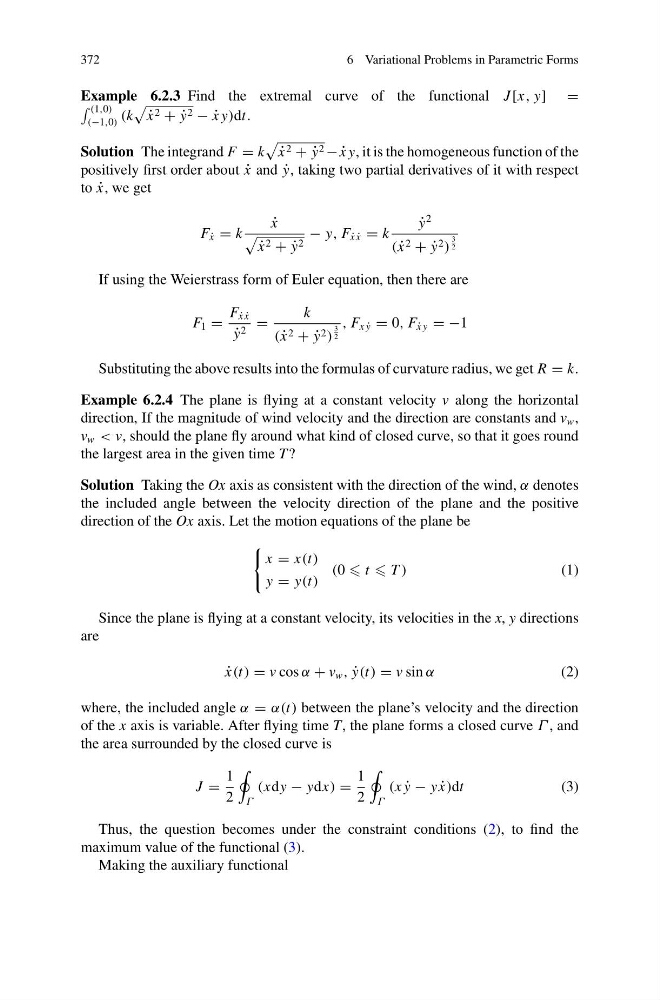
Example 6.2.3 Find the extremal curve of the functional J [x, y] =
(1,0)
(−1,0) (k
˙
x 2 + ˙
y 2 − ˙
x y)dt.
Solution The integrand F = k
˙
x 2 + ˙
y 2 − ˙
x y, it is the homogeneous function of the
positively first order about ˙
x and ˙
y, taking two partial derivatives of it with respect
to ˙
x, we get
F ˙
x = k
˙
x
˙
x 2 + ˙
y 2
− y, F ˙
x ˙
x = k
˙
y
2
( ˙
x 2 + ˙
y 2 )
3
2
If using the Weierstrass form of Euler equation, then there are
F 1 =
F ˙
x ˙
x
˙
y 2 =
k
( ˙
x 2 + ˙
y 2 )
3
2
, F x ˙
y = 0, F ˙
x y = −1
Substituting the above results into the formulas of curvature radius, we get R = k.
Example 6.2.4 The plane is flying at a constant velocity v along the horizontal
direction, If the magnitude of wind velocity and the direction are constants and v w ,
v w < v, should the plane fly around what kind of closed curve, so that it goes round
the largest area in the given time T ?
Solution Taking the Ox axis as consistent with the direction of the wind, α denotes
the included angle between the velocity direction of the plane and the positive
direction of the Ox axis. Let the motion equations of the plane be
x = x(t)
y = y(t)
(0 t T )
(1)
Since the plane is flying at a constant velocity, its velocities in the x, y directions
are
˙
x(t) = v cos α + v w , ˙
y(t) = v sin α
(2)
where, the included angle α = α(t) between the plane’s velocity and the direction
of the x axis is variable. After flying time T, the plane forms a closed curve Γ , and
the area surrounded by the closed curve is
J =
1
2
Γ
(xdy − ydx) =
1
2
Γ
(x ˙
y − y ˙
x)dt
(3)
Thus, the question becomes under the constraint conditions (2), to find the
maximum value of the functional (3).
Making the auxiliary functional
6 Variational Problems in Parametric Forms
Example 6.2.3 Find the extremal curve of the functional J [x, y] =
(1,0)
(−1,0) (k
˙
x 2 + ˙
y 2 − ˙
x y)dt.
Solution The integrand F = k
˙
x 2 + ˙
y 2 − ˙
x y, it is the homogeneous function of the
positively first order about ˙
x and ˙
y, taking two partial derivatives of it with respect
to ˙
x, we get
F ˙
x = k
˙
x
˙
x 2 + ˙
y 2
− y, F ˙
x ˙
x = k
˙
y
2
( ˙
x 2 + ˙
y 2 )
3
2
If using the Weierstrass form of Euler equation, then there are
F 1 =
F ˙
x ˙
x
˙
y 2 =
k
( ˙
x 2 + ˙
y 2 )
3
2
, F x ˙
y = 0, F ˙
x y = −1
Substituting the above results into the formulas of curvature radius, we get R = k.
Example 6.2.4 The plane is flying at a constant velocity v along the horizontal
direction, If the magnitude of wind velocity and the direction are constants and v w ,
v w < v, should the plane fly around what kind of closed curve, so that it goes round
the largest area in the given time T ?
Solution Taking the Ox axis as consistent with the direction of the wind, α denotes
the included angle between the velocity direction of the plane and the positive
direction of the Ox axis. Let the motion equations of the plane be
x = x(t)
y = y(t)
(0 t T )
(1)
Since the plane is flying at a constant velocity, its velocities in the x, y directions
are
˙
x(t) = v cos α + v w , ˙
y(t) = v sin α
(2)
where, the included angle α = α(t) between the plane’s velocity and the direction
of the x axis is variable. After flying time T, the plane forms a closed curve Γ , and
the area surrounded by the closed curve is
J =
1
2
Γ
(xdy − ydx) =
1
2
Γ
(x ˙
y − y ˙
x)dt
(3)
Thus, the question becomes under the constraint conditions (2), to find the
maximum value of the functional (3).
Making the auxiliary functional