

352
5 Variational Problems of Conditional Extrema
y =
c
2
1 − x 2 + c 2
(5.14)
or
x
2
+ (y − c 2 )
2
= c
2
1 = R
2
(5.15)
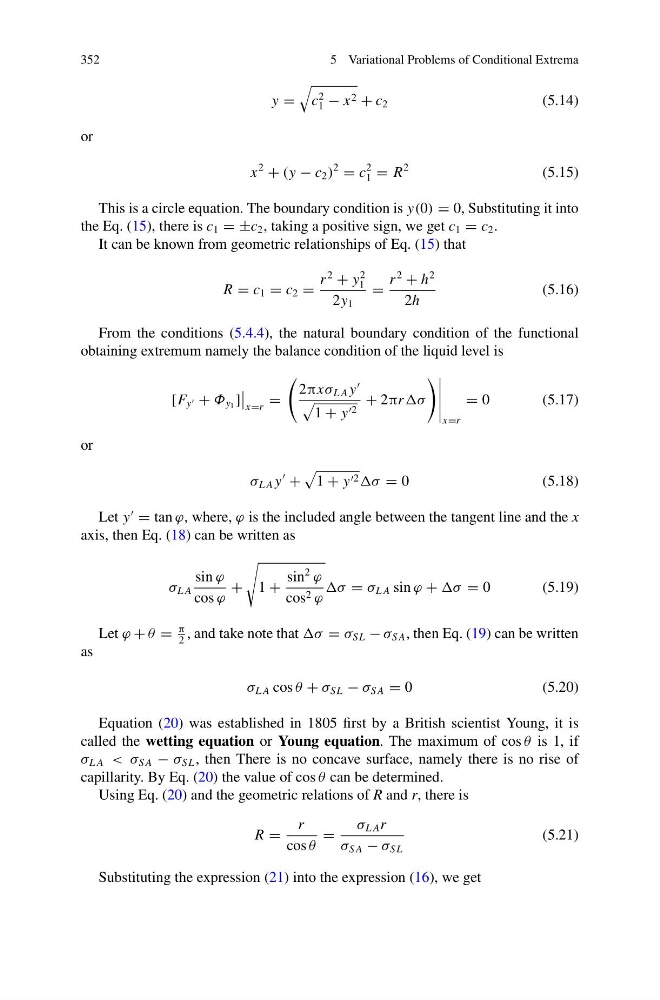
This is a circle equation. The boundary condition is y(0) = 0, Substituting it into
the Eq. (15), there is c 1 = ±c 2 , taking a positive sign, we get c 1 = c 2 .
It can be known from geometric relationships of Eq. (15) that
R = c 1 = c 2 =
r
2
+ y
2
1
2y 1
=
r
2
+ h
2
2h
(5.16)
From the conditions (5.4.4), the natural boundary condition of the functional
obtaining extremum namely the balance condition of the liquid level is
[F y + Φ y 1 ]
x=r
=
2πxσ L A y
1 + y 2
+ 2πr σ
x=r
= 0
(5.17)
or
σ L A y
+
1 + y 2 σ = 0
(5.18)
Let y
= tan ϕ, where, ϕ is the included angle between the tangent line and the x
axis, then Eq. (18) can be written as
σ L A
sin ϕ
cos ϕ
+
1 +
sin
2
ϕ
cos 2 ϕ
σ = σ L A sin ϕ + σ = 0
(5.19)
Let ϕ + θ =
π
2
, and take note that σ = σ SL − σ S A , then Eq. (19) can be written
as
σ L A cos θ + σ SL − σ S A = 0
(5.20)
Equation (20) was established in 1805 first by a British scientist Young, it is
called the wetting equation or Young equation. The maximum of cos θ is 1, if
σ L A < σ S A − σ SL , then There is no concave surface, namely there is no rise of
capillarity. By Eq. (20) the value of cos θ can be determined.
Using Eq. (20) and the geometric relations of R and r, there is
R =
r
cos θ
=
σ L A r
σ S A − σ SL
(5.21)
Substituting the expression (21) into the expression (16), we get
5 Variational Problems of Conditional Extrema
y =
c
2
1 − x 2 + c 2
(5.14)
or
x
2
+ (y − c 2 )
2
= c
2
1 = R
2
(5.15)
This is a circle equation. The boundary condition is y(0) = 0, Substituting it into
the Eq. (15), there is c 1 = ±c 2 , taking a positive sign, we get c 1 = c 2 .
It can be known from geometric relationships of Eq. (15) that
R = c 1 = c 2 =
r
2
+ y
2
1
2y 1
=
r
2
+ h
2
2h
(5.16)
From the conditions (5.4.4), the natural boundary condition of the functional
obtaining extremum namely the balance condition of the liquid level is
[F y + Φ y 1 ]
x=r
=
2πxσ L A y
1 + y 2
+ 2πr σ
x=r
= 0
(5.17)
or
σ L A y
+
1 + y 2 σ = 0
(5.18)
Let y
= tan ϕ, where, ϕ is the included angle between the tangent line and the x
axis, then Eq. (18) can be written as
σ L A
sin ϕ
cos ϕ
+
1 +
sin
2
ϕ
cos 2 ϕ
σ = σ L A sin ϕ + σ = 0
(5.19)
Let ϕ + θ =
π
2
, and take note that σ = σ SL − σ S A , then Eq. (19) can be written
as
σ L A cos θ + σ SL − σ S A = 0
(5.20)
Equation (20) was established in 1805 first by a British scientist Young, it is
called the wetting equation or Young equation. The maximum of cos θ is 1, if
σ L A < σ S A − σ SL , then There is no concave surface, namely there is no rise of
capillarity. By Eq. (20) the value of cos θ can be determined.
Using Eq. (20) and the geometric relations of R and r, there is
R =
r
cos θ
=
σ L A r
σ S A − σ SL
(5.21)
Substituting the expression (21) into the expression (16), we get