

5.4 Extremal Problems of Mixed Type Functionals
353
h
2
−
2σ L A rh
σ S A − σ SL
+ r
2
= 0
(5.22)
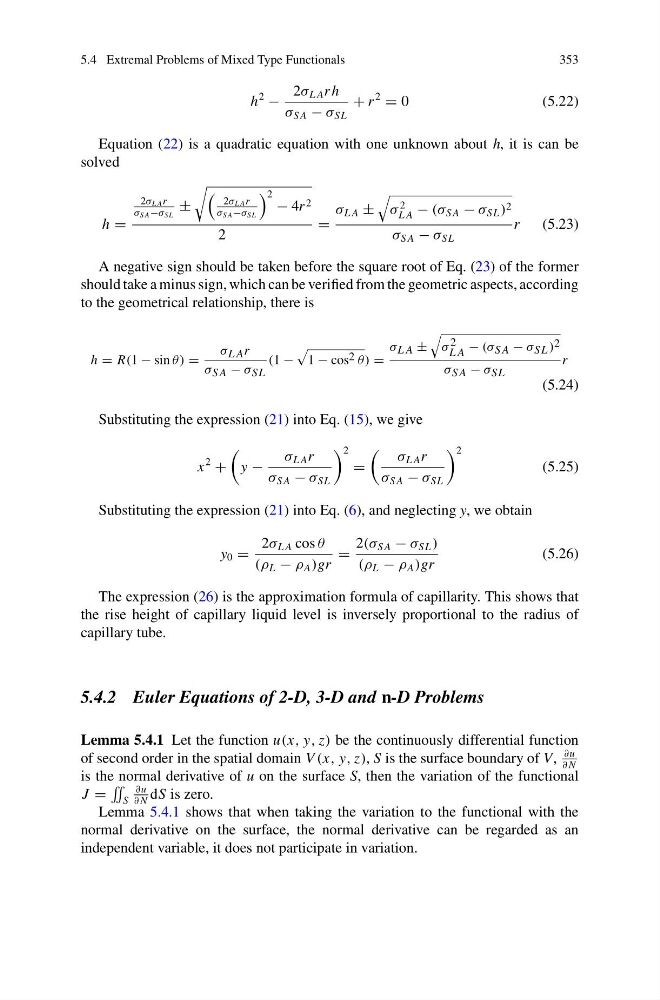
Equation (22) is a quadratic equation with one unknown about h, it is can be
solved
h =
2σ L A r
σ S A −σ SL
±
2σ L A r
σ S A −σ SL
2 − 4r 2
2
=
σ L A ±
σ
2
L A − (σ S A − σ SL ) 2
σ S A − σ SL
r
(5.23)
A negative sign should be taken before the square root of Eq. (23) of the former
should take a minus sign, which can be verified from the geometric aspects, according
to the geometrical relationship, there is
h = R(1 − sin θ) =
σ L A r
σ S A − σ SL
(1 −
1 − cos 2 θ) =
σ L A ±
σ 2
L A − (σ S A − σ SL ) 2
σ S A − σ SL
r
(5.24)
Substituting the expression (21) into Eq. (15), we give
x
2
+
y −
σ L A r
σ S A − σ SL
2
=
σ L A r
σ S A − σ SL
2
(5.25)
Substituting the expression (21) into Eq. (6), and neglecting y, we obtain
y 0 =
2σ L A cos θ
(ρ L − ρ A )gr
=
2(σ S A − σ SL )
(ρ L − ρ A )gr
(5.26)
The expression (26) is the approximation formula of capillarity. This shows that
the rise height of capillary liquid level is inversely proportional to the radius of
capillary tube.
5.4.2 Euler Equations of 2-D, 3-D and n-D Problems
Lemma 5.4.1 Let the function u(x, y, z) be the continuously differential function
of second order in the spatial domain V (x, y, z), S is the surface boundary of V,
∂u
∂ N
is the normal derivative of u on the surface S, then the variation of the functional
J =
˜
S
∂u
∂ N
dS is zero.
Lemma 5.4.1 shows that when taking the variation to the functional with the
normal derivative on the surface, the normal derivative can be regarded as an
independent variable, it does not participate in variation.
353
h
2
−
2σ L A rh
σ S A − σ SL
+ r
2
= 0
(5.22)
Equation (22) is a quadratic equation with one unknown about h, it is can be
solved
h =
2σ L A r
σ S A −σ SL
±
2σ L A r
σ S A −σ SL
2 − 4r 2
2
=
σ L A ±
σ
2
L A − (σ S A − σ SL ) 2
σ S A − σ SL
r
(5.23)
A negative sign should be taken before the square root of Eq. (23) of the former
should take a minus sign, which can be verified from the geometric aspects, according
to the geometrical relationship, there is
h = R(1 − sin θ) =
σ L A r
σ S A − σ SL
(1 −
1 − cos 2 θ) =
σ L A ±
σ 2
L A − (σ S A − σ SL ) 2
σ S A − σ SL
r
(5.24)
Substituting the expression (21) into Eq. (15), we give
x
2
+
y −
σ L A r
σ S A − σ SL
2
=
σ L A r
σ S A − σ SL
2
(5.25)
Substituting the expression (21) into Eq. (6), and neglecting y, we obtain
y 0 =
2σ L A cos θ
(ρ L − ρ A )gr
=
2(σ S A − σ SL )
(ρ L − ρ A )gr
(5.26)
The expression (26) is the approximation formula of capillarity. This shows that
the rise height of capillary liquid level is inversely proportional to the radius of
capillary tube.
5.4.2 Euler Equations of 2-D, 3-D and n-D Problems
Lemma 5.4.1 Let the function u(x, y, z) be the continuously differential function
of second order in the spatial domain V (x, y, z), S is the surface boundary of V,
∂u
∂ N
is the normal derivative of u on the surface S, then the variation of the functional
J =
˜
S
∂u
∂ N
dS is zero.
Lemma 5.4.1 shows that when taking the variation to the functional with the
normal derivative on the surface, the normal derivative can be regarded as an
independent variable, it does not participate in variation.