

324
5 Variational Problems of Conditional Extrema
−
dx
√
1 − x 2
=
1 − a 2 ds
(5.10)
Integrating the Eq. (10), we get
arccos x =
1 − a 2 s + c
(5.11)
where, c is an integral constant, thus
x = cos(
1 − a 2 s + c)
(5.12)
Substituting the expression (12) into the third equation of Eq. (6), we give
z = sin(
1 − a 2 s + c)
(5.13)
Integrating the first equation of Eq. (6), we get
y = as + b
(5.14)
where, b is an integral constant.
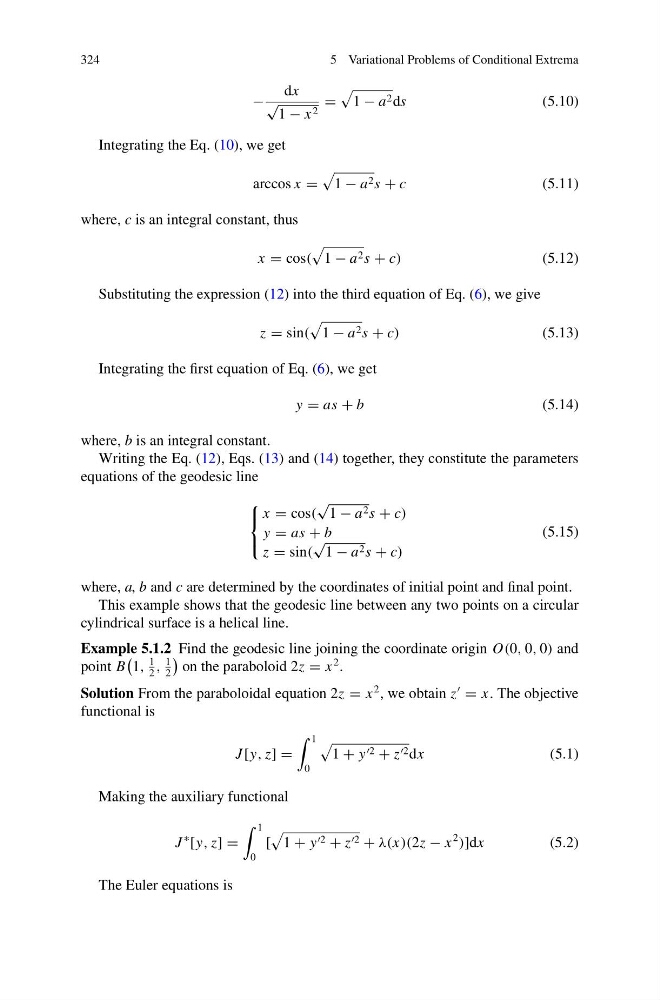
Writing the Eq. (12), Eqs. (13) and (14) together, they constitute the parameters
equations of the geodesic line
⎧
⎨
⎩
x = cos(
√
1 − a 2 s + c)
y = as + b
z = sin(
√
1 − a 2 s + c)
(5.15)
where, a, b and c are determined by the coordinates of initial point and final point.
This example shows that the geodesic line between any two points on a circular
cylindrical surface is a helical line.
Example 5.1.2 Find the geodesic line joining the coordinate origin O(0, 0, 0) and
point B
1,
1
2
,
1
2
on the paraboloid 2z = x
2 .
Solution From the paraboloidal equation 2z = x
2 , we obtain z
= x. The objective
functional is
J [y, z] =
1
0
1 + y 2 + z 2 dx
(5.1)
Making the auxiliary functional
J
∗
[y, z] =
1
0
[
1 + y 2 + z 2 + λ(x)(2z − x
2
)]dx
(5.2)
The Euler equations is
5 Variational Problems of Conditional Extrema
−
dx
√
1 − x 2
=
1 − a 2 ds
(5.10)
Integrating the Eq. (10), we get
arccos x =
1 − a 2 s + c
(5.11)
where, c is an integral constant, thus
x = cos(
1 − a 2 s + c)
(5.12)
Substituting the expression (12) into the third equation of Eq. (6), we give
z = sin(
1 − a 2 s + c)
(5.13)
Integrating the first equation of Eq. (6), we get
y = as + b
(5.14)
where, b is an integral constant.
Writing the Eq. (12), Eqs. (13) and (14) together, they constitute the parameters
equations of the geodesic line
⎧
⎨
⎩
x = cos(
√
1 − a 2 s + c)
y = as + b
z = sin(
√
1 − a 2 s + c)
(5.15)
where, a, b and c are determined by the coordinates of initial point and final point.
This example shows that the geodesic line between any two points on a circular
cylindrical surface is a helical line.
Example 5.1.2 Find the geodesic line joining the coordinate origin O(0, 0, 0) and
point B
1,
1
2
,
1
2
on the paraboloid 2z = x
2 .
Solution From the paraboloidal equation 2z = x
2 , we obtain z
= x. The objective
functional is
J [y, z] =
1
0
1 + y 2 + z 2 dx
(5.1)
Making the auxiliary functional
J
∗
[y, z] =
1
0
[
1 + y 2 + z 2 + λ(x)(2z − x
2
)]dx
(5.2)
The Euler equations is