

4.6 One-Sided Variational Problems
305
J 2 =
x 1
¯
x+δ ¯
x
F(x, y, y
)dx −
x 1
¯
x
F(x, y, y
)dx
= −
¯
x+δ ¯
x
¯
x
F(x, y, y
)dx = −
¯
x+δ ¯
x
¯
x
F(x, ϕ, ϕ
)dx
(4.6.6)
According to the continuity of function and the mean value theorem, there is
J 2 = − F(x, ϕ, ϕ
)
x= ¯
x
δ ¯
x + εδ ¯
x
(4.6.7)
When δ ¯
x → 0, ε → 0, therefore
δ J 2 = − F(x, ϕ, ϕ
)
x= ¯
x
δ ¯
x
(4.6.8)
Substituting the expression (4.6.5) and the expression (4.6.8) into the expression
(4.6.4), we get
[F(x, y, y
) − F(x, ϕ, ϕ
) + (ϕ
− y
)F y (x, y, y
)]
x= ¯
x
= 0
(4.6.9)
Applying the mean value theorem to the first two terms of the left side, we obtain
F(x, y, y
) − F(x, ϕ, ϕ
) = F y (x, y, q)(y
− ϕ
)
(4.6.10)
where, q is between ϕ
and y
. Thus the expression (4.6.9) is changed into
(y
− ϕ
)[F y (x, y, q) − F y (x, y, y
)]
x= ¯
x
= 0
(4.6.11)
If F y y is not equal to zero and is a continuous function, then using the mean value
theorem to expression (4.6.11), we obtain
(y
− ϕ
)(q − y
)F y y (x, y, q 1 )
x= ¯
x
= 0
(4.6.12)
where, q 1 is between q and y
, q is between ϕ
and y
, thus there must be
y
= ϕ
(4.6.13)
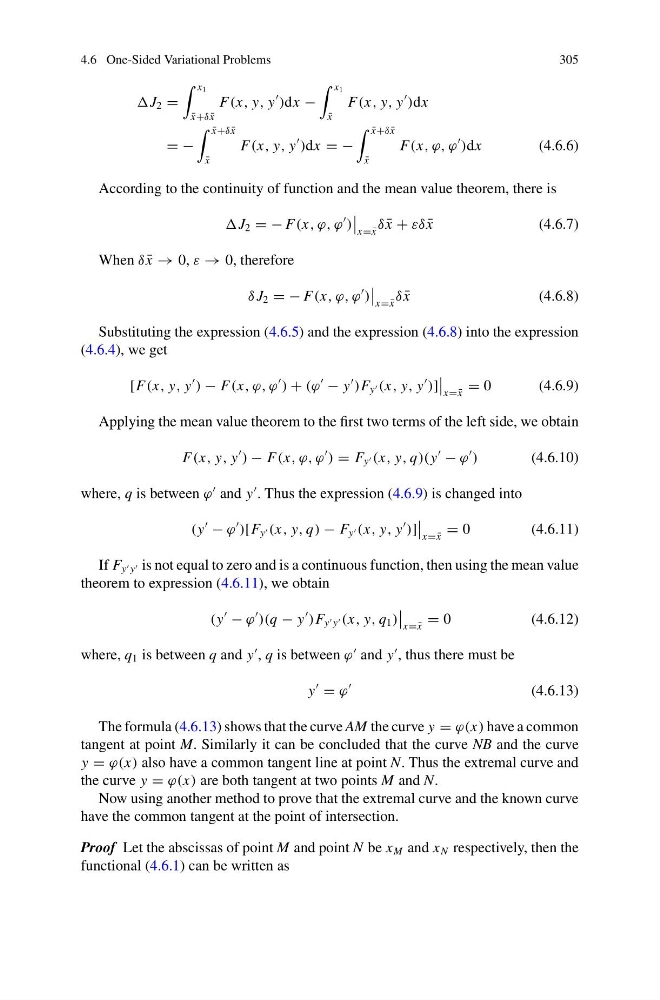
The formula (4.6.13) shows that the curve AM the curve y = ϕ(x) have a common
tangent at point M. Similarly it can be concluded that the curve NB and the curve
y = ϕ(x) also have a common tangent line at point N. Thus the extremal curve and
the curve y = ϕ(x) are both tangent at two points M and N.
Now using another method to prove that the extremal curve and the known curve
have the common tangent at the point of intersection.
Proof Let the abscissas of point M and point N be x M and x N respectively, then the
functional (4.6.1) can be written as
305
J 2 =
x 1
¯
x+δ ¯
x
F(x, y, y
)dx −
x 1
¯
x
F(x, y, y
)dx
= −
¯
x+δ ¯
x
¯
x
F(x, y, y
)dx = −
¯
x+δ ¯
x
¯
x
F(x, ϕ, ϕ
)dx
(4.6.6)
According to the continuity of function and the mean value theorem, there is
J 2 = − F(x, ϕ, ϕ
)
x= ¯
x
δ ¯
x + εδ ¯
x
(4.6.7)
When δ ¯
x → 0, ε → 0, therefore
δ J 2 = − F(x, ϕ, ϕ
)
x= ¯
x
δ ¯
x
(4.6.8)
Substituting the expression (4.6.5) and the expression (4.6.8) into the expression
(4.6.4), we get
[F(x, y, y
) − F(x, ϕ, ϕ
) + (ϕ
− y
)F y (x, y, y
)]
x= ¯
x
= 0
(4.6.9)
Applying the mean value theorem to the first two terms of the left side, we obtain
F(x, y, y
) − F(x, ϕ, ϕ
) = F y (x, y, q)(y
− ϕ
)
(4.6.10)
where, q is between ϕ
and y
. Thus the expression (4.6.9) is changed into
(y
− ϕ
)[F y (x, y, q) − F y (x, y, y
)]
x= ¯
x
= 0
(4.6.11)
If F y y is not equal to zero and is a continuous function, then using the mean value
theorem to expression (4.6.11), we obtain
(y
− ϕ
)(q − y
)F y y (x, y, q 1 )
x= ¯
x
= 0
(4.6.12)
where, q 1 is between q and y
, q is between ϕ
and y
, thus there must be
y
= ϕ
(4.6.13)
The formula (4.6.13) shows that the curve AM the curve y = ϕ(x) have a common
tangent at point M. Similarly it can be concluded that the curve NB and the curve
y = ϕ(x) also have a common tangent line at point N. Thus the extremal curve and
the curve y = ϕ(x) are both tangent at two points M and N.
Now using another method to prove that the extremal curve and the known curve
have the common tangent at the point of intersection.
Proof Let the abscissas of point M and point N be x M and x N respectively, then the
functional (4.6.1) can be written as